Abe Kosoff: Dean of Numismatics
Q. David Bowers
Although the number of 1913 Liberty Head nickels struck will probably never be known for sure, the generally accepted figure is five. B. Max Mehl used the 1913 nickel as the keystone of a publicity campaign, first offering to pay $50 for a specimen, then raising the ante to $500 and more. At one time virtually every schoolboy was looking through his pocket change hoping to find the coveted 1913 date. 1913 Buffalo nickels were aplenty, but no extra 1913 Liberty Head nickels ever turned up via this route. However, in the process Mehl sold hundreds of thousand of copies of his star Rare Coin Encyclopedia catalogue.
With the success of the establishment of the American Numismatic Association Certification Service behind him, Abe Kosoff set out in another direction-the standardization of grading in the hobby. It is not that grading was an unknown territory, for in 1949 Dr. William H. Sheldon attempted to standardize the situation, at least for the large cent series, in his Early American Cents book. The Sheldon Scale, a numerical system ranging from the lowest grade, 1, or basal State, to Mint State':'70-a perfect Uncirculated coin-subsequently achieved widespread use among devotees of American copper cents of the 1793-1857 years. By 1973, when Abe Kosoff took up the grading gauntlet, the Sheldon scale had been extended unofficially by a number of collectors and dealers to encompass other fields. The auction catalogues of Paramount International Coin Corporation assigned such grades as Very Fine-20, AU-SO, and MS-65 to descriptions in its auction catalogues, as did Abe Kosoff in his sales of the era. In 1973 Abe Kosoff noted:
"Application of the numerical system is an attempt to apply an exact or mathematical standard to the process of grading coins. Naturally, this is not a simple matter. Grading may be defined as the determination of the state of preservation by an experienced numismatist without prejudice as to ownership. I throw prejudice in as an important factor because, to any of us who have bought, sold, traded coins for any length of time, we know the coin does not look so hot when it belongs to the other fellow-but my how it improves with age after it comes into our possession!
"Remembering the story about the dealer who just bought a coin from the little old lady after be-moaning the fact that someone had handled it very badly and had almost mutilated it-it looked like it had been run over by a trolley car-so he claimed before he bought it. No sooner did the little old lady leave his shop than the dealer turned to a friend who had been standing aside, a potential buyer, and remarked, 'Did you ever see such a beautiful coin in your life?'
"Exaggerated, of course, but the point I make is real and reflects what is probably a daily occurrence in the buying and selling of coins. This value of a numerical system, while readily apparent, must be subject to the experience, eyesight and prejudice of the examiner. Two impartial and equally experienced examiners will not be far apart in their grading of a coin. There is one point OJ which all must agree. A Mint State-70 coin must be flawless, exactly as the coin left the die, without a nick, hairline, bagmark, or blemish. Not as it left the mint-but as it left the die before it cam into contact with other coins in the mint or in a sack.
'This is one point from which no deviation must be permitted. If one believes that an MS-70 coin is not available in a series, that is no excuse for elevating MS-65 coins to the MS-70 status. A coin with a minimal number of bagmarks, no matte how few, cannot be classified as an MS-70 coin An MS-70 coin must not have any bagmarks. It is quite possible that a perfect example of a give issue does not exist. If that is so, that still does not change the picture. If the best available coin is MS-65, then that is that. There is no MS-70 for this particular issue. We do not raise the MS-6 to MS-70 simply because it is the finest available.
The reference to MS-70 was a commentary upon a practice employed by many collectors an dealers at the time-if a coin was Uncirculated an was "special," even though it might not have bee perfect, it was apt to be called MS-70. Thus dealers breaking up mint-sealed bags of 1,000 silver dollars were apt to arrange them into groups. In a typical instance, not a single perfect coin could be found in the bag, so the best ones in the lot-perhaps the top few dozen-might be assigned an MS-70 grade, with the worst being assigned MS-60, and the ones in between designated as MS-65. Later, such grades as MS-6 and MS-67 were added, grades not originally on the Sheldon scale.
To be sure, grading was a controversial subject long before Abe Kosoff added his opinion! Numismatic literature back well into the last century is rife with debates and discussions. Sometimes one numismatist would call a coin a Proof while another would suggest that it was only Very Fine!
In 1958, Brown & Dunn published a grading guide to United States coins, illustrated by line drawings. The text sold well and was widely adopted. Then, in 1970, dealer James F. Ruddy introduced Photograde, a photographic guide to the grading problem. Match any coin to the photograph and, presto, it was graded!-so ran the advertisements. And, indeed, Photograde and Brown & Dunn rendered a valuable service.
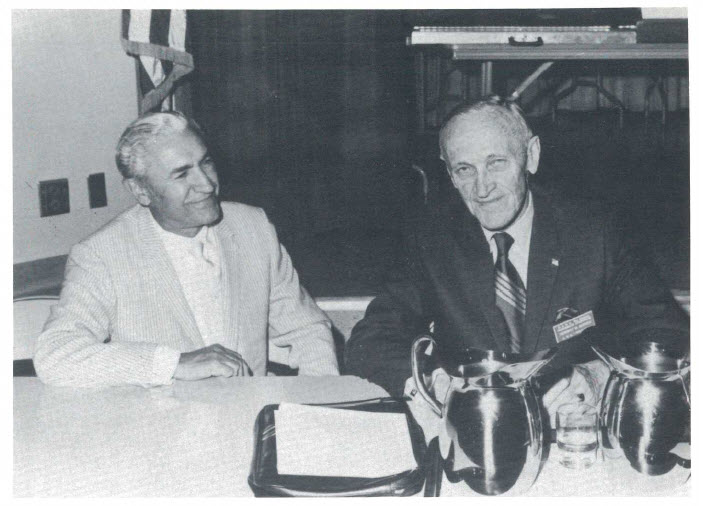
Abe Kosoff and Herbert Bergen at a symposium held at the California State Numismatic Association Convention in 1971.