Abe Kosoff: Dean of Numismatics
Q. David Bowers
"Warren Tucker really did not need a plane to take him back to Atlanta. He was on Cloud Nine." It turned out that the prices were cheap in the light of later events. World-Wide sold the pieces ) Bowers & Ruddy Galleries which then resold le silver dollar to a Minneapolis dealer and the Liberty Head nickel to Superior Galleries, which laced it in the Jerry Buss Collection. The 1804 dollar also reached the Buss Collection, although through a different route. Early in 1985 the pieces came up for auction, with Superior being the seller. The 1913 Liberty Head nickel fetched $385,000 to Reed Hawn, a Texas connoisseur, while Aubrey Bebee and Adeline Bebee, the Omaha numismatists, acquired the 1804 for $308,000. So, this pair of coins, which had cost $180,000 in 1972, sold for a total of $793,000!
While the 1913 Liberty Head nickel was in the possession of World-Wide from 1972 through early 1975,' they had a grand time with it. At one point it was featured in a television serial, Hawaii 5-O, and at other times it was shown at national conventions. The present writer (Q. David Bowers) exhibited the piece at the 1975 ANA convention, held that year in Los Angeles. Resting by itself in a closely-guarded showcase, the piece drew the attention of television and newspaper people and also a long line of convention goers.
No two coins in American numismatic history have had more fame and publicity than the 1804 dollar and the 1913 Liberty Head nickel. The dollar garnered virtually endless columns of print during the late 19th and early 20th centuries, as a perusal of the American Journal of Numismatics, The Numismatist, and other periodicals will vividly testify. In 1962 a book on the coin, The Fantastic 1804 Dollar, by Eric P. Newman and Kenneth E. Bressett, delved into the history of the issue, brought together facts and articles from many sources, and stated the conclusion that 1804 dollars were never struck in 1804 but, rather, were first coined in the 1830s for inclusion in presentation Proof sets. Later, probably around 1860, additional examples were restruck on at least two occasions and from a slightly differing reverse die. No matter that the "King of coins is an impostor," as Bressett and Newman stated, publicity is the name .of the game, and so long as coins are collected, the 1804 dollar will be an object of awe and admiration. Certainly the appearance of any example has been a cause for multiple-page auction catalogue descriptions, not to overlook lots of front page headlines!
So goes it with the 1913 Liberty Head nickel. This piece first made its appearance around 1920 when Samuel W. Brown, who had earlier advertised to buy them, showed up at the annual convention of the ANA with five pieces. He implied that he had purchased them through his publicity efforts, but Don Taxay years later unearthed the fact that during 1913 Brown himself, who later moved to North Tonawanda, New York, was an employee at the Philadelphia Mint who could have had ready access to dies!
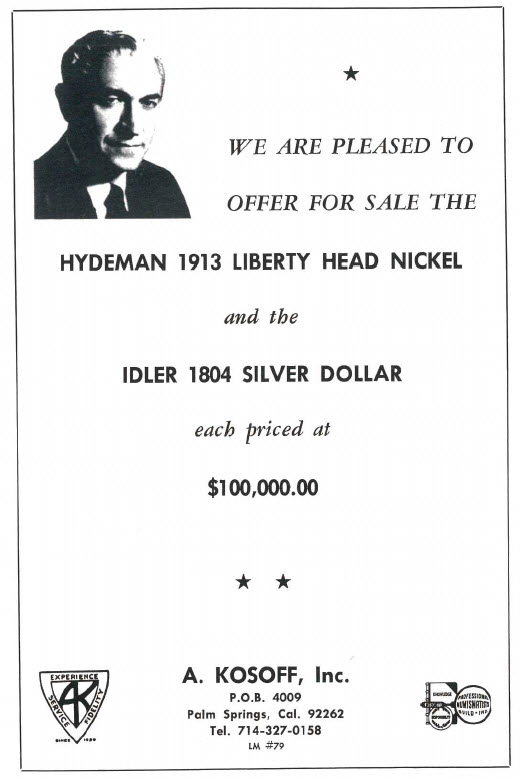
In January 1972, the Hydeman 1913 Liberty Head nickel and the Idler 1804 silver dollar, both of which had appeared in the 1961 catalogue of the Hydeman Collection, were again offered for sale, this time each with a fixed price of $100,000. A sale was consummated later in the year to World-Wide Coin Investments for $100,000 for the nickel and $80,000 for the dollar. ("The Numismatist," January 1972)
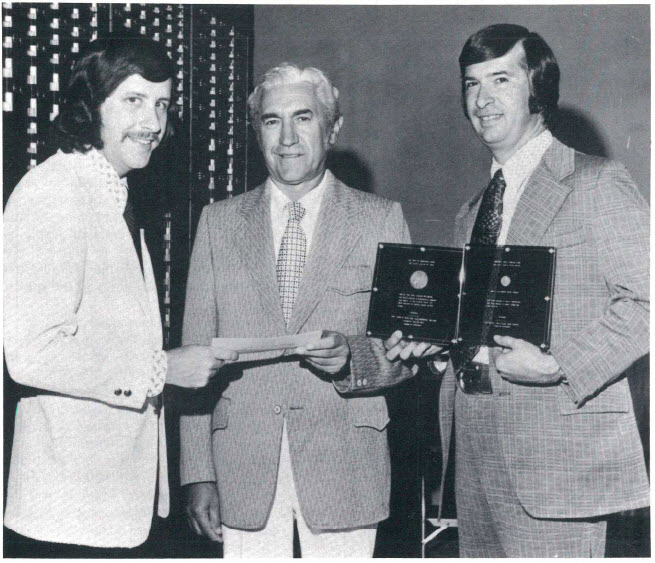
Taken in October 1972, this photograph documents the sale of the 1804 silver dollar and the 1913 Liberty Head nickel by Abe Kosoff to World-Wide Coin Investments for $180,000. Representing World-Wide are John Hamrick (to the left) and, to the right, Warren Tucker, while Abe Kosoff, center, accepts the check.