Abe Kosoff: Dean of Numismatics
Q. David Bowers
It was learned by these grading pioneers that while it was possible to illustrate circulated grades by means of line drawings or photographs, Uncirculated coins were a problem. Hairlines, bagmarks, nicks, scuffs, and abrasions simply did not show up well in photographs. And, they were apt to be of a random nature-no two coins were alike-so they could not be represented in line drawings either. Thus, it was every man for himself, so to speak, when it came to defining differences within the Uncirculated span-such as MS-60, MS-65, and MS-70. What one person called MS-70, another might call MS-65, and still another might suggest that it's no finer than MS-60.
In their passion to introduce scientific objectivity, other dealers suggested that absolute precision was possible. Thus, a survey of advertisements appearing in Coin World, Numismatic News, and other places in the early 1970s turned up many intermediate numbers such as MS-61, MS-62, and so on, sometimes with pluses or minuses added .or good measure. In a seminar sponsored by the ANA in Colorado Springs, Q. David Bowers reviewed grading practices of the period and, including plus and minus designations, came up with more than 25 different ways dealers were expressing coin descriptions in the Uncirculated category! In the meantime, MS-70 coins were appearing in quantity prompting Abe Kosoff to write:
"Does the advertising director of any of the reading newspapers or magazines really believe that dealers can offer so many MS-70 coins as appear in the advertisements placed with them? It just isn't likely. Impossible is a word not to be bandied about, but the situations reflected by some Jf the advertisements are as close to being as impossible as I can imagine. There are just not so nany MS-70 coins around that an offering of silver dollars in MS-70 condition for 30 or 40 or 50 different dates can be accurate.
'I'll state my reputation, with 44 years of professional numismatic activity behind it, that there .s no such thing as any dealer having that many different dates of silver dollars in MS-70 condition. So, let's stop playing games!
"I challenge any advertiser who has listed that many silver dollars in MS-70 condition to make me eat my words. If the collector is satisfied to buy a coin in an envelope which describes the contents as MS-70, then that is his problem. Maybe he can get more for the envelope than he can for the coin! Sounds silly, doesn't it? Yet, that is what some collectors are doing!"
As noted, many did not agree with Abe Kosoff. Sheldon's scale for numerical grading was proposed only for large cents, not for other series. When adapted to other series, silver dollars being an example, many felt that MS-70 could truly express a "very nice" Uncirculated coin, not necessarily a perfect one. And, there were some old-time dealers who felt that the use of mathematics and numbers were just so much nonsense, and that the adjectival designations of Fine, Very Fine, Choice Uncirculated, etc. were sufficient.
More and more appeared in print on the grading subject. Dr. Richard Bagg and James Jeliniski, numismatic professionals, spent time compiling a book composed of past articles on the grading subject which had appeared in different numismatic periodicals. Letters were written to editors of popular publications. First Coinvestors, a New York firm headed by Stanley Apfelbaum, proposed that an "Independent Coin Grading Board" be established.
The momentum continued to grow. Increasingly, it became apparent that there was little if any problem with lesser grades from Fair or Good through Almost Uncirculated. The problem lay with Uncirculated and Proof pieces and the fineness thereof. By the end of 1973, the ANA Board of Governors, meeting in Colorado Springs at ANA Headquarters, took up the subject of grading.
During the next year, the ANA encouraged Abe Kosoff to study the problem. Many suggestions were made. It was pointed out that the Sheldon Scale was originally intended as a pricing formula, and then only for the large cent series from 1793 to 1814. Dr. Sheldon proposed in 1949 that a Basal Value could be assigned to each die variety in the large cent series. The higher the rarity or the more popular the piece (due to being a scarce type or variety), the higher the Basal Value would be. Then, to determine market value one simply used a formula to multiply the Basal Value by the numerical grade. Thus, a coin with a Basal Value of $6 in VF-20 grade was worth six times 20 or $120. A multiple was suggested for Uncirculated pieces as well as the very finest examples of a given variety.
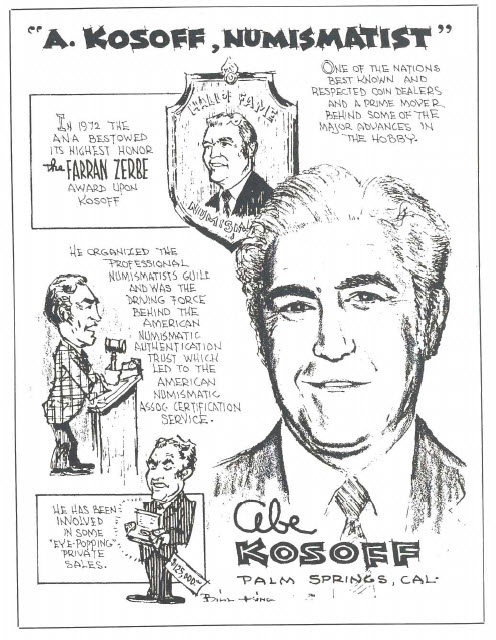
An illustration by Bill King which accompanied a "Numismatic News" feature on Abe Kosoff written by Ed Reiter, This appeared in the March 19, 1974 issue.