Abe Kosoff: Dean of Numismatics
Q. David Bowers
The March 10, 1979 issue of Numismatic News featured on the front page a charge by Abe Kosoff that the ANA Grading Service needed improvement: "Concern has been expressed by two major professional numismatists over the manner in which the American Numismatic Association began operations of its Grading Service on March 1st. Abe Kosoff in an open letter to ANA executive vice-president Edward C. Rochette, said he is disturbed about the status of the Grading Service and offered several suggestions for improving its credibility with prospective users. 'I have been amazed at the continued overgrading practice by some of our leading establishments,' Kosoff said, 'but, before the service can begin to tell dealers what is wrong with their grading, it should first be able to do proper grading itself.'
"To back up his charge, Kosoff cited the results of a grading test program conducted late last year by the Grading Service staff. During the test, the ANA staff graded 70 coins submitted by seven different major numismatic firms. 'I had suggested the testing procedure, hoping that some degree of uniformity would result,' Kosoff said. 'Now, we find that the service and those who submitted the coins agree on only 40 of the 70 coins. It is apparent that further exploration is necessary.' "
The veteran dealer pointed out that the Grading Service personnel should establish sound operating procedures and then test again and again the various procedures until they had confidence in them.
From November 28 through 30, 1979, Bowers and Ruddy Galleries sold Part I of the Garrett Collection of United States Coins for The Johns Hopkins University of Baltimore. Abe Kosoff subsequently reported on the event: "I attended, I saw, and I still wonder, almost in disbelief, at what occurred. I came prepared to buy for several important clients. I was loaded.
After all, it had to be something of an extraordinary offering to bring me to New York City in the winter!
"As you may know, United States patterns have been one of my favorite specialties. I was prepared to buy practically every pattern listed, and I was and I was prepared to figures quoted in the Judd book. Bear with me while I review the pattern group.
"Lot 362, Judd-72 which lists for $1,250, sold for $7,500. Judd-73 lists for $2,100 and sold for $6,000. Judd-76a lists for $2,400 but sold for $9,000. Judd-79 lists for $2,600, and I thought my estimate of $6,500 would buy the coin, but it went for $11,500.
"Lest you think these are selected exceptions, I would like to continue. Judd-95-1 thought my bid of $8,500 was really high, but it fetched $17,5001 I was prepared to pay $8,250 for Judd-99; it sold for $13,000.
"Now, all of these pieces are fairly scarce, even rare. But how about a J-235 which lists for only $475? It brought $4,600. The J-237, which books at $550, went for $4,400. J-277, a coin listed at $850, went for $4,000... Then came the famous and popular Amazonian pattern half dollar, J-1200. This lists Tor $7,500 and I went to $20,000!
No, I did not get it, because it went for $23,000. "The ever-popular 1877 pattern half dollar has created quite a stir. In 1976, Stack's sold some of the Garrett pieces, among them several 1877 half dollar patterns. They fetched between $3,750 and $4,500 each, all new record prices. So, if I bid to $22,500 on Judd-1601 I was reaching. It was still not enough, for the coin fetched $25,000. The J-1503, which lists at $4,500, had some smudges which discouraged some bidders, but it still sold for $12,500 ...
"Well, that's the way it went. When the gold coins were offered, things were no different. A Proof gold dollar, A Type II 1854, admittedly very rare, opened at $16,000 and went to Ken Goldman for $90,000. Proof gold dollars of 1860, 1861, and 1865 fetched $9,000, $12,500, and $17,000 respectively... I did not like the Proof $3 pieces as much. I thought they were really not so choice. The 1854 Proof, very rare, went for a reasonable $45,000. Reasonable in the only sense that everything else was crazily going out of hand! Proofs of 1860 and 1861 brought $21,000 and $25,000 respectively. The only $3 gold piece which I considered to be a Proof-65 was the 1865, and I paid $40,000 for it. Apparently others agreed! ... I was topped out on the 1879 Coiled Hair $4 stella when my bid of $110,000 lost to a $5,000 increase. It reminded me that I once sold a set of four gold $4 stellas for $1,125 and within six months thereafter sold another set to A.A. Grinnell for $1,250! How times have changed!
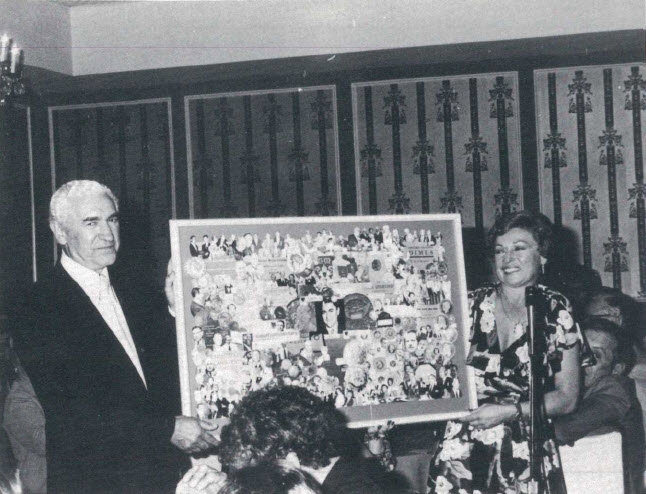
Abe Kosoff and daughter Sonnie hold aloft a montage of photographs, cataloguer, and other memorabilia covering Abe's 50th year are a proleoaional numismatists. The year is 1979, and the occasion is a tribute given at the banquet of the Numismatic Association of Southern California.