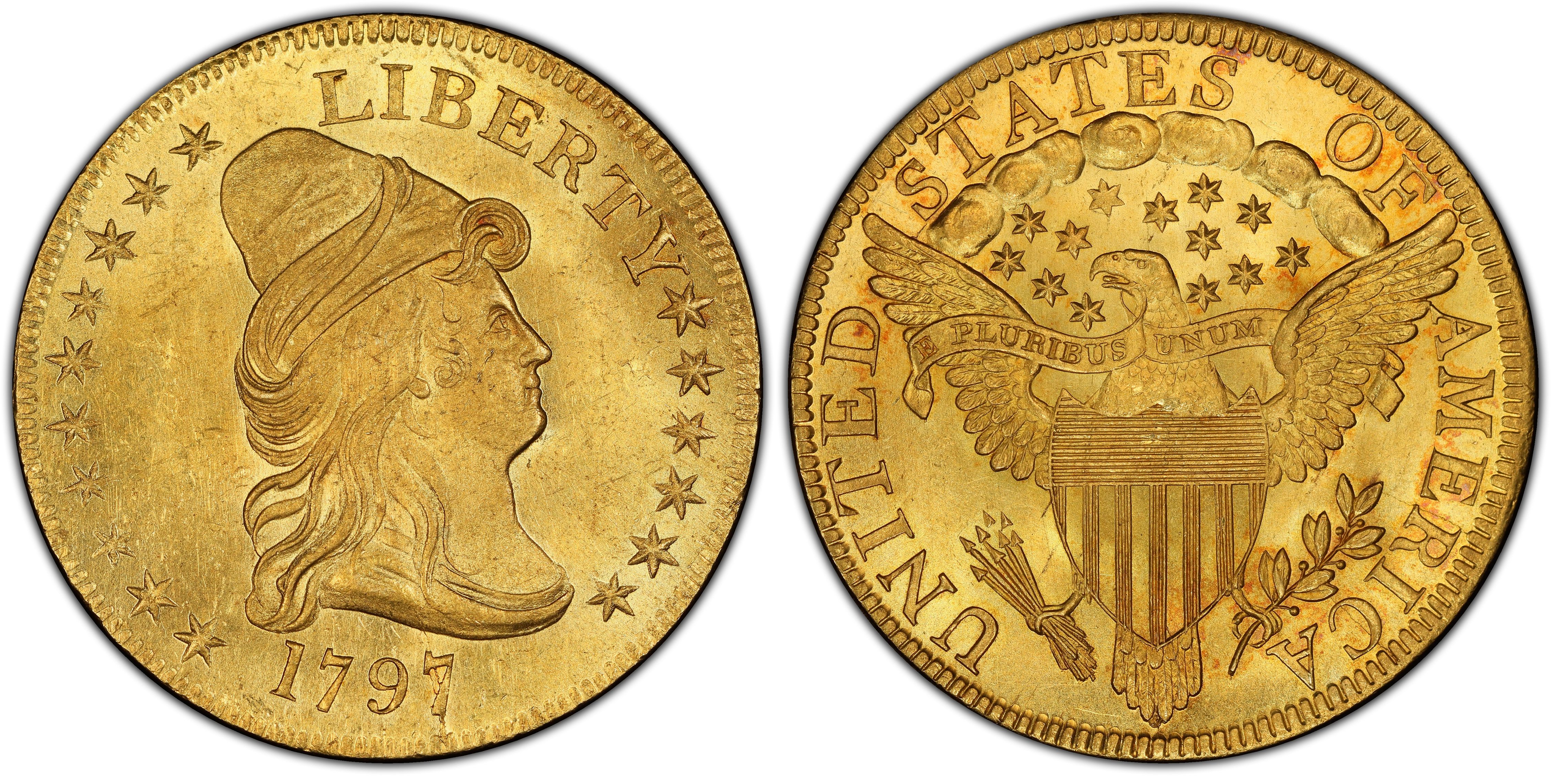
PCGS MS63
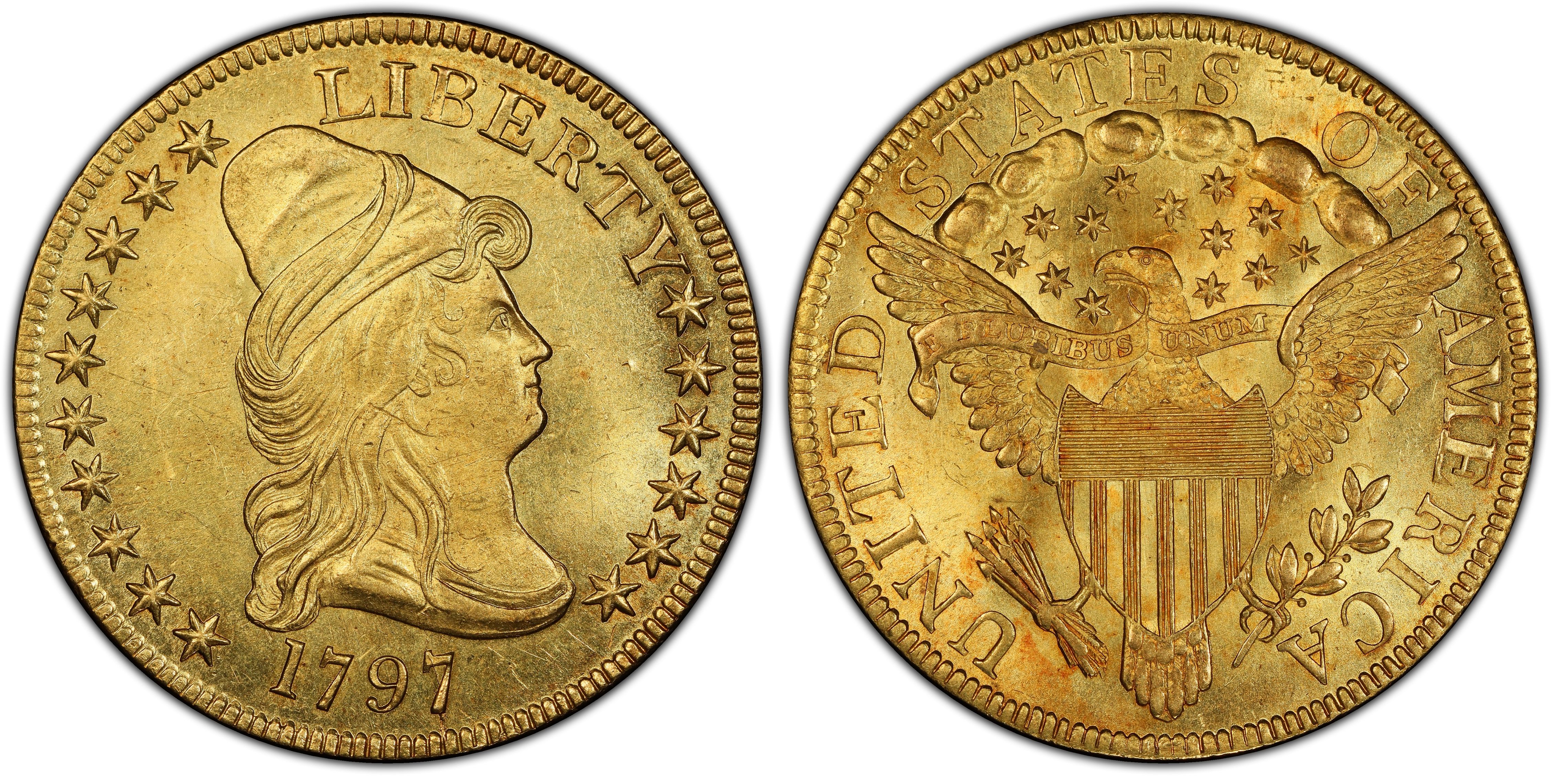
PCGS MS63
- PCGS #:
- 8559
- Designer:
- Robert Scot
- Edge:
- Reeded
- Diameter:
- 33.00 millimeters
- Weight:
- 17.50 grams
- Mintage:
- 10,940
- Mint:
- Philadelphia
- Metal:
- 91.7% Gold, 8.3% Copper
- Auction Record:
- $276,000 • MS63 • 05-08-2022 • Heritage Auctions
Major Varieties
- 1797 $10 Large Eagle
Rarity and Survival Estimates Learn More
| Survival Estimate | |
|---|---|
| All Grades | 250 |
| 60 or Better | 50 |
| 65 or Better | |
| Numismatic Rarity | |
|---|---|
| All Grades | R-6.6 |
| 60 or Better | R-8.5 |
| 65 or Better | R-10.1 |
| Relative Rarity By Type All Specs in this Type | |
|---|---|
| All Grades | 5 / 10 TIE |
| 60 or Better | 5 / 10 |
| 65 or Better | 1 / 10 |
| Relative Rarity By Series All Specs in this Series | |
|---|---|
| All Grades | 8 / 14 TIE |
| 60 or Better | 8 / 14 |
| 65 or Better | 1 / 14 |
Condition Census What Is This?
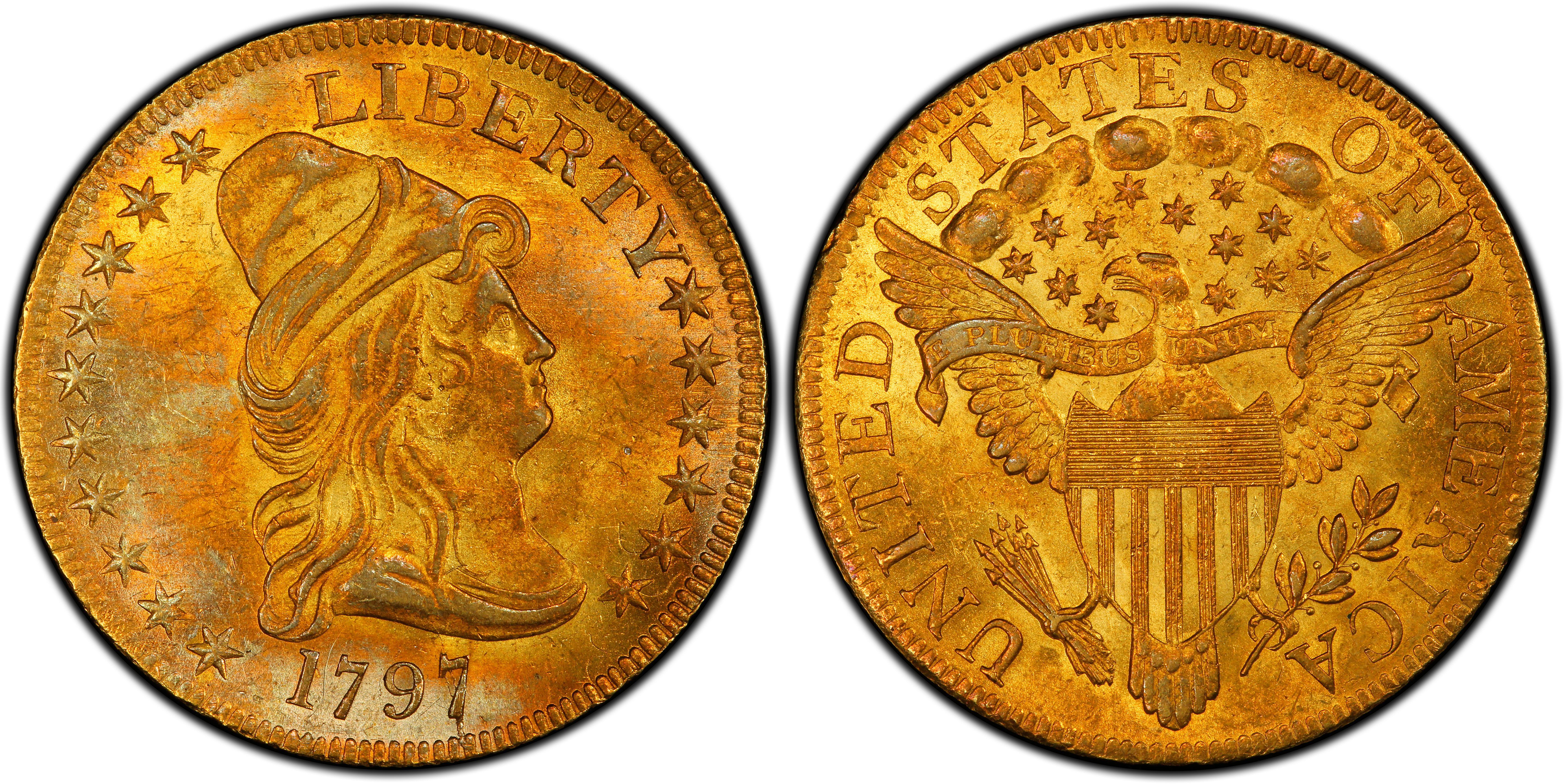 #1 PCGS MS63+
BD-2. Highlights of gold-green toning blending with orange and reddish-gold. |
|
#2 PCGS MS63
“The Fairfield Collection,” Bowers and Ruddy, October 1977, Lot 1785; “The Harry W. Bass Jr. Core Collection, Part IV,” Heritage Auctions, August 10, 2023, Lot 9068 – $192,000. BD-2. Diagonal hit across hair at the ear with small planchet void below. Small tick to the left of star 13. Vertical tick below star 16. Curved marks at the top of the eagle’s head. |
|
#2 PCGS MS63
Goliad Corporation (Mike Brownlee), by sale, March 4, 1991; “The Harry W. Bass, Jr. Core Collection, Part II,” Heritage Auctions, January 5, 2023, Lot 9060 – $192,000. BD-4. Die state d/b. Cud formed between flag and the stem of the 7. Cracks through "R" and "C" of AMERICA. Scattered splashes of orange gold toning present on the reverse. |
 #2 PCGS MS63
As PCGS MS63 #4330689. “The New Orleans Collection,” Heritage Auctions, April 23, 2015, Lot 5381 – $164,500. As PCGS MS63 #44156470. “The Bob R. Simpson Collection, Part VIII,” Heritage Auctions, May 5, 2022, Lot 3611 – $276,000. BD-2 (per Heritage Auctions). Thin scratch across Liberty’s cheek. Pair of small vertical ticks below bust truncation above 9. Spider crack to the left of star 12. Tick in field above S of PLURIBUS and above the star above U of UNUM. |
 #2 PCGS MS63
Stack’s Fixed Price List 1994, Lot 114; “The Anthony J. Taraszka Collection,” Stack’s Bowers, August 15, 2019, Lot 4011 – $132,000. BD-3. Copper spot in hair near the coin’s center. Planchet void in the field to the right of star 5. Curved horizontal mark below lowest hair curl down to the left of 1. |
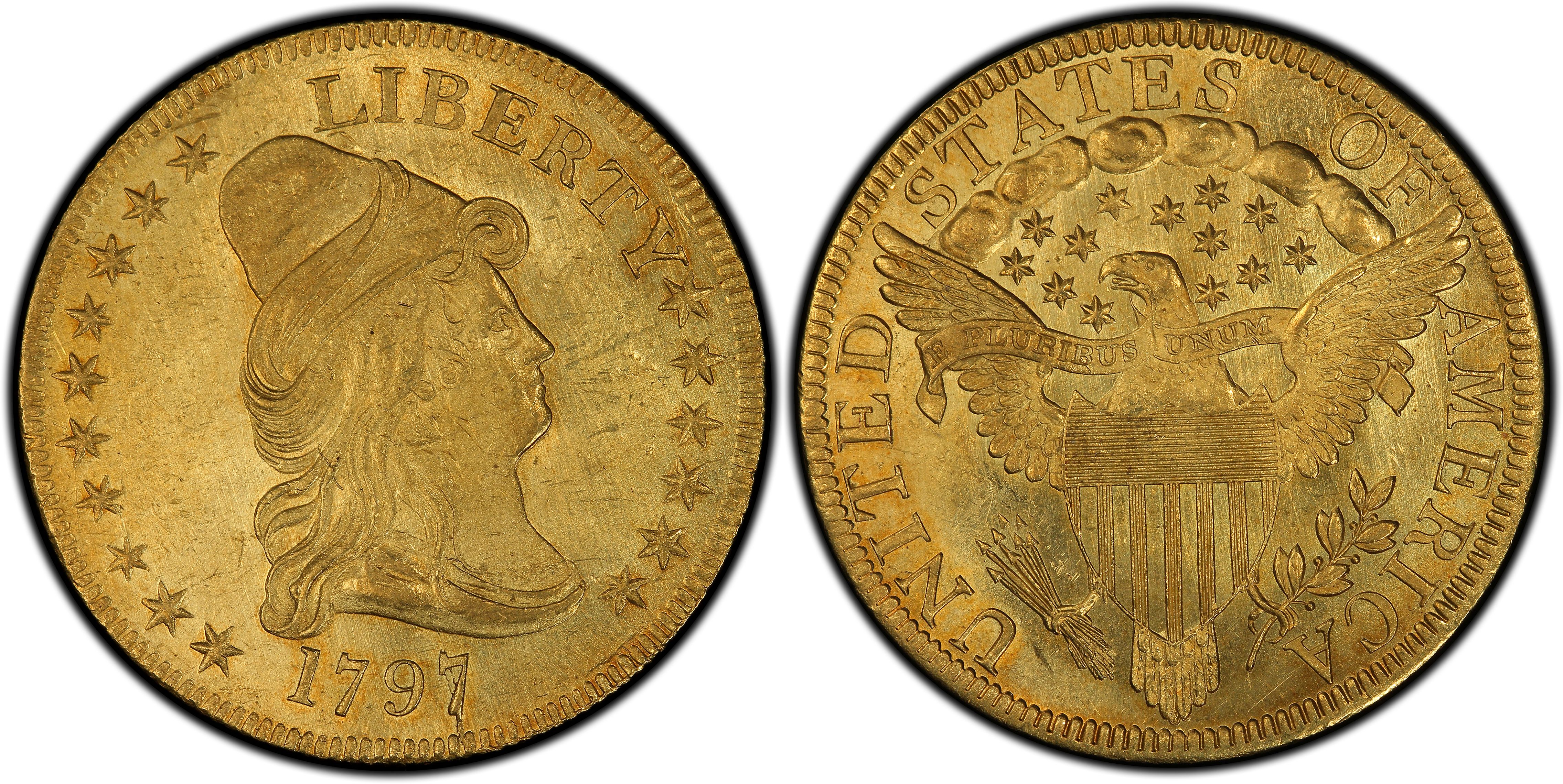 #2 PCGS MS63
"Auction ’81," RARCOA, July 1981, Lot 456; “The D. Brent Pogue Collection, Part II,” Stack’s Bowers / Sotheby’s, September 30, 2015, Lot 2095 – $152,750. BD-4. Struck with perfect reverse die. Coppery-gold toning in the protected areas. |
1797 Capped Bust Right Eagle: The Transition to the Heraldic Eagle
Following a limited production 1797 Draped Bust Eagles of the Small Eagle reverse (#8555), the United States Mint transitioned to a new, more robust reverse design for the majority of the 1797-dated coinage. This second style, the Heraldic Eagle, utilized hubs executed by John Smith Gardner. Introduced in 1796 and continuing through 1807, this design provided American silver and gold coinage with a more unified and regal appearance, featuring a larger, more powerful eagle than its predecessor.
While Mint records make precise accounting difficult, it is estimated that the 1797 Heraldic Eagle type (#8559) outnumbers the Small Eagle by a factor of 3:1. In his recent research, numismatist John W. Dannreuther suggests a Heraldic Eagle mintage between 8,750 and 12,500 pieces, noting that some 1796-dated coins were struck in 1797, while some 1797-dated coins were likely struck in 1798—a common practice for the Mint at a time when servicable dies were dear.
Three distinct die marriages comprise the 1797 Heraldic Eagle series, identified as Bass-Dannreuther (BD) varieties 2 through 4.
Identifying the Three Reverse Dies
The primary diagnostics for identifying these varieties reside in the eagle’s anatomy and star placement:
- BD-2 (#45717): Characterized by a long, thin neck and a staggered left column of stars in the glory. The fifth star is centered directly above the eagle’s beak.
- BD-3 (#45718): Features a short, thick neck.
- BD-4 (#45719): Features a long, thick neck. On this variety, the fifth star in the glory is positioned just above the tip of the eagle’s beak.
Variety Analysis
1797 BD-2 (Rarity-4+)
This represents the inaugural die marriage used for the Heraldic Eagle reverse. While the obverse die was fashioned from the original 1795 hub, the reverse utilized Gardner’s new design. Dannreuther estimates 90 to 110 survivors from an original mintage of 3,500 to 5,000. In the typical die state b/b, thin cracks are visible below the final "7" of the date, and a distinct rust lump appears on the second "T" of STATES.
1797 BD-3 / Taraszka-11 (Rarity-5)
Traditionally listed as the second Heraldic Eagle reverse, researcher Anthony Taraszka postulates that production of the BD-3 actually occurred after the 1798/7 issues. Though both 1798/7 marriages share this reverse die, all known 1797 BD-3 coins exhibit a significantly later die state. With an estimated mintage of 1,500 to 2,500 and fewer than 50 known examples, this is the scarcest die marriage of the date.
1797 BD-4 (Rarity-4+)
Though rare, the BD-4 is the most frequently encountered 1797 variety in Mint State. Survival estimates range from 90 to 110 pieces out of a mintage of 3,500 to 5,000. This variety is often identified by an obverse die crack that eventually progresses into a cud through the "7" in the date. This variety can be found to be struck with perfect or cracked reverse dies.
PCGS will certify these important Draped Bust Eagle varieties through our Variety Attribution Program.
* * *
PCGS will certify this collectible Jefferson Nickel variety through our Variety Attribution Program.