Walter Breen's Encyclopedia of Early United States Cents
Walter Breen
3b. Rotated centered. Both impressions are approximately centered on the planchet. The newly struck coin was partly ejected and fell back into the coining chamber, receiving a second impression rotated at a noticeable angle to the first. Rare.
(1795 variety 6, about 15° apart, Ruby: 662. Variety 8, about 15° apart, incomplete straight dip, Ruby: 663; About 45° apart, Jack H. Robinson: 146. About 90° apart, Ruby: 664. About 1150 apart, R Tettenhorst, two visible dates; at least four others.
1796 variety 9, about 1600 apart, Jack Beymer. Variety 45, Jack H. Robinson: 189.
1797 variety 2b, John S. Ashby collection. Variety 8,35° apart, John S. Ashby collection. Variety 15, John S. Ashby collection. Variety 16, 30° apart, John S. Ashby collection. Variety 18, 1975 EAC: 563. Variety 21, about 30° apart, R. Tettenhorst, dentils of a third impression, 95% off center at K-10:30. Variety 25, "Dupont": 163a; another about 150° apart, John D. Wright.
1798 variety 2, 1980 GENA: 1518.
1800 variety 12, John S. Ashby collection. Variety 17, John S. Ashby collection, only slightly apart. Variety 21,1800 apart, John D. Wright 1803 variety 20, Jack H. Robinson: 584.
1813 variety 1, about 110° apart, 1975 EAC: 568A.)
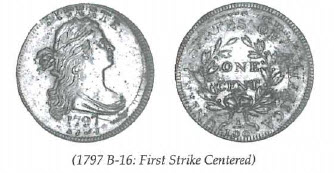
3c. First strike centered, second off center. Here, the newly struck com fell back only part way into the coming chamber at second impression, which may be rotated at any angle to the first. Sometimes it is not certain which impression came first: compare next two groups below. This and the three following types of double strikes have produced some of the rarest and most spectacular mint error coins in the Mint's history. Again, I have attempted completeness, but am under no illusion of having achieved it. (1794 variety 6, 1975 EAC: 555. 1800 variety 6, Bob Reynolds.
1810 variety 3, John S. Ashby collection. 1813 variety 2, "Dupont": 518a.)
3d. First strike off center, second centered. Converse error to preceding; same comments. (1794 variety 5, first strike off-center (FSOC) 25% at K-9, John S. Ashby collection.
1795 variety 3, Dorothy Gershenson at 1989 ANA. Variety 4b, FSOC 15% at K-11, Robert W. Miller, Sr.; FSOC 10% at K-7, Robert W. Miller, Sr.; others. Variety 8, John D. Wright; others.
1796 variety 1, Allen McDowell. Variety 10, Jack H. Robinson: 161.
1797 variety 17, "Dupont": 159. Variety 20, FSOC 5%, rotated about 10°, Ruby:667. Variety 21, FSOC 33% at K-10:30, Bob Everett. Variety 22, FSOC 5%, rotated about 15°, Ruby: 668.
1798 variety 2, FSOC at K-3, C. Douglas Smith, with two dates, two LIBERTY. Variety 5, FSOC 10% at K-6, Ruby: 670. Variety 21, 1975 EAC: 565.
Variety 45, Downing: 1839.
1802 variety 10?, one impression 40% off center at K-4, EVN 209, p. 13 (1986). 1814 variety 2, 1977 ANA: 4470.)
3e. Both strikings off center. Here the planchet was never fully inside the coining chamber, The second impression may be rotated at any angle to the first. (1795 variety 4b, 1975 EAC: 557. Variety 6, Jim Young Jr.
1797 variety 2b, Jack H. Robinson: 224, both strikes about equally off center, plainest at dentils. 1798 variety 32, ANS.
1814 variety 1, Robert W. Miller Sr., the two strikes are 50% and 80% off-center.)
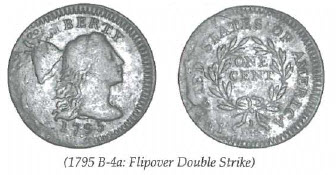
3f. Flipovers. Here the newly struck com fell back partly or wholly into the coining chamber, but with reverse up instead of obverse. Either impression may be off center and rotated to any angle with respect to each other. All are extremely rare.
Robert W. Miller, Sr., using a database of over 200 mint error cents 1793-1814, estimated the rarity level of each date (all varieties together) in double strike form, all types, as follows: 1793, none reported; 1794, 5 to 8 known; 1795 (mostly plain edge), 16 to 25 known; 1796 (mostly Caps), 9 to 15 known; 1797-98, 16 to 25 known each; 1799, one reported, unconfirmed; 1800, 9 to 15 known; 1801-03, 2 to 4 known each; 1804-06, none reported; 1807, 2 to 4 known; 1808, only one known; 1809, none reported; 1810,2 to 4 known; 1811, only one known; 1812, none reported; 1813, 5 to 8 known; 1814, 9 to 15 known. (1795 variety 4a, 1977 ANA: 4467; 1975 EAC: 556. Variety 8, on incomplete planchet, Ruby: 665; "Dupont": 108a; Dan Trollan,
1796 variety 3, "Dupont": 111; John S. Ashby collection. One of these may be in the R Tettenhorst collection. Variety 9, with one impression 10% off-center and rotated about 120°, Ruby: 666; Robert J. Shalowitz, with impressions crosswise, seen at 1990 CSNS (possibly the same as the Ruby coin); Del Bland. Variety 10, illustrated in EVA 221, p. 44 (1989); 1990 EAC; 34. Variety 21, John S. Ashby collection. 1798 variety 2,1975 EAC: 564; John S. Ashby collection.)
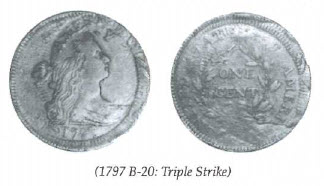
3g. Triple and multiple strikes. Here the newly struck coin fell back more than once into the coining chamber. One or more impressions may be off center, rotated to any angle, or even a flip over or a brockage. The spectacular error at the beginning of this chapter illustrates this class of error. Examples are extremely rare. (1795 variety 8, Thomas D. Reynolds. 1797 variety 21,1975 EAC: 560. Variety 22, 1975 EAC: 562.)
3h. Overstrikes. For coins struck over brockages or other "spoiled cents," see Multiple Errors below. When struck over other varieties of cents or on tokens, see above under Choice of Planchets.