Walter Breen's Encyclopedia of Early United States Cents
Walter Breen
Choice of Blanks
This category is listed here rather than under the Planchets class above, because the problem is not in the host coins (undertypes) themselves but in the coiner's decision to use these to make cents. The three following could exist on early cents.
1. Struck on half cent blank. Identifiable by weight: 104 grains (6.74 grams) for 1793-95;84 grains (5.44 grams) for 1795 to about 1811. These should not be confused with possible coins struck on half cent stock, above; the latter would be of half cent thickness but large cent diameter. Later dates exist; I have seen an 1851 and have heard of others.
The only early date reported so far is an example of 1807 variety 1 on a half cent blank, heavy at 94.1 grains: the blank, rejected as too heavy, was flung into a bin or hopper which later carried cent blanks. Not wrong stock because ever since 1800 all half cents were made on blanks from Boulton & Watt. (Robert W. Miller, Sr. Seen May 10, 1990 at the EAC convention.)
2. Struck on obsolete blanks. Theoretical possibilities include 1793 Liberty Caps or 1794s with two leaves after DOLLAR, or arguably any variety later than 1794 variety 5 with the edge of 1793 (leaf after DOLLAR points down). None even rumored.
3. Obsolete stock blanks are even less likely. In cents the only possible instances are 1795 variety 4b states IVIX, or later varieties, at the 1793-95 standard of 208 grains (13.48 grams). To date none are reported, but they could exist-most likely as overstrikes on obsolete "spoiled cents."
4. Foreign undertypes do exist, however. Examples are known of several kinds, most are unique. (1795 Variety 3 on a 1794 Talbot, Allum & Lee token, Fuld 3 or 4. Smithsonian. Variety 5 on a 1794 Talbot, Allum & Lee token. Both known examples of this variety show extensive undertype.
1797 Variety 23 on an unidentified token. Jonathan K. Kern.
1798 Variety 24 on a 1788 Anglesey Mines halfpenny, in the ANS collection. Variety 26 on an unidentified token, in the John D. Wright collection.
The following piece belongs nearer here than anywhere else, but only by stretching the concept of "foreign."
1795 Variety 11 ("Jefferson Head") overstruck on a 1794 cent.)
Feeding
Normally, the feeder mechanism released one blank at a time from the hopper, and guided it into the coining chamber, atop the lower die and within the open collar. Malfunctions can arise from feeding no blank at all (in which the dies clash against each other); feeding foreign matter with a blank; feeding a single blank improperly so that it rests partly or wholly outside the open collar (off centers, broadstrikes); or feeding more than one blank at once. Examples of all these classes are known.
1. Clashed dies are known in all dates and nearly all varieties. See Die States at the individual variety listings.
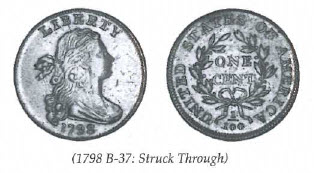
2. Struck through. Cents struck while unidentified matter adhered to die or planchet occur on many varieties. (1802 Variety 12, in the ANS collection, struck through a bent 33 millimeters round-headed pin! See Remarks at the variety listing in the main text.)
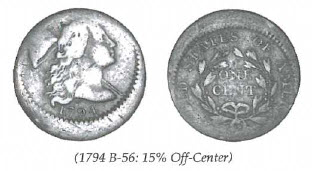
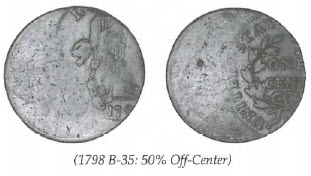
3. Off-centers. Often confused with misaligned dies. Many extreme off-centers had half cent blanks punched from them. Slightly off-center examples (under 10%) are fairly common because the open collar was enough wider than any cent blank to permit it to land that way. Off-centers are also often confused with broadstrikes (described in the next section, below). True off-center examples have some of the design elements missing on both the obverse and the reverse. Most collectors prefer coins which are off-center 30% to 70%, especially when the date is visible. The percentages are usually guess-work although careful measurement of the widest off-center portion as compared to standard diameter will provide a reasonably accurate determination.)
Mint error collectors often try to assemble sets of 12 in anyone denomination or type representing the primary clock positions. (These are designated by K numbers for Kolman & Litman.) This could be done, with some difficulty, for mixed dates 1795-98, but probably not for any single date.
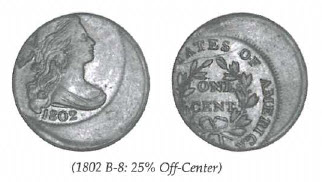
Robert W. Miller, Sr., using a database of over 200 early cent mint errors, estimated rarity levels for each date in off-center (all varieties taken together); 1793 and 1794,2 to 4 known each; 1795-97, 9 to 15 known each; 1798, 16 to 25 known; 1799, reported but unconfirmed; 1800-01, 5 to 8 known each; 1802, 2 to 4 known; 1803, unconfirmed; 1804, none reported; 1805, 2 to 4 known; 1806, only one known; 1807,2 to 4 known; 1808, only one known; 1809- 12,2 to 4 known each; 1813-14, 5 to 8 known each. (The following list represents, as nearly as possible, all attributable examples seen or reliably reported to date; some few others have remained unavailable for checking. "Milton Cohen" references are to Natalie Halpern's catalogue of this mint error collection, 1980.
(K-1: 1797 variety 27, R. Tettenhorst. 1798 variety 1, Ruby: 486. 1802 variety 9, 15%, Robert W. Miller, Sr., stolen in 1976. 1813 variety 1, Milton Cohen: 7. K-1:30: 1800 variety unspecified. EVN 221, p. 44 (1989); 1811 variety 1, 20%, Pete C. Smith. 1812 variety 1, R. Tettenhorst; 1814 variety 2, 25%, Jack H. Robinson: 650. Many others less off center.
K-2: 1793 variety 10, Milton Cohen: 4. 1794 variety 13, 15%, John S. Ashby, Jr. collection. 1794 variety 48, 15%, Pine Tree 3/1976: 2432. 1798 variety 3, Robinson S. Brown, Jr.: 208. 1798 variety 33, 50%.1808 variety 3, Pete C. Smith. 1811 variety 1, 20%, Pete C. Smith.
K-2:30: 1797 variety 2b, Robinson S. Brown, Jr.: 168. 1803 vareity 20, Milton Cohen: 6, Wes Rasmussen. K-3: 1807 variety 1, Jack H. Robinson: 603, and others. 1814 variety 1, 1975 EAC: 569.
K-5: 1801, 20%, John S. Ashby; Jr. collection. 1803 variety 1,35%, Robert W. Miler, Sr.
K-6: 1814 variety 1, John D. Wright; 1814 variety 2, John D. Wright.
K-7: 1813, John S. Ashby, Jr. collection.
K-8: 1798/7 variety 7, Jack H. Robinson: 304. K-8:30: 1795 variety 8, Milton Cohen: 5.
K-9: 1795 variety 8, 1957 ANA: 1408; 1797 variety 20, John D. Wright.
K-9:30: 1795 variety 8, John D. Wright; 1800 variety 14, Robinson S. Brown, Jr.: 283.
K-10: 1797 variety 22, 1975 EAC: 561. 1802 variety 16, 20%,John S. Ashby; Jr. collection; 1810/09 variety 1,1964 ANA: 614.
K-10:30: 1798 variety 34, 15%, Robinson S. Brown, Jr.
K-11: 1798, counterstamped I CAIRNS in serrated rectangle, R. Tettenhorst. 1798 variety 36,45%, John S. Ashby, Jr. collection. K-11:30: 1796 variety 45, Jack H. Robinson: 190.
K-12: 1794 variety 56, John D. Wright. 1798/7 variety 7, EVN Numismistake 206, p. 43 (9/1986). 1807,50%, Robert W. Miller, Sr. unknown position: 1797 variety 27, ANS. 1798 variety 33, Seen at 1988 EAC. 1803 variety 14, J. J. Teaparty.)