Walter Breen's Encyclopedia of Early United States Cents
Walter Breen
Cutting Blanks from Strip
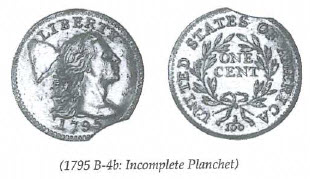
1. Curved Incomplete Planchets (Curved clips), though common in later decades in many denominations, are scarce on early cents. The variety most often seen with a curved clip is 1795 number 4b, most with less than 5% of the planchet missing. It is unlikely that any mint error specialist has yet assembled a set of the 12 Kolit positions (Kolman and Litman.) on pre-1815 cents (though it could be done for 1795 Plain Edge specimens). (1793 Variety 12, K-7:30, 1975 ANA: 75.
1794 Variety 5, K-5, Jack H. Robinson: 30. Variety 53, K-4, Adams: 53. Variety 57, K-9:30 (slight), 1976 ANA: 233.
1795 Variety 4b, K-5:15, Ruby: 411. Variety 4b, K-1, 1983 ANA: 329. Many others of this variety are known. Variety 6, Thomas D. Reynolds listed at least three different in his fixed price lists since February 1986. Variety 8, Tom Reynolds listed at least seven different in his fixed price lists since October 1983.
1796 Variety 6, K-9:30, Jack H, Robinson: 155. Variety 8, K-12, 1957 ANA: 814. Variety 9, K-6:30, seen at Long Beach, October 5, 1989. Variety 11, Dr. CR, Chambers. Variety 16, K-3:30, ANS. Variety 20, K-11, Kagin's 1/1986: 4149. Variety 44, K-11, Robinson S. Brown, Jr.: 139.
1797 Variety 2b, K-11:30 Naftzger: 436. Variety 5, K-10:30, Robinson S. Brown, Jr.: 191. Variety 9, K-4:30, Robinson S. Brown, Jr.:171. Variety 32, K-11, Robinson S. Brown, Jr.:204.
1799 Variety 3, K-6:30, unlocated.
1802 Variety 8, K-12:15, Jack H. Robinson: 500. Variety 9, K-6, Jack H. Robinson: 503. Variety 15, K-12, Jack H. Robinson: 514. 1808 Variety 1, K-3:30, ANS.
1810 Variety 1, Pete C. Smith.
Double or multiple clips are rarer.
1795 Variety 4b, John D. Wright reports at least two with double clips. Variety 6, Pete C. Smith reports at least six with double clips. One was in Tom Reynolds FPL of 5/1981 with clips at K-6 and K-12.
1797 Variety 25, with small clips at K-8 and K-10, Jack H. Robinson: 255.)
2. Incomplete clip. If the blank-cutter punch gives a blow not strong enough to pierce the strip, it leaves a thin arc on the strip (curvature same as a cent planchet) which remains on the next blank cut from it. Incomplete clips exist on later cents and other denominations. I am almost certain I have seen them on early cents.
3. Elliptical Incomplete Planchet (or clip). If a planchet with an incomplete clip breaks at striking or later, the larger fragment (roughly football shape) is termed an elliptical clip. (1795 half cent in this form is pictured in Half Cent Encyclopedia, page 470.) The smaller fragment from such a break is a crescent clip. To date none have been reported for cents, nor is even one cent rumored to exist struck on scrap.
4. Straight clips occur when the blank-cutter punch overlaps the end of a strip. When the strip end is irregular the coin is said to have a ragged clip. This latter is much rarer. (1793 Variety 20, John S. Ashby, Jr. collection.
1794 Variety 8, ANS with plain edge.
1795 Varieties 2 and 3 are reported by Denis W. Loring. 1795 Variety 3, James Livingston. Variety 4b, straight clip.)
5. Unstruck blanks, "first process" or Type 1. Without upset rims or edge device. Authentication is recommended. Weight should be close to either standard, 208 or 168 grains (13.48 or 10.89 grams) and the diameter should be larger than a normal struck cent. That illustrated has a 3% clip. (Bowers and Merena, 3/24-25/1995: 3405.)
6. Unstruck planchet, "second process" or Type II. With upset rims; if at the 208-grain standard these will have an edge device. Many years ago I heard of a 1793 unstruck blank with vine and bars on edge although this is still unseen. Blanks at the 168-grain standard may not be datable unless they show one of the edges enumerated at 1796-1800.
7. Struck on "first process" blank. Normally detectable only if enough off center to show that the rim of the unstruck area was not upset. The 1793-95 thick coins with plain edges (below) are also struck on first process blanks, because the Castaing machine which imparted the edge device compressed the blanks edgewise, making the rims thicker.
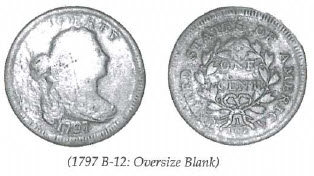
8. Oversize blank. If from the wrong blank punch and of normal thickness, these are apt to be overweight. If broadstruck (lying above the open collar), these are apt to be off center, of normal weight, and deformed in striking: see below. (Compare the 1795 variety 4a "struck over another cent, size 19" (30 millimeters) mentioned by Proskey in Coin Collector's Journal, March 1880, p.34. 1793 Variety 16c, 29 millimeters Described by Dr. William H. Sheldon, unseen. 1796 Variety 2, 30.5 millimeters, ANS. Variety 8, 30 millimeters, Ruby I: 424. 1797 Variety 12, Chris Victor-McCawley collection and illustrated above, 30.3 millimeters 1798 Variety 12, reported by Denis W. Loring. 1808 Variety 2, 30 millimeters, several examples of state VI have been discovered by Pete C. Smith.)
9. Undersize. From the wrong blank-punch. The only one claimed to date is a 1793 variety 16a at 25 millimeters mentioned by Dr. William H. Sheldon." This probably will show at least one region of weak or overlapping edge lettering. Cents of 1796 and 1797 might exist on Mint-made blanks at 27.5 millimeters from the 1796 quarter dollar blank-punch, however, these would not be easy to tell from ordinary cents.