Walter Breen's Encyclopedia of Early United States Cents
Walter Breen
Ejection: Two or More Planchets in Press.
When a newly struck coin fails to eject properly, sometimes it falls back partly or wholly into the coining chamber after a new blank has been fed in. This produces still different classes of mint errors, some as spectacular as the double and multiple strikes above.
1. Indents. If two planchets were fed into the coining chamber at striking but at least one was not properly centered, they produced an indent: the upper planchet shows a nearly normal obverse strike with an expanded area opposite the reverse indent (unstruck lens-shaped area whose two circular arc boundaries are the coin edge and the edge of the other coin), the lower coin shows an obverse indent with a nearly normal reverse impression (less expanded because it was restrained by the open collar). Some indents show obverse double striking; others were used as undertypes: see Multiple Errors below. Very few survive. (1802 variety 16, ANS.)
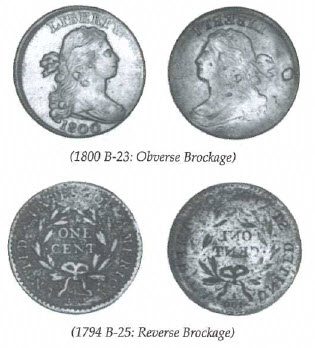
2. Full Brockages. Here a newly struck coin remains in the coining chamber while subsequent planchets enter, becoming a brockage maker (class 3 below), producing one or more brockages on subsequent strikes coins with one side a normal obverse, the other side an incuse impression of the obverse from the first coin. In early cents, brockages are very rare. Far more rarely, the first newly struck coin adheres to the obverse die, or falls back into the coining chamber atop a new planchet, making the latter into a reverse brockage one side a normal reverse, the other an incuse impression of the reverse from the first coin. Some brockages were double struck or from a loose (axially misaligned) die; others were used as undertypes: see Multiple Errors, below. ("Picker" citations are from the Coin Galleries sale of the Richard Picker collection of brockages, May 24, 1989. The following list is as nearly complete as I could manage; others exist, mostly unattributable, mostly dated 1798. All are obverse brocktzges unless otherwise noted.
1793 variety 1, seen by C. Douglas Smith years ago, unlocated. Variety 12-13, offered (and illustrated) in Sotheby's sale number 4774E, January 14, 1982, lot 9. No further details are available.
1794 variety 25, reverse identifiable by die state, Denis W. Loring.
1795 variety 9, reeded edge, holed. Possibly the most famous of all early cent brockages. 1797 variety 31, R. Tettenhorst.
1798 variety 27-28, Picker: 1055; Bob Matthews. Variety 31, Picker: 1054, early die state. Variety 35, ANS. For the double struck brockaga see Multiple Errors below. Other varieties reported.
1800 variety 7, Picker: 1056. Variety 23, Picker: 1057. Variety 28, bought unattributed at the November 1985 Silver Dollar Convention by Fred Weinberg. Variety unspecified, R. Tettenhorst.
1803 variety 5-7, 1975 EAC: 566A. Variety 13, Manuel Ahumada. For the double struck variety 18 see Multiple Errors. Variety 21, Picker: 1058,
obverse illustrated on Newcomb plate for his number 14b. Other varieties reported. 1807 variety 1, Picker; 1059.
1808 variety 2, Bob Matthews. Variety 3, Picker: 1060.
1810 variety 3, Picker: 1061, hammered against an 1855 Slanting 5's cent. Variety 5, Picker: 1063; Picker: 1064; R. Tettenhorst; Pete C. Smith. 1811 variety 1, Picker: 1065; Picker: 1066; another is reported with a scratch at the incuse date.
1812 variety 1-2,1975 EAC: 568; Picker: 1069, See Multiple Errors. Several others reported. Variety 3, reverse, Jack Beymer. Variety 4, Picker: 1067.
1813 variety I, reverse, Denis W. Loring. Variety 2, Picker: 1070.
1814 variety 2, Picker: 1071. Variety 2, reverse, Picker: 1072; Pete C. Smith.)
3. Partial brockages. Here the incuse side is off center, because either the brockage maker or the new planchet, or both, were off center at striking. These seem to be more rare than full brockages. I have seen none and found no recent auction records. Partial brockages were used as undertypes in other denominations, and such overstrikes may occur in early cents; such overstrikes would belong in Multiple Errors, below.
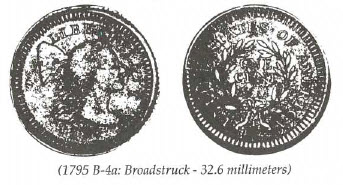
4. Capped die (cup-shaped) coins exist in later dates yet have not been identified among the early cents. These are also known as brockage makers, being the coins that adhere to the hammer die to make subsequent planchets into brockages as above, until pried loose from the coining chamber.
5. Counterbrockages. If a brockage impression (rather than a normal struck coin) remains partly or wholly in the coining chamber when a fresh planchet arrives, it will produce counterbrockages, one side (most often the obverse) normal, the other (most often the reverse) with a weak, enlarged (or even distorted) relief impression from the incuse side of the brockage. These exist in various denominations and could exist in early cents although none have been identified.
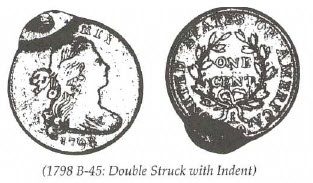
1. Double strike, one strike with Indent. (1798 variety 5, second strike off-center over 5% at K-12; reverse indent, Ruby: 669. 1814 variety 2, 1975 EAC: 570.)
2. Overstrike on off-center with indent. (1810 variety 1, 1975 EAC: 567.)
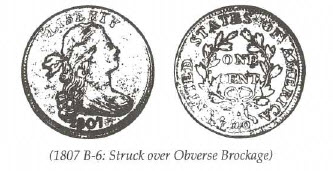
3. Overstrike on brockage.
(1794 variety 55, incuse retrograde LISE at K-7 on the obverse from a brockage impression, 1983 ANA: 4554, where called 5-59 (our number 57). This coin has not been recently examined and the illustration in the auction catalog is not clear enough to be certain how this was made.
1798 variety 29, on obverse brockage. Three clear dates, including the retrograde incuse one on the reverse, Jack H. Robinson: 345. 1800 variety 2, on obverse brockage. Jenks: 6131, ANS. 31 millimeters
1802 variety 14, flip over on partial obverse brockage. "The coin that broke the die." (The break at B lines up with the area of maximum stress during striking), Robert W. Miller, Sr.)
4. Double struck with brockage.
(1798 Head of 1799, unattributable from illustration. Obverse double struck, first impression about 60% off center at K-8. Geoff Noe, Illustrated Error Coin Pricing Guide, January 1990, vol. 2, no. 1.)
5. Axially misaligned brockage. (1812 variety 2, Picker: 1068, slightly off center at K-9, obverse axially misaligned.)
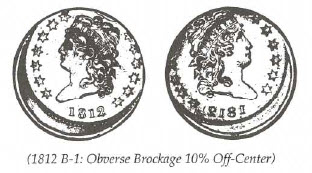
6. Off-center brockage. (1812-S-291, 10% off-center at K-1, Picker: 1069)
Blundered die coins may occur off center or double struck or in brockage form or with any of the other classes of errors described above.
Other types of mint error cents may exist. To be authenticated as such, they must be explainable in terms of the mint processes of the period.