Walter Breen's Encyclopedia of Early United States Cents
Walter Breen
Positioning and Locking Dies in Press
Normally, dies are aligned vertically so that their centers are exactly opposite each other, their faces are parallel planes, and their devices are oriented 1800 apart (head to foot, coin alignment).
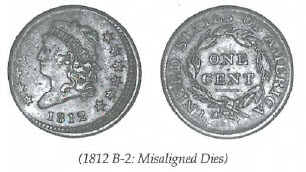
1. Misaligned dies occur when centers of die faces are not opposite each other, one die being locked into position appreciably displaced in any direction but still vertical (die faces remain in parallel planes). Often mistaken for off-center striking, but a little attention will distinguish them. On an off-center striking without offset die misalignment, borders will be broad at corresponding locales, e.g., upper right obverse with lower right reverse. On coins with offset misalignment, broad areas of border on obverse and reverse are not correlated; one side will look off center, the other normal, or both will appear off center in different directions and! or degrees. Minor examples are common and usually unrecognized. The condition was sometimes corrected one or several times during a given die's life, with different degrees or directions of offset. Most likely the misalignments occurred when dies were returned to press after polishing to remove clash marks; realignments were not always immediate, any more than for axial misalignment (among others, 1800 variety 18, state VI often comes with marked offset misalignment). This needs to be verified by checking die states of known examples. Occasional cents come with both offset and axial die misalignment or are a little off center. These are not always easily distinguishable in catalogue illustrations. A few cents cited below may display both types of misalignment with or without minor off centering, though every effort has been made below to cite only examples of "pure" offset misalignment without these complications. (Major examples are fairly unusual, probably noticed and corrected at once (all lots cited were illustrated). 1793 Variety 19, Robinson S. Brown, Jr.: 22. Variety 22, Jack H. Robinson: 20.
1796 Variety 39, Jack H. Robinson: 219.
1797 Variety 1, Robinson S. Brown, Jr.: 165. Variety 2a, Jack H. Robinson: 221. Variety 5, Halpern: 135. 1798 Variety 6, Jack H. Robinson: 300. Variety 22, Halpern: 150.
1800 Variety 18, Jack H. Robinson: 426; Halpern: 180; others
1810 Variety 1, John D. Wright collection, 10%.
1812 Variety 2, John D. Wright collection, 7%.
Minor instances are to numerous to list here.)
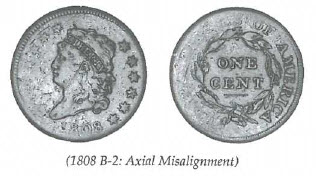
2. Axial misalignment is rarer for obvious reasons: the die faces are not in parallel planes, so that the striking force goes obliquely through the misaligned die, weakening the area which comes closest to the other die face, contributing to early breakage and discard. Often the pressman noticed the misalignment early and corrected it. Usually, the more obvious the misalignment, the rarer the die state. (There are two surprising exceptions, 1794 varieties 18 and 51.) On coins struck from axially misaligned dies, the border will be much deeper (and details usually sharper) at the area where the one die edge comes nearest the other die face, and much weaker at the diametrically opposed area, but the coin will be no thicker at the strongest area, no thinner at the weakest.
Major examples are unusual: 1794 varieties 18 and 51 provide the most dramatic instances. Minor examples are far more frequent than earlier suspected. All details regarding these are listed at the individual variety and die state listings.
3. Fixed Rotational misalignment (Rotated dies): From a die being locked into place at other than normal head-to-foot orientation. Some instances of "medal" or head-to-head alignment in other series were intentional, identifying restrikes (notably certain of Gobrecht's 1836-dated silver and gold dollars). Others were accidental, apparently including early cents. (Examples are few: 1793 Variety 19. Ruby I: 335. 1796 Variety 11 state I: Jack H. Robinson: 162 and 163, both normal and "medal" orientations. Denis W. Loring says he has seen only one in normal alignment; John D. Wright says "almost as common [misaligned] as normal." Evidently he has seen many not shown to me as I have seen few with normal alignment.
1798 Variety 20 state 1. Later die states corrected. At angles other than 180°, when the angle of rotation does not vary, one die must have been locked in place while rotated. Always accidental. 1797 Variety 2a, reverse locked in about 30° from normal.
1804 Variety I, reverse locked in rotated so that 0 in date is aligned with 0 in OF. Any other alignment is grounds for suspecting fakery.)
4. Loose Rotational Misalignment: When reverses are found II all around the clock," as in 1807 variety 6, a loose screw must have allowed the anvil die (normally the reverse) to rotate slightly as well as jiggle up and down at repeated impacts, perhaps producing occasional off centers or even broad strikes. Possibly, if a die shank broke in an approximately horizontal plane, the die face could rotate similarly although this is not likely. The latter event would produce a certain amount of axial misalignment, differing in location at different angles of rotation. No such examples are reported, but then nobody has been specifically looking for that effect. (Familiar examples:
1798 Variety 38. Various angles. States II through VI, possibly later. See Ruby: 515, an example of state VI. 1807 Variety 6. Various angles in all die states.) Some students sub-divide these into clockwise and counter-clockwise rotation.