Walter Breen's Encyclopedia of Early United States Cents
Walter Breen
Oops!
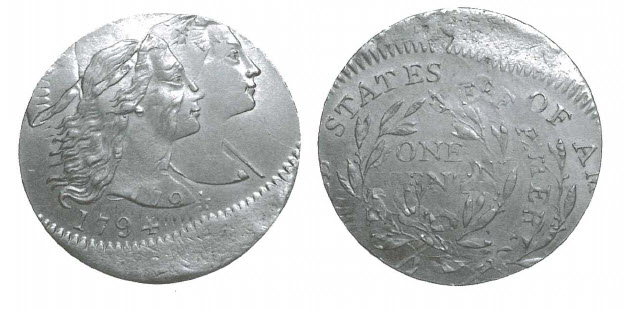
In every date from 1793-1814, die descriptions have called attention to die blunders, and Remarks and Condition Census sections have alluded to occasional mint error coins; bizarre productions overlapping the waste-basket category of factory rejects, freaks, mint errors, striking varieties, or whatever one chooses to call them. I have herein deferred intensive attention to such coins until all the regular types and varieties were described.
The classification scheme in my half cent book is followed here with necessary modifications. Some types of mint errors occur in half cents but not cents, others con-versely. (To extend this system to other pre-1837 U.S. denominations will require other variables not dealt with herein, some having to do with stars and edge reeding, others with errors that could have occurred on cents but are not known on them.) However, you need not be familiar with my half cent book to understand the classification herein; and the classification numbers in the half cent book are not identical to those herein.
The basic principle is that in each subroutine of every process a sample of copper goes through from ingot to strip to planchet, any malfunction produces a particular kind of anomaly. Similarly, this is the case with every process in die-making from the die blank to the working die in the press, and with the striking process where the finished die meets a finished planchet to produce a coin. From this follows a variation of Alan Herbert's standard "P-D-S" (planchets, dies, striking) classification system. In technical descriptions below, I paraphrase and sometimes quote the corresponding materials in my half cent book. (Half Cent Encyclopedia, pp. 467-84.)
Many specific examples of the various errors, described below, are listed in the footnotes with additional details listed in the main text for the appropriate variety.
Planchet Blunders
Making Strip
1. Foreign matter remaining in the strip produced discolored streaks, usually dark or brassy colored, and of different texture from neighboring normal areas. Some types of trapped material contributed to chipping, pitting, laminating, or splitting along the boundaries between the atypical alloy and normal copper. (Examples include 1793 variety 6 (the Atwater Coin), several examples of 1793 varieties 21 and 22, along with 1794 variety 1a.) This type of erroris sometimes known as "improper alloy mix" although, in the case of the early cents, the coinage metal was properly pure copper without alloy.
2. Gas bubbles occluded in the melt would normally burst during rolling into strip, producing laminations or planchet cracks. Blanks containing such bubbles too small to have burst will not ring; the Mint's term for these was" dumb blanks." However, even normal 1793 Chain and Wreath cents will often not ring properly; the thicker a coin is in proportion to its diameter, the less it will ring, even in the absence of internal bubbles or splits.
3. Improper annealing, from which some regions remained stress-hardened, contributed to brittleness and cracking. It is not always ascertainable which of these several factors were responsible for any given planchet crack or planchet defect. Lamination detects are common on cents dated from 1793-1797, less common on later dates. 1793 variety 16c is notorious for them.
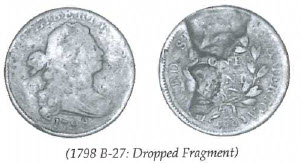
Laminations often peel away from the field. They may peel away edgewise, splitting the coin creating a "clamshell" split with the appearance of an open clam. Flakes eventually fall off forming dropped laminations. Alternatively, a thicker piece with design elements remaining may fall out producing a dropped fragment. (For reasons of space, we list only a few of the most famous cents with lamination defects, slivers, or fragments that have fallen out. 1793 variety 19, from the Naftzger collection, illustrated in Early American Cents and Penny Whimsy (Sheldon 16, obverse 14VD) as a die break. 1794 variety 1a include Ruby: 340, Adams: 3, Adams: 4, and others. Some of these qualify as dropped fragments. Additional examples include 1794 variety 45, Adams :48; 1798 variety 34, Ruby: 514; 1798 variety 38, Downing: 1825; 1800 variety 8, Ruby: 539; and 1803 variety 19, in the John D. Wright collection, with almost half of the obverse lost in laminations.)
4. Rollers set too close together made strip, and therefore blanks, too thin. Tentatively listed as mint errors only if about 10% or more underweight, without incomplete planchet or lamination, and without evidence of overstriking on tokens or other coins. Lesser weight deviations are more common (several are recorded at 1794).(An example of 1794 variety 57 in the collection of the ANS weighs 190.95 grains (12.37 grams). "Wrong stock" would apply only if the cents were on blanks cut from half cent strip, therefore of half cent thickness. Three possible standard weights: a 1793 variety 16 or any 1793 Liberty Cap on the earliest half cent stock (made mid-May for 1793 half cents at 22.2 mm) would weigh about 172.64 grains (11.19 grams), 1793 Liberty Cap through 1795 on late 1793-95 half cent stock (made for half cents at 23.8 mm) would weigh 150.11 grains (9.73 grams), and 1795 Plain Edge through about 1800 would weigh 121.26 grains (7.86 grams).)
Authentication is recommended. Prolonged acid baths outside of the Mint also lower weight, though at the cost of blurring details and ruining the coin.
5. Rollers set too far apart made strip, and therefore blanks, too thick. Tentatively listed as a mint error only if more than 5% overweight; specimens under 5% excess are more common (several are known dated 1794) and are not of interest to error collectors. Authentication is recommended: cast and electrotype copies are usually grossly overweight also. Look at the edge first. (Major examples include: 1794 variety 52,222 grains (14.39 grams, 6.7% overweight). Unseen. 1795 variety 8, 187 grains (12.12 grams, 11.3% overweight), Kagin's 1/30/1986 : 4139.)
6. Tapered blanks, from rollers suddenly coming closer together on strip than normal, though primarily a problem of later decades, occurred early among the errors produced by failure-prone rolling mills. (1794 half cent on a tapered blank is pictured in my Half Cent Encyclopedia, p. 470.) This class of mint error is known on cents as early as 1820 (John D. Wright collection) and may occur on earlier dates. Axial die misalignment produces similar local weakness, but the coin will have normally thick edges (look at any example of 1794 variety 51), whereas the edge of a tapered coin will be noticeably thinner at the weak areas than elsewhere. Two coins from the same axially misaligned dies will have their opposed weak areas in the same places; two coins of a single variety on tapered blanks would have their opposed weak areas (with thin edge regions between) in different places-anywhere on the circumference. One would expect coins struck on tapered blanks to be much rarer than their neighbors on thin planchets. Happy hunting.