Walter Breen's Encyclopedia of Early United States Cents
Walter Breen
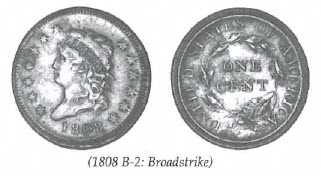
4. Broadstrikes are apt to be confused with oversize planchets or off-centers, above. Unlike oversize planchets, these are of normal weight and may be warped near the rims by the open collar, depending on how far below its upper surface the reverse die was at impact. Examples are extremely rare.
5. Uniface. If two unstruck blanks were simultaneously fed into the coining chamber, both centered, they produced two uniface coins, one obverse, one reverse. Examples are extremely rare. (For instance when at least one of the pair of blanks is not centered, see Indents below.) (1793 variety 13, reverse. 1977 ANA: 4465. 1794 variety 62, obverse. Richard Rosichan.)
Ejection: Single Planchet
Any failure of the feeding mechanism to eject the newly struck coin completely from the coining chamber will produce a mint error. Except for double profiles, these are major errors, some grotesque, all prized.
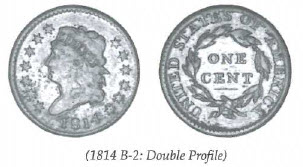
1. Double profiles. Created by a die which is loose in the press causing the die face to shift on a horizontal axis during striking? Earlier, Charles S. Barkelew had postulated operator error in striking," Were this the case, one would expect double profiles to be considerably scarcer and to occur at random rather than frequently on certain varieties and almost never on others; nor does it explain triple and quadruple profiles on middle date cents. Study of the earliest surviving Mint presses might provide a better explanation. Whatever the cause, it occurs more often now than then, and such coins are unjustly scorned as machine doubling, strike doubling, or die chatter. (1801 variety 6 with reverse tripled, Douglas F. Bird.
1814 variety 1, Ex A. C. Gies, unlocated, described by McGirk. Variety 2, Robinson S. Brown, Jr.: 435; others.)
2. Triple profile. Explanation akin to double profiles. Examples are extremely rare. (1795 variety 8, Ruby: 663, on incomplete planchet from end of strip; 1977 ANA: 4468; others.
1796 variety 4, 1957 ANA: 811.
1797 variety 2b, several seen. Variety 3b, 1975 EAC: 558. Variety 5, "Dupont": 169. Variety 20, several seen, including Ed Kucia collection (reverse only) and Jack H. Robinson: 277 (both sides). Variety 21, 1975 EAC: 559. Variety 22, reverse, Ruby: 482. Other varieties reported.
1798 variety 8, Warfield; Boys Town: 666. Other varieties reported.
1800 variety 12, Van Cleave: 5216, both sides. Other varieties reported.)
3. Double strikes are the most familiar :instances of ejection failure: after the first impression (which itself may be normal or off center), the newly struck coin remains partly or wholly in the coining chamber and receives a second impression. Double strikes are conveniently classifiable as follows:
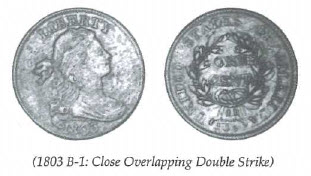
3a. Close overlapping. Both impressions are approximately centered. This class overlaps with, and may be confused with, double profiles although the entire design on obverse or reverse, or both, is slightly doubled. Sometimes called "chatter strikes."
3b. Rotated centered. Both impressions are approximately centered on the planchet. The newly struck coin was partly ejected and fell back into the coining chamber, receiving a second impression rotated at a noticeable angle to the first. Rare.
(1795 variety 6, about 15° apart, Ruby: 662. Variety 8, about 15° apart, incomplete straight dip, Ruby: 663; About 45° apart, Jack H. Robinson: 146. About 90° apart, Ruby: 664. About 1150 apart, R Tettenhorst, two visible dates; at least four others.
1796 variety 9, about 1600 apart, Jack Beymer. Variety 45, Jack H. Robinson: 189.
1797 variety 2b, John S. Ashby collection. Variety 8,35° apart, John S. Ashby collection. Variety 15, John S. Ashby collection. Variety 16, 30° apart, John S. Ashby collection. Variety 18, 1975 EAC: 563. Variety 21, about 30° apart, R. Tettenhorst, dentils of a third impression, 95% off center at K-10:30. Variety 25, "Dupont": 163a; another about 150° apart, John D. Wright.
1798 variety 2, 1980 GENA: 1518.
1800 variety 12, John S. Ashby collection. Variety 17, John S. Ashby collection, only slightly apart. Variety 21,1800 apart, John D. Wright 1803 variety 20, Jack H. Robinson: 584.
1813 variety 1, about 110° apart, 1975 EAC: 568A.)