Walter Breen's Encyclopedia of United States and Colonial Proof Coins 1722-1989
Walter Breen
XVI. RESTRIKES AND FANTASY
Excluding alleged patterns, or pieces embodying on one or both sides designs never adopted by the United States, the following chapter is devoted to irregular and largely incredible productions of the United States mint for diplomatic presentation or for collector whimsy. In short, coins more or less associated with regular designs, but now known to have been specially made, in the year of date or some later year, not for legitimate pattern or experimental purposes, nor as part of the regular yearly proof sets, not as true transitional proposed issues, but for purposes of surreptitious sale on behalf of venal employees in the Coiner's Department.
It is not impossible that a few coins already mentioned in the regular sequence of proofs may, through subsequent research, turn out to be products of the "workshop for their gain" which Taxay has so brilliantly exposed to the discredit of the Snowdens, Linderman, Theodore Eckfeldt, Franklin Peale and company.
These activities appear to have begun on a small scale in the 1830's, and reached an apogee in 1858-60 with subsidiary peaks in the mid 1860's, 1867-68, 1870-78, 1884-85, and brief flareups thereafter. At their height they included manufacture of simulated series coins of impossibly early or impossibly late dates as well as sundry mulings and pure fantasy pieces. To what category any given item belongs will become apparent from the description. It is perhaps singular that among these questionable coins reside some of the most highly publicized and highly valued items in the numismatic history of the United States. For proof, one need only allude to the silver dollars dated 1804, the 1884-5 trade dollars, and the 1913 Liberty Head nickels.
This is essentially a nightmare world in which one never knows what will show up next, or what a supposedly familiar item will suddenly change into. I say this without automatically executing moral judgments on these coins, their bona fide owners, or the dealers who sell them honestly for what they are. The moral judgments come only against the original perpetrators, especially when they misrepresented the pieces, and against those who would exploit them as other than what they are. I leave to Don Taxay thetask of playing Saturn (the Grim Reaper) and executing moral judgments against all connected with such coins in any form; his views have been made abundantly clear in his various books. My task here is to record them as accurately as I know how and let later researchers complete the task of identifying the remaining undated dies as to actual year of manufacture (as I had done with the silver dollar reverse of 1858-59, used in rusted state as late as 1876, and the three-dollar obverses of 1872 and 1877-79, used on restrikes of 1865 and 1873). Perhaps by then either a vengeful Treasury Department will have made all further researches a matter of might-have-beens, as Taxay might wish, or at the other extreme we might have something like the British amused tolerance of collectors holding their mints' former vagaries. For convenience, listings herein are in order of date on coin, not order of emission.
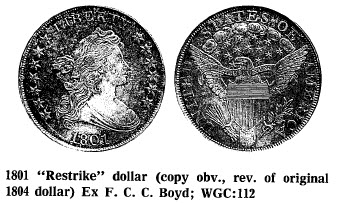
1801. Silver Dollar. *Novodel (made from copy dies). Obv. of regular design but date punches are of modern type, top of 1 's curved, somewhat similar to that on dimes after 1820, and some half dollars of 1821 and later dates; marked vertical thick parts in 8 and 0; stars squeezed close together so that they are very distant from L, Y and drapery; heavy crack through date and left stars; reverse of 1804 dollar of first type. Beaded borders within plain broad rims. Silver proofs. Listed as Bolender 5. Struck at the same time as the 1803 dollar novodel. Eric Newman has mentioned (Fantastic 1804 Dollar, 48) a small depression in space between UM and shield on all known specimens, from a sliver of metal adhering to die; this is found on the 1801's and 1803's, not on the 1802's, indicating common origin in time. As the reverse is the undamaged one of 1804 class I, these coins must have been struck between about 1836 and some time in the 1850's, but perhaps not as late as 1858 because by then the reverse die had been destroyed (a replacement had to be made for the plain edge dollars made in 1858 bearing the 1804 date). However, edges are blundered as on some 1804 dollars. Left surreptitiously in the hands of William Idler. Introduced to the numismatic world, doubtless via Idler, by his son-in-law, Capt. John W. Haseltine. Probably mint personnel, as likely as not some of the Eckfeldt descendants who dared not peddle these with the 1804's after the 1858 debacle with the plain-edged coins, held them unsold until 1876 when they felt the heat might be off. First record: Coin Collector's Journal, I, 83 (March 1876), wherein Edouard Frossard described Haseltine's showing around a set of dollars dated 1801, 02, 03, in brilliant proof state. Offered with the 1802 and '03 in sets by Haseltine in various sales, 1877-80 and in later years. Compare also Cleneay: 944; Lyman: 13 (where S. H. Chapman says, November 7, 1913, that these were being offered in May 1876 by mint officials when he entered the coin business - as a Haseltine protege! - and that they were from discarded, unused or newly made dies); WGC: 112; Newcomer-Green-Jack Roe: 426-Neil: 28. Less than 9 now known.
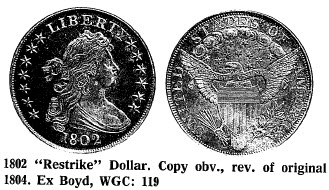
1802 Dollar. *Novodel. In every respect similar to last. Old date punches except for the 2 which is nearest in style to the Fancy 2 of 1824-27 half dollars. Reverse as preceding. A few more exist of this than of the 1801. Cf. Cleneay: 949; Lyman: 14, WGC: 119, Dunham: 1005, Neil: 29 (same pedigree as the 1801, Neil: 28); "Groves":443 at $37,000.