Walter Breen's Encyclopedia of United States and Colonial Proof Coins 1722-1989
Walter Breen
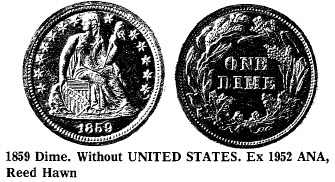
* 1859 Dime, without UNITED STATES. Identical to above. Obv. different from regular proofs., date higher; pendant almost over center of 5. Rev. Different from regular 1860 proofs; ribbons away from wreath. Judd 233, A-W 308. Piece de caprice, as above, though usually marketed as a transitional item. (1) Olsen, Neil:1269. (2) 1952 ANA: 572, Reed Hawn:723, $7,250. (3) "Dupont":1601, Miles:686, $4,000. (4) "Gilhousen": 389; others, possibly a dozen known.
1860 Half Dime, piece de caprice, identical type to preceding. [100] Usually flat at upper left reverse. Claimed to exist in proof, e.g. Lohr: 277 (1956), which I saw and identified as a first strike from imperfectly polished dies (vertical striae), lacking the striking qualities of a proof. On the other hand, by some mischance I missed examining 1952 ANA: 516, ex Allenburger: 1212, called by J. J. Ford and previous owners a proof; the plate looks quite remarkable. If so, this is the only one known, to date. The regularly seen ones are uncirculated; 100 made by J. R. Snowden for collectors, as pure pieces de caprice, not transitionals. The reverse die isnot identical to any known to have been used on 1860 proofs or business strikes. Judd 267, silver, reeded edge.
* 1863/62 Trime. Restrike. Only eight seen so far; bold date twice punched over lighter 1862. Rev. Rust spot in center of third I of . III; struck after original 1863 and 1864 proofs, but before at least some 1864 business strikes. NN 57: 336 at a then high $280; cf. Don Taxay's article in October 1962 Numismatic Scrapbook. Reverse is in state III of four states known of the same die, first usedon 1863 proofs (Clashmarks from star; line joins bases of first two J's, line from 3rd I to leaf), then relapped for 1864 proofs so that spearhead-like devices and inner circles in C smaller (II), then further relapped for this 1863/2 so that point of spearhead in first recess is gone (state III). On the unc. 1864's the die was again relapped and has developed a crack from rim at 4:00 (state IV). This establishes an 1864 date for these restrikes, apparently between early July and late August.
* 1863 Half Dime, 1 not recut, open D as in 1871-73. Rev. Die of 1870-71 pattern 5¢ silver. One seen in silver, several in copper. There used to be a small hoard of these and of the trimes (both 1863-64) in copper proofs, but this was broken up before I had any opportunity to examine it. An aluminum example was Dr. Caldwell: 132.
*1864 Trime. No recutting on 4. Top of D open or virtually so. Different rev. from foregoing (?). Silver, Phila. Estate and one other. Others in copper and aluminum (Olsen: 398 copper, 399 aluminum).
*1864 Half Dime. Restrike. High date; top of D open. Rev. same as 1870-71, ribbon ends touch wreath. Silver, Phila. estate and one other. Also in copper and aluminum.
*1865 Gold Dollar. Date slants up to right. Restrike. (1) Stack's, about 1958. (2) Pvt. coll, Cf. Scanlon: 1970 (not so identified), possibly ex Jay: 239. Not from original dies (the only ones made for 1865).
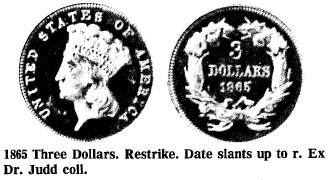
*1865 Three Dollars. Restrike. Date slants up to right. Obv. of 1872. Judd 440, AW 480. Gold: (1) Woodin, Newcomer, Boyd, Judd, "Ill. Hist."; 297, Dr. Wilkison, Paramount, A-Mark. (2) Farouk: 324. One known in silver, several in copper, Judd 441-2.
The other variety, with obv. of 1867-8 and high level date, must have been in existence no later than 1870, as a nickel striking from these dies was in Fewsmith: 1336. Cf. also Woodside: 160. Gold strikings include Grant Pierce: 1252, others.
We can probably exonerate the 1865 transitional nickel with rays from any claims of restrike status by noting that its rev. die is that of 1866 and it was first reported in Mickley: 2241 (1867).
On the other hand, the nickel of 1865 without rays has an 1868 die for reverse and sounds like an afterthought. In Parmelee: 149 it was claimed that only two were known; that is not very far from the truth even now.
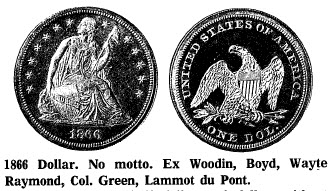
*1866. Quarter, half dollar and dollar, without motto. Pieces de caprice. Long listed in the Standard Catalogue and elsewhere as "transitional" pieces, solely as a favor to F. C. C. Boyd (who owned the set), these must now be debunked. The quarter, half and one silver dollar formed a set in the Woodin collection, thence to Newcomer, Boyd, Wayte Raymond, Col. E. H. R. Green, again to Boyd, later to King Farouk. The quarter and half dollar were sold to the same customer as Hydeman: 1107 and 1108; the dollar reportedly went via a western dealer to the same buyer. A duplicate dollar turned lip, identified as "ex Farouk," and was offered in the "Fairbanks" auction of December 1960, then to Samuel Wolfson at $13,000; later Wolfson II: 1425 at $18,000, C. Jay: 182 at $15,000, Winner Delp: 91, A-Mark. Calling them transitional pieces destroys the meaning of the term; the true transitionals are the 1865 coins with motto as adopted in 1866.
1868 Large Cent. Type of 1844-57. Piece de caprice. Nickel, 2 known. Copper, 4 or 5 known: record $7,250 claimed, about 1/3 of that verified.