Walter Breen's Encyclopedia of United States and Colonial Proof Coins 1722-1989
Walter Breen
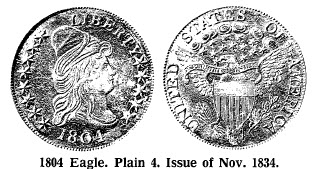
*1804 Eagle. Novodel. Plain 4, style of 1834 and of 1804 dollar. (Judd 33) [4+] Made originally in 1834 for inclusion in the diplomatic presentation sets intended for Siam, Muscat, Japan and Cochin-China. Possibly as many as eight were originally made, like the dollars, but not that many are now traced. (1) Eliasberg, from John H. Clapp, ex Woodin: 1200, Steigerwalt, Parmelee: 814. (2) Col. Green, Eliasberg duplicate, offered with the "H. R. Lee" sale of 1947, later Baldenhofer: 1459. (3) The former Brand specimen, offered by C. E. Green of Chicago. (4) The King of Siam proof set in case. There are also several proofs in silver, at least one of them with a plain edge (Ed Schuman), the others with reeded edges. (Judd 34, AW 23) Cf. Baldenhofer: 1460, Dr. Bolt: 1609,Hydeman: 979. First illustrated in the 1869 AJN by Benjamin Betts on a plate depicting various changes in the conception of the Liberty head, 1793-1869. It was not given any special attention in that display; no mention of the beaded borders, which are similar to those on the 1804 obverse and the Gobrechts.
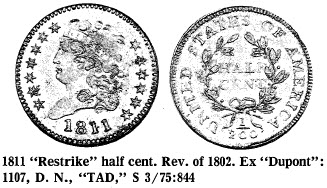
At this point, because there has been controversy and confusion over this coin, it may be appropriate to mention, and dismiss, the so-called restrike half cent of 1811. This is a muling, made in 1858 or 1859 for Joseph J. Mickley, from the original obverse (now badly rusted) of the 1811 close date half cent with the reverse of 1802 (badly rusted from the time of striking, with edges chipped). Only six were made, outside the mint only; they are bright red and the dies show some evidence of polishing in an attempt to remove the rust, not too successful. They have sharp knife-rims or "wire edges." However, they are not true proofs. Five of the six are now located: (1) "Dupont": 1107 to D. N., to the owner of the "TAD" coll.: S 3/75: 844 at $4,750. (2) Brobston. (3) Showers. (4) R. L. Miles:34, at $1,900, ex Lester Merkin. (5) Jon Hanson, ex Alfred Bonard, ex "Century": 89; this or preceding presumably the former B. Max Mehl private collection specimen. The dies were seized by the Treasury Department agents at the sale of Mickley's estate by Moses Thomas & Sons, 1878, repayment going to his widow.
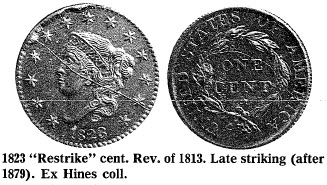
In almost the same breath we can allude to, and dismiss, the so-called restrike cents of 1823. These, though made from dies much repolished, are not proofs, and were also made outside the Mint; the first 49, for J. J. Mickley before the obv. die cracked across, in 1862, the remainder for various parties (Taxay mentions M. W. Dickeson, on unknown authority), including a reputed 12 for John W. Haseltine early in 1879 in silver, and more copper ones in subsequent years. The dies have been offered clandestinely since 1960, but it is not known if they are in condition to strike any more of the things. For one of the rare "original" 49 of 1862, see Helfenstein:99; first record of a silver specimen, S. K. Harzfeld's December 10, 1879 sale: 414; no recent record in silver, except for one in a Bowers & Ruddy FPL about 1973 (no mention of metal), at $149, more recently sold in four figures.
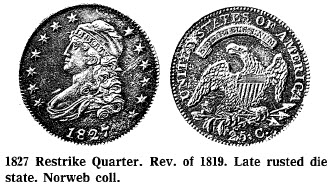
*1827 Quarter. Restrike, made in the mint ca. 1858-60. Regular obv., rev. of 1819 with crack through U and various stages of rust marks. State I: Unrusted obv. die. (1) Neil: 898. (2) Eliasberg, from J. H. Clapp?, overstruck on an 1806 quarter; the edge is that of the quarter, suggesting that these were made about the same time as the Class II 1804 dollars of 1858, before a Castaing machine had been set up to letter or reed planchets with appropriate old devices. (3) J. A. Stack: 30, $14,500. One other similar overstrike reported.
State II: Dies with increasing signs of rust. About 9 or 10 in silver, at least 3 and more probably 5 in copper. (1) Atwater: 679, later Grant Pierce: 612 at $6,000, KS 4/67: 1321, C. Jay: 180 at $6,400, Winner Delp: 56. (2) Atwater: 680, since untraced. (3) WGC: 90. (4) "Dupont": 1803, apparently reappearing as Baldenhofer: 403, Cass - "Empire": 1026; small mark points southeast, midway between 4th star and tip of nose. (5) Wolfson: 789 at $8,250 (1963), possibly no. 2, 3 or 4? (6) "Century": 855. The report that only 3 were known in copper stems from Parmelee: 22. Cf. NN 35: 390; Olsen: 203, possibly ex Woodside: 13 (the Parmelee coin?); Roach: 2387; Miles: 899, etc.
1830 Half Dime. Early restrike. Valentine 5. Struck in 1831, probably in response to a request in some official quarter for a proof 1830 half dime to fill a set or date sequence; a reverse intended for business strikes (and later used for them) was burnished and put into the screw press, an old 1830 obverse, faintly cracked, being fished out of the Coiner's stock of old dies not yet ready to be melted down, also reburnished, and a few pieces struck off, at least three being known; see Chapter IV above under 1830. No evidence here of chicanery.