Walter Breen's Encyclopedia of United States and Colonial Proof Coins 1722-1989
Walter Breen
(6) Omaha City Library, ex Byron Reed bequest, 1891, ex Parmelee: 817, ex E. H. Sanford (E. Cogan, November 27, 1874):99; Sanford bought it about 1868, earlier history unknown though said to have been bought from the mint "during PresidentPolk's administration" (1845-49) by one of those ubiquitous little old ladies. (Whether or not she was wearing tennis shoes the rumor has not specified.) Brilliant proof, flat stars. I examined this piece in 1953 at the Omaha Library. It was then kept in a small round black box sealed with tape, in one of the display cases but never opened for inspection. I had the box in my hand and nearly dropped it a moment before one of the curators told me what was in it! Apparently previous curators, probably fearing theft like the one which afflicted the Boston Public Library in 1948, had been unwilling to display so spectacular a coin -not realizing that the Reed bequest includes many other more easily negotiable items, and that any thief wanting the latter could just as easily have walked out with the little box too.
(7) Unknown private owner, October 1970, ex Massachusetts Historical Society, 1905-1970, ex William Sumner Appleton, ex Edward Cogan, February 1868 in trade, ex W. A. Lilliendahl in trade a few days before,ex Mickley: 1696, ex Teller Henry C. Young, Bank of Pennsylvania, Philadelphia, about 1850; supposedly taken in by Young at face with a deposit. EF-AU, former proof, cleaned to death.
(8) Stolen (1967) from the Lammot du Pont family, Wilmington, Delaware, via bequest from Lammot duPont, 1952, ex Elmer S. Sears (1922) via B. Max Mehlat $3,200, ex Manning: 778 (Mehl, May 1921), ex Chapman Bros., 1906, ex William B. Wetmore:208 (Chapmans, June 27, 1906), ex H.G. Sampson, 1878, ex Lorin G. Parmelee privately, ex Henry S. Adams auction (Bangs, Merwin & Co., November 1, 1876), ex Col. Mendes 1. Cohen of Baltimore at the auction of the Cohen collection, by Edward Cogan, October 15, 1875: 535, ex the Colonel's nephew Edward Cohen, Richmond, Virginia, ca. 1865, over the counter at his exchange office. Fine, evidently kept as someone's pocket piece; nicked, scratched and banged up.
*1804 Dollar. Class II. Surreptitious restrike of 1858. Obv. as preceding. Rev. Similar, some letter punches as Class I rev., but ST much closer, F about centered over space between clouds (in the "original" reverse Stare widely spaced, space between clouds under left serif of E). Beaded border, raised plain rim around, probably a replacement die made at the same time as the issue of 1834, but not then put into use as the first reverse die held. (Note the same differentiae of wide and close ST on the half-cent reverses of 1833-4-5 Gilbert 2 and 1835 Gilbert 1 respectively.) The reverse must have been surreptitiously held, at first probably by Adam Eckfeldt, later by his successor Franklin Peale, still later by other employees in the Coiner's Department upon the sudden departure of Peale (1854), together with the cracked 1804 obverse. It should have been thoroughly greased up to prevent oxidation, but evidently the process was not entirely successful as a rust spot shows at U of UNITED on all specimens from this die of Classes II and III.
Class II consists of the unique plain edged coin, so struck because at the time either the surreptitious makers did not know how to letter edges, or had not noticed that the Class I 1804 had a lettered edge, or more likely had not yet found the Castaing edge device bars for the old lettered edge dollar blanks of 1794-1803. As the rust spot on reverse varies in size on the Class III's, these coins may have been struck on several occasions; as the die alignment is approximately the same on all examined of Classes II and III, Newman believes all were made on the one occasion, but it is also possible that the die alignment was accomplished by use of the set screw on a slightly misplaced flat or groove - a fairly common occurrence on regular and proof coins early and late.
The only surviving Class II coin is now in the Smithsonian Institution, from Mint Cabinet, where placed by J. R. Snowden in 1859 on recovery of a reputed four such specimens, the other three having been destroyed in the presence of W. E. DuBois, a fifth supposedly being still unrecovered. These plain edge coins had been bought by Major C. P. Nichols (Springfield, Mass.) from William Idler, and by Edward Cogan (the New York City coin dealer) from, probably, Theodore Eckfeldt in 1858 or '59; the source of the third piece was not named. This Eckfeldt, barely 21 at the time, was the same one whose practice in peddling restrikes of various other issues made him notorious by 1860. The going price then was $75.00. The Class II dollar was examined by me in 1951, courtesy of my mentor the then curator Stuart Mosher, on which occasion I discovered that it was overstruck on something, and made a drawing of as much of the undertype as I could make out, devices and lettering. This enabled me to identify the coin, with Stuart's help in supplying books on dollar size coins and with a prolonged search in the Smithsonian's collection of dollars of the world, as a cut-down 5 Franken Schiitzenfesttaler or Shooting Festival Thaler of Bern, Switzerland, 1857, now known as Yeoman 4-S. (The piece had had its edge device shaved off in order to prevent identification of the 1804 as a recent restrike, reducing weight from standard 392 grains to 38l.) Numerous electrotypes were later made from it in the Mint.
An interesting 'Sidelight on its history is that it and the Mint's Class I were for long transposed in the display case in which both were shown, as it has better striking quality and more convincingly prooflike surface. For which reason - or possibly with malice aforethought - various unscrupulous individuals, beginning with William Ewing DuBois and his successor in the Mint Cabinet Curatorship, Patterson DuBois, at various times claimed that this plain edge fabrication was the "original" 1804 in order to support authentication of various Class III 1804s. It was retransposed before 1912, however, and was listed as No. 569 in the Comparette catalogue.
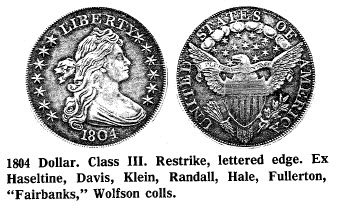
*1804 Dollar. Class III. Restrike. Same dies, edge lettered after striking by Castaing edge dies, probably in order to prevent seizure by Treasury authorities after the 1858 scandal. At least 6 now known, and generally acknowledged today (after the Newman-Bressett publication) as a restrike, though Haseltine's Type Table of 1881 and some later catalogues attempted in the interest of higher prices to slur over any distinction between restrikes and originals, sometimes speaking only of first and second varieties. These Class III's may have been leftovers from Class II coins of 1858, lettered on edges to conceal their origin. All have reverse die slightly misaligned, the ° in date approximately aligned with second T in STATES; the Berg coin, and to a lesser extent others of Class III, show reverse die chatter. Some specimens were carried as pocket pieces or the like, possibly in order to give them an appearance of age and to distinguish them from new-looking brilliant proofs.