Walter Breen's Encyclopedia of United States and Colonial Proof Coins 1722-1989
Walter Breen
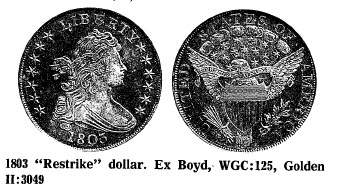
1803 Dollar. *Novodel. Large 3 type, from old date punches. Small raised line, slanting a little down, just above center dot on obv. Heavy rust marks around 4th star, lighter ones at 18. Reverse as preceding. In a rarity class with the 1801. Cf. Cleneay: 954; Lyman: 15; WGC:125 reappearing as Golden II:3049; Neil:30 (same pedigree as the 1801-2 above mentioned, Neil: 28-29); Dr. J. Hewitt Judd. This last has an old sales record of $3,000 and in the mid 1960's was offered at a then incredible $7,500. One of these was Lichtenfels II: 1146.
All foregoing have beaded borders surrounded by raised rims. All show a rust pit midway between next to lowest feather of wing at r. and top leaf on olive branch. This is very minute on the 1801 and 1803, and larger -nearly half the size of a berry - on the 1802, showing that the order of manufacture was probably 1801 and 1803, then afterwards 1802. This rust pit is not visible on any of the known 1804 Class I dollars, which have the same reverse die. It follows that the 1801-2-3 coins must have been made after all the known 1804 Class I dollars, which the Newman-Bressett book effectively dated to November 1834 for diplomatic presentation purposes (see below). There is no certainty of order of manufacture of the dies, but my own guess is that the reverse was made first (fall 1834, for the 1804), then the 1801 obverse as this shows the most amateurish spacing of stars, together with horizontal and vertical die scratches on bust to enable location of center point for drawing temporary guide arcs of circles for placement of stars, letters and numerals. Note that this 1801 obverse has broken curl tip. The 1802 and 1803 dollar obverses may have been made together at some later date as they share letter, numeral (except the 2) and star punches with each other and the 1804 but not with the 180l. They may well have been replacements. The 1804 dollar die has the missing curl tip, like the 1803 as hubbed but corrected in hand finishing these obverses. Note that the uppermost locks on all these dollars differ in detail, from extensive handwork, probably by Kneass or Gobrecht. A set of the three (Neil's?) was in the Amon Carter coll.

*1804 Dollar. Class I. Antedated Fantasy. [4+] Obv. Type of 1803, from bust puncheon with missing curl tip (though hand finished differently from the 1801 die). LIBERTY and stars as in the 1803 obverse just described, but Y nearly touches 8th star. The 4 punch in date is of the style found on various 1834 coins and no earlier ones (half eagle, half dollar, cent, half cent and various others): top of upright flat, plain crossbar without crosslet, right serif of foot nearly as long as crossbar. Borders of beads surrounded by raised flat rim, similar to the 1801-2-3 novodel dies. Die cracked through tops of LIBERT, this crack faint on the Class I's but varying slightly in strength. Rev. As preceding. The dies are slightly smaller than the finished coins so that a close collar could be used, but the pieces were struck on planchets of normal weight, approximately 416 grains. (The 1801-2-3 novodels come on overweight flans, 419 to 423 grains apiece.) At least four specimens were struck, November 1834 through possibly early 1835 (perhaps all in November 1834), for inclusion in diplomatic presentation sets for the King of Siam, the Imaum or Sultan of Muscat, the Emperor of Cochin-China; duplicates were made on that occasion for possible subsequent presentations of the same sort, or perhaps for exchanges or surreptitious sales. The die remained in custody of the Coiner, Adam Eckfeldt, and subsequently with his successor in office, Franklin Peale; for its later use and history see below. At present eight examples of Class I are known; not enough development in obverse die crack is visible to justify a conclusion that they were struck on separate occasions, though all were certainly struck before the 1801-2-3 pieces with the same reverse, as the reverse with the 1804 obverse has no rust pit.
(1) Smithsonian, from U.S. Mint. No. 568 in the Comparette catalogue, 1912-1914 editions. Placed in the Mint Cabinet presumably by Adam Eckfeldt in June 1838 at the time of the original gift. First known to outsiders in 1842; one of two on display when Matthew Stickney came to the Mint to make his trade (see below). Badly cleaned proof, nicked around ERT.
(2) Louis Eliasberg, ex Atwater: 213 (1946) at $10,500, ex Wayte Raymond, March 1923, ex Col. James W. Ellsworth, ex Stickney: 849, ex Curator, United States Mint Cabinet, May 9, 1843, in trade for various specimens of Massachusetts silver and other coins including a 1785 IMMUNE COLUMBIA in gold over -struck on a 1775 guinea. Pictured in Eckfeldt & DuBois, Mint Manual, 1842. Cleaned, rubbed, somewhat impaired proof.
(3) Undisclosed present owner, included in the 1834 proof set in special presentation case (yellow morocco leather with American eagle design on top), given to the King of Siam April 5, 1836 by Edmund Roberts, Special Diplomatic Agent of the United States Government as part of a series of exchanges of presents in connection with establishment of the first U.S. - Siam trade treaties; set was made up by Mint personnel acting under orders of the State Department, November 1834, and finally got into Roberts's hands April 21, 1835. Brilliant gem proof, exhibited in the set at the 1962 ANA Convention by David Spink.
(4) Childs estate, Chicago, ex C. F. Childs, ex C. E.Green, 1945 at $5,000, ex Armin W. Brand, 1945, Virgil M. Brand estate, 1937, Virgil M. Brand, June 20, 1918, Henry Chapman, 1917, ex Glendining & Co. sale, London, June 14,1917, lot 227, of the C. A. Watters, Liverpool, England, collection, almost certainly as part of the 1834 proof set given by Edmund Roberts to the Imaum of Muscat, Sayid Sayid bin Sultan, October 1, 1835; made up under the same circumstances as the Siam proof set. Brilliant proof, blue tone, flat stars.
(5) Harold Bareford, 1950 to present day, from Charles M. Williams via Abe Kosoff and S. Kaplan at a reported $10,000, ex Dunham: 1058 at $4,250 (1941), ex H. G. Brown (Lyman Low, October 11, 1904), lot 431, ex Roland G. Parvin, 1903, executor of the estate of James V. Dexter, Denver, Colorado; Dexter had obtained it from J. W. Scott in 1885, his agent at the Chapman sale of their own collection, May 14-15, 1885: 354; Chapman Brothers had it from the Adolph Weyl auction of October 13, 1884: 159, earlier source unknown, rumored to have been placed with Weyl by the Chapmans in order to give it a foreign pedigree. Brilliant proof, dipped once but not scrubbed; one of three finest.