Walter Breen's Encyclopedia of United States and Colonial Proof Coins 1722-1989
Walter Breen
For the half cents to follow it is necessary -to gain some idea of chronology - to pay some attention to the fabric, i.e. to the kind of blanks from which they were made. My assumption is that coins of various dates having identical physical properties (weight, manner of patination, texture, striking characteristics, etc.) and identical reverse die state were made on the same occasion; and that when subsequent orders came in for half cents, a new piece of copper strip was made up and cut out into blanks. In a given "series" - group of half-cents of various dates made from one and the same batch of blanks - presumably the reverse die was left in place and anywhere from 3 to a dozen impressions were made from each successive obverse as it was inserted into the press, the whole group afterwards being assembled and sold in sets or as individual dates. There were three different reverses, the large berry die (original of 1840-48) being used only very late, probably in 1860 and most likely only after long search in the Coiner's vaults where Peale had stored it in 1849. A description of the seven distinct "series" follows.
Series I. Early. "81.8 grains". Actual weights run about 81.8 grains plus or minus 2, but generally the coins from this series stay quite close to the named figure. They patinate light iridescent brown, blue or blue-green. Only two reverses were used, the coins of 1831 and 1836 having the original reverse die of 1836 (which later cracked), those of 1841, 42, 52, 56 and 57 having a single reverse die among them, that earlier called "B" of 1856, showing double impressions on CENT and ribbon.
Series II. Thick, 87 grains average. Brown, irregularly mottled. Weights range from 85.3 to 91 grains. Reverse B of 1856, obvs. of 1842, 49, small date, 52, 56, 57.
Series III. Late light I-B's. Average 76.5 grains, range 75.6 to 81.4. Dies usually bulged (caved in centrally, producing convexing on coins), in some cases cracked or rusted as well; unnatural-looking knife-rims or "wire edges," sometimes filed down; streaky, irregularly patinated. Always weak in centers of both sides. With reverse B of 1856 in late state, this series includes coins dated 1840 through 1848 inclusive, the latest ones known being dated 1848; there are also a few 1831's with the badly cracked reverse die of 1836.
Series IV. Early thin J-C's. Weight average 77.2 grains, plus or minus 0.6 grains. All dates, 1840 through 1848 inclusive, with the reverse commonly called C or "Second Restrike", showing die file marks above RICA. Variable patination. Not as rare as II, III above. Variable tone.
Series V. Thick 1-C's. Weight, extraordinary, 96 grains (95.7 to 98.1 grains). The C reverse comes with obvs. 1840 through 1848 (except 1844) and 1852, 4 or 5 being seen of each. Usually dark brown.
Series VI. Late light 1-C's, Rather like III. Average 77.5 grains, range 68.2 (an 1842) to 79.0. Always bulged, with weak centers and wire edges. Dates 1831, 1836, probably as the original 1836 reverse was now completely hors de combat; 1840-42, 1844-47 inclusive. Variable toning.
Series VII. Large berry restrikes. Dates 1840, 43, 45, 47, 48, 49 small date, 1852, and possibly others. Weight range 78.8 to 87.9 grains. May have been made on more than one occasion.
We can now proceed to the description of the half cent restrikes in greater detail than anywhere previously, based on the material in the unpublished ms. which I completed in 1956 together with the other data since assembled.
*1831 Half Cent. Large berries. Restrikes. Rev. of 1836. State B. Series I. Published by Gilbert in a rare supplement to his 1916 book as the "original", contrary to all evidence. High leaf ends left of center of final S, whereas on the originals (rev. of 1832) high leaf ends under r. side of final S. Uncracked, but repolished and strengthened; broader borders than on 1836 originals, often with some trace of wire edge. Gardner's brought $1,300, Brobston's had been offered at $850; Garrett: 9, $1900 to J. E. I. Not over fifteen or so known, possibly about a dozen.
-Same dies, state C. Series III. The reverse is now cracked from rim through r. serif of T in UNITED, to leaves, to HA and upwards through wreath to F in OF to border. Obverse now caved in. (1) Martin Kortjohn. (2) Eric P. Newman. (3) Brobston at $925, ex "Dupont"; 1119. Compare H. P. Smith: 1213, Stickney: 1743, D. S. Wilson, etc.
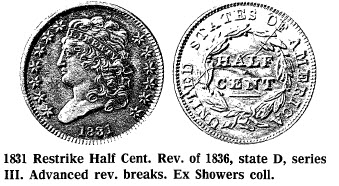
- Same dies, state D. Series III. Additional crack through L of HALF through NT to wreath, final A and border. About four of these are known, one of them in the Philip M. Showers collection. Unnatural knife-rims on at least two.
*1831. Half Cent. Small berries. Rev. C of the 1840-48 group; type adopted with the Coronet Heads, 1840- 57, die file marks above RICA. Series VI. Disclosed to the numismatic world by John W. Haseltine (who else?) about 1879, with claim that only 12 had been struck; this claim is quoted in the Frossard monograph on cents and half cents (Irvington-on-Hudson, New York, 1879). Specimens appeared in Haseltine sales in June, July -and October 1879 and some later years. At the moment only four can be traced. (1) Eliasberg, ex J. H. Clapp, ex Steigerwalt (1907). (2) Omaha City Library, ex Byron Reed bequest. (3) Miles: 42 at $2,200 ex Brobston at $1,750; 76.6 grains. (4) The former King Farouk coin. Where are the other eight? It is possible that Haseltine meant that only 12 were made of the 1831 and 1836 small berry coins taken together?
1832. Half Cent. Early restrike. Gilbert 3, recutting on DES. Badly rusted reverse die. Possibly made late in 1832 or early 33 under circumstances analogous to the 1830 half dimes earlier mentioned. No hint of chicanery. Both proofs are badly cleaned. One is the former B. M. Doublas example, the other is in the writer's collection; I have heard of a third.
1833. Half Dollar. Restrike. *Obv. Large beads in border, a wide flat rim around. Rev. most like 1836 D, with spine on end of stem, first T in STATES too low, small beads in similar border. Struck on old lettered edge planchet in a close collar, the edge lettering squashed almost to invisibility. Probably made late in 1836 together with coins dated 1834 and 1835. Extremely rare. (1) Smithsonian, from Mint Cabinet. (2) R. E. Cox had one of these. This may possibly be Winsor: 525. (3) The piece pictured on page 59 of the Newman-Bressett book, provenance not known to me. I have seen one other I believe to be different from any of the above.