Walter Breen's Encyclopedia of United States and Colonial Proof Coins 1722-1989
Walter Breen
III. As above but obv. again repolished, no trace of recutting on date. At least 16 in Beck in this state.
IV. Obv. again repolished; new die file mark through U to border above N; the earlier die file marks almost or completely invisible. Varying strengths of a crack from beak nearly vertically down to border; this becomes plain. Rev. Perfect, repolished. Less rare.
V. Obv. crack now extends through beak and UNI (base of U, middle of N, nearer to top of I). Rev. Crack from cotton leaf to rim, about 11:00. Less rare.
VI. As above, a second crack from cotton leaf to rim, about 1 :00. Less rare.
VII. As above, several rev. rim breaks outside dentils, tiny crack from rim below r. side of 5. Less rare. At least 53 were in the Beck hoard in these late states, and this variety constitutes over % of the 1856's seen outside it, uncs. (?) and proofs - often it is very difficult to tell if a perfectly preserved coin originated as a proof; also found worn. Believed to be restrikes,from the fabric, though theymust have been made in 1857-58, and no small cent dies were among those seized and boxed by Snowden (see Restrikes and Fantasy Pieces).
For quick finding purposes, check the following variables.
Date - very thin on obv. 2, thin on 1, heavier on the others.
6 - open on obvs. 1 and 2, closed on the others. E's - open on obv. 2, closed on others.
Part of extra 5 left of 5 - obv. 1
Recut CA - obv. 3
Die file mark or crack through beak – 5
E's in ONE CENT - open on A, C; closed on others.
Center dot - microscopic above serif of N on B, plainer below serif on D.
Leaves at C T - both low on C; left low and r. high on A; left high and r. low on B; both high on D.
In addition to the above regular design coins, the following three anomalies exist:
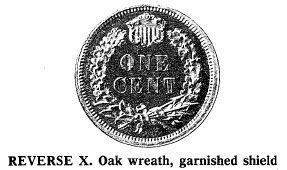
REVERSE X. Oak wreath, garnished shield "2-X". Obv. 2 above described, the date a little stronger than on 2-B or 2-C. Rev. Oak wreath and garnished shield. Center dot on at least one. Broad rims. Restrike? (a) Copper-nickel, Judd 184, A-W 209. Three known, one ex Judson Brenner, exhibited ANS 1914. (b) Copper or bronze, Judd 185, A-W 210. Three known, one the Judson Brenner coin in same exhibit.
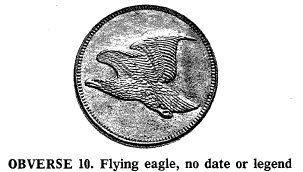
D." Obv. Flying eagle, no letters or date.
Rev. D as above described. (a) Copper-nickel, Judd 178, A-W 213 or 211. (1) Olsen, Neil: 2922, Wm. Guild. (2) Woodside: 71, Woodin, Judson Brenner (ANS 1914), Brand, B. G. Johnson, Dr. Judd, "Ill. Hist.":188. Discovery: Bangs & Co. 10/18/60:324. (b) Copper. J-179, A-W 212. About four known.
"11-D." Obv. Flying eagle, large letters, no date (an 1858 product?). Rev. As last. (a) Copper-nickel. Judd 201, A-W 215. Existence long controversial. Olsen:512, Col. Curtis:1050. (b) Copper. Col. Cohen:478, E. Cogan 5/79:134, Crosby: 1730, unlocated.
Other and still more obscure rarities in this series are reported. The unverified records are cited here for what they may be worth, which is probably only as a stimulus to further research.
A. Regular issue, "silver," "broken dies." Redlich:580 (March 4, 1878). Possibly a mint error on a dime or half dime blank? Unlocated.
B. Copper, "trime size." Zabriskie: 237.
C. Die trial of reverse, apparently in copper-nickel. Bache II: 1511 ex Bache I: 2940 (the two great Woodward sales of 1865). May be an imperfectly described prior appearance of following.
D. Die trial of reverse, large square brass flan. Mickley:2202 (1867); no. 3 in John F. Jones list, Numismatist April 1944.
E. Identical but Incuse, probably a hub trial. No. 4 of the Jones list just cited.
F. Mule of obv. "10" and "11" above.
Copper-nickel proof. Adams-Woodin 251, Judd 219. One known: Fewsmith:1219 (1870), A. S. Jenks, E. Cogan sale (4/77) :420, Woodside:70, W. F. Gable, unknown
intermediaries, Dr. Judd.
The remarkable price history of the cents of this date has had much to do with hysterical claims about their alleged rarity. In actuality, the 1857 and 1858 proof cents are many times rarer; but then these dates are much commoner in uncirculated business strike form than the 1856, and many collectors are still under the dealer-fostered illusion that proof is the name of the grade higher than uncirculated, rather than a different method of making coins. Instability of the market for 1856's has been evident whenever even a half dozen show up at once. The Beck hoard has been very carefully handled so as not to depress the market (1975). But then, even George W. Rice's hoard (before World War I) of some 756 pieces was absorbed. For long the presence of the Beck hoard not only kept the price artifically high, it deterred many from collecting this date owing to fear that its value might collapse when the Beck hoard came onto the market. These fears appear to have been groundless; the coin remains overvalued in comparison to other patterns and to other proof small cents 1857-64, though as the new knowledge of varieties becomes disseminated, the rarer ones may appreciate markedly compared with no. 8.