Walter Breen's Encyclopedia of United States and Colonial Proof Coins 1722-1989
Walter Breen
Obverse variables are as follows: Heavy or thin numerals, open or closed 6 (on the closed, a line joins knob and loop), open or closed E's (in UNITED STATES, the crossbar touches upper serif on the "closed," but is smaller and free of it on the "open").
Reverse variables: "High" or "long" leaves extend above base line of C-T, "low" or "short" extend only toa point well below base line. E's in ONE CENT come closed, almost closed, or wide open, the last only with low left leaf. A center dot mayor may not show, just under or just above top left serif of N of CENT.
The following enumeration of varieties is believed to be approximately chronological, though this is subject to revision as the remainder of the Beck hoard becomes available for study.
1. Obv. 1. Closed E's. Thin date, open 6. Part of an extra 5 (slanting stroke) shows immediately to left of 5, slightly below normal position. Left base of 1 about over space or extreme left edge. Rev. A. Prototype die, left leaf low, right leaf high, both E's wide open, relief veins in maple leaves, center dot not visible on the coin seen by me. Copper, thick flan. Beck, ex Henry Chapman.
2. Obv. Same die. Earlier impressions (very rare) show the part of extra 5 plainly, later ones have it very weak or hardly visible. Rev. B. Left leaf high, r. leaf low (left leaf in fact unusually high, extending over double the thickness of serif of E above base line); closed E's; rare earliest state has microscopic center dot above N, usual later states have none. Scarce, usually nonproofs; proofs rare. Few seen double struck (die chatter earlier thought to be double entry from hubs): NN 57:38, "Dupont":1161, two others in Beck. Some 26 normal ones were among the first 116 seen from the hoard.
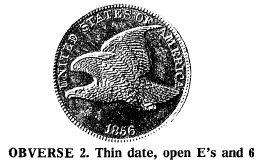
3. Obv. 2. Open E's, very thin shallow date, open 6; left base of lover r. part of dentil. Rev. B. (a) Three or four seen in experimental nickel alloy, silvery color (AW 204); cf. Ten Eyck -Neil:2921. (b) Copper, thick flan, one seen at 1966 ANA Convention. (c) Three in Beck, 5 or 6 outside the hoard to date, normal copper-nickel alloy. The 1857 proof die believed to be a repolished state of B, with second kernel on open wheat stalk at top r. disconnected; unconfirmed.
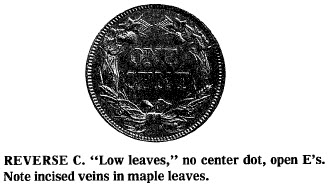
4. Obv. 2, above. Rev. C. Low leaves, open E's, thin letters, no center dot, incised veins (as in 1857 and a few 1858 coins). (a) Copper or bronze, called Judd 181,182 (we cannot tell them apart in this issue); thick nan, A W 207 "bronze" and 205A "copper" (latter number given privately by Adams to the Judson Brenner coin in ANS 1914); thin, AW 208 "bronze", 205 "copper." Thin coins are about of same thickness as later bronze cents 1864-1909; weights not recorded. (b) Copper-nickel. NN 57:311, two in Beck, six others seen, proofs and worn coins, no uncs., probably no business strikes. Restrikes? Barely possibly NN 57:37 may have been from these dies in different state of repolishing; 1 heavier than 856.
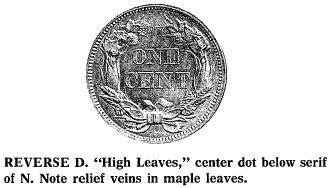
5. Obv. 3. Closed E's, heavier date, closed 6, plain recutting within loop of 6 and on top left serif of 1, and on bases of CA (not double striking). Left base of 1 r. of left edge. Rev. D. High leaves, closed £'s, with center dot just below top left serif of N; no plain double outlines on lower r. ribbon or below top of E of CENT; perfect die, no cracks, no rim crumbling. One in Beck hoard. Very rare.
6. Obv. 4. Closed E's, heavier date, 6 almost closed (later states have it open - repolished die), left base of lover space; none of the stigmata of obvs. 3 or 5. Rev. D. Nonproofs only seen to date, about seven in all. Rare.
7. Obv. 5. Closed E's, heavy date, closed 6, left base of 1 left of center; faint recutting atop 8, at very tip of6, atop 6 and below top of hollow of loop. Die file mark up to border from r. upright of I(TED); small mark about joins two dentils above N. On earliest states (rare), the recuttings are fairly clear (they are never pronounced, usually blurry, and on later states not visible); no cracks, no repolishing, no marks through U. Rev. B, above. Two in Beck hoard, few outside; it is uncertain if these began life as proofs.
8. Obv. 5 above; rev. D above, or something that answers its description; no cracks, no rim breaks, but with many extra outlines, most prominent on lower part of bow and of r. ribbon, and below top of E(NT). This may possibly be a different working die, but we are not yet convinced one way or the other. Many die states, of different degrees of rarity.
I. With the die file mark at I as above; recutting on date shows. Ten in Beck hoard, nonproofs, often worn. Rarer than later states.
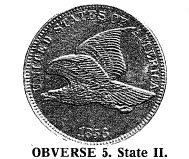
II. Die repolished, recutting blurry, mark above N weaker, that above I only microscopically visible or not at all. Rev. Repolished; no double outlines; E of ONE no longer quite closed. Eight in Beck hoard, both unc. and proofs, rare.