Abe Kosoff: Dean of Numismatics
Q. David Bowers
"A quick visit to Chicago for the show there, and a round of discussions with several clients. Picked up a few choice coins in the process and then headed back to Los Angeles. Claire, Mike, and Steve had already prepared all auction shipments, which made it really nice. I am still catching up on mail, however, but by the time this is released we should be back to normal. .. I have had a chance to review recent lists, catalogues, etc., and am impressed, not necessarily favorably, by inexperienced 'professionals.' This is most certainly a time for caution by buyers."
Among the fixed price offerings in that issue were such diverse coins as an Uncirculated 1862 dime at $9.50 and a Proof 1884 of the same denomination for $28.50, an Uncirculated 1895-S dime at $110 and an 1896-S for $300, Uncirculated Barber quarters from $12.50 upward, and an offering of currency.
Proof sets reflected the rising market and were priced as follows: 1936 $385; 1937 $187.50; 1938 $92.50; 1939 $80; 1940 $71.50; 1941 $55; 1942 $45; 1950 $63.50; 1951 $35; 1952 $25.75; 1953 $15; 1954 $12.50; 1955 $12; 1956 $7.35; 1957 $5; 1958 $9.25; 1959 $5; 1960 Small Date $21; 1960 Large date $3.85, and 1961 $2.85.
Commemoratives offered included the following: 1892 Columbian $4; 1893 Isabella quarter $44.50; 1900 Lafayette dollar $60; 1918 Lincoln Illinois $15; 1920 Maine $15; 1922 Grant $13.50; 1925 Stone Mountain $4.50; 1925 Vancouver $70; 1927 Vermont $30; 1928 Hawaii $300; 1934 Maryland $19; 1935 Hudson $125; 1935 Old Spanish Trail $77.50; 1936 Albany $32.50; 1936 Bridgeport $32.50; 1936 Cleveland $6; 1936 Elgin ;25; 1936 Long Island $9.50; 1936 Norfolk $35; 1936 Wisconsin $15; 1936 York $13; 1937 Antietam $47.50; 1937 Roanoke $15; and 1946 Iowa; 12.50.
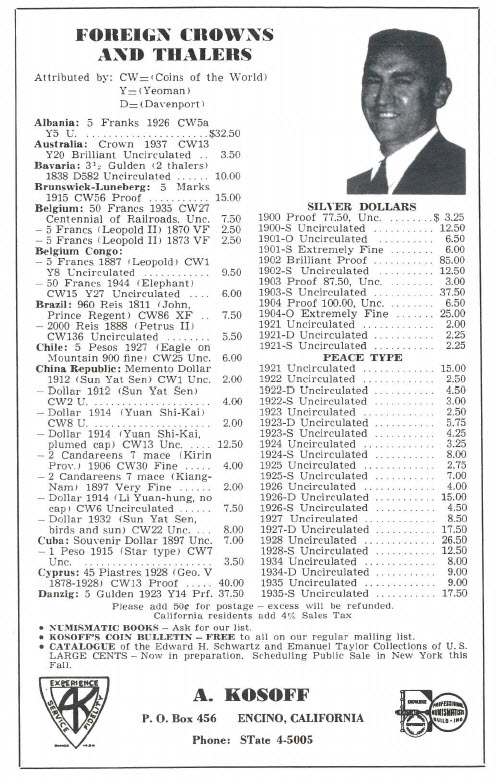
Commemorative gold coins were rising also, and among the pieces offered were 1904 and 1905 Lewis & Clark Exposition gold dollars at $300 each, a 1915-S Panama-Pacific quarter eagle for $275 and a 1926 sesquicentennial quarter eagle for $45.
In its annual "Crystal Ball" survey of market conditions, Lee F. Hewitt's Numismatic Scrapbook Magazine asked dealers what they predicted for the hobby in 1962, to which Abe Kosoff replied: 'Put on the same record. Inflation continues, new collectors, shrinking supplies." The market was growing, the theme of investment was coming into the forefront, and the hobby continued its metamorphosis into either an investment medium or industry, depending on who was discussing it.
At the same time, Abe Kosoff announced that he was no longer planning to conduct auctions on a regular basis. Rather, he envisioned working as a consultant with collectors and occasionally offering outstanding holdings as they were acquired. It was noted that Kosoff's Coin Bulletin would be issued on a more regular basis, although not monthly. Instead, they would be "published when Kosoff and his staff have the opportunity to prepare and handle them adequately."
The early 1960s saw a vast influx of new "professional numismatists" enter the field -some of whom had little in the way of credentials. From his Encino office, Abe Kosoff expressed his concern, as published in the January 19th issue of Coin -World:
"A. Kosoff, veteran professional numismatist and one of the highly respected names in the field, has issued a sharp warning. He urges collectors and dealers alike to be cautious of the newcomer in the numismatic field. 'Some, with the best intentions, know so little about coins that it is pitiful. Some make all sorts of representations, most of which are unfounded and which only tend to mislead,' said the prominent numismatist.
"Continuing his observations, Kosoff said: 'The unfortunate part is that many of the collectors are just as green in the hobby and assume that because an ad appears in Coin World or The Numismatist Or the Numismatic Scrapbook Magazine, the advertiser is well versed as an expert. Unfortunately, this is very far from the truth. It has been my long contention that there is a moral responsibility to the publisher to see to it that the facts in the ads are really facts-and that they are not merely wishful thinking on the part of the advertiser. As a result of this type of operation we have found collectors who could have advanced in the hobby for many years suddenly decide that this is not for them, and they give up. This, of course, helps no one and certainly is frustrating to the collector who seeks the hobby for his enjoyment and relaxation.' "