Abe Kosoff: Dean of Numismatics
Q. David Bowers
In Hong Kong, United States trade dollars, minted for circulation from 1873 through 1878, were once plentiful, but in 1960 they were becoming scarce. Perfect pieces, without defects, were very expensive. Those bearing chopmarks, or counterstamps of Oriental banks and merchants, were more reasonably priced. Gold was extremely expensive and cost more in Hong Kong than virtually anywhere else.
The next stop was Bangkok, Thailand, where Abe bought out the coin inventory of a downtown shop. "Now came the problem of shipping the coins home," he later wrote. They first had to be photographed by the Ministry of Education. Coins not in the National Museum were not allowed to leave Thailand.
Through the agency of an American who lived in Bangkok arrangements were finally made. The pieces were shipped to Encino, California, where they awaited the purchaser's return.
Then came a visit to Calcutta, India. "Coins are scarce in India, although gold values are generally considerably higher than almost any other place in the world. We did see a few small gold coins of King Akbar, and occasionally we ran across a Bactrian gold piece, but characteristically all were either worn, bent, holed, or high priced. Dealers, usually jewelers, were not keen to sell because they seldom acquired gold coins."
Then it was on to sightseeing in Calcutta, Benares, and then Agra, location of the Taj Mahal. "Hotel facilities were poor, but the Taj Mahal makes all inconveniences worthwhile. See it at various times of the day and see it differently, each time splendorously, and in the full moon it is a sight you will never forget."
Next stop was Katmandu in the tiny kingdom of Nepal, high in the Himalayan Mountains, a journey accomplished in an antiquated DC-3. Although the trip by air was supposed to have taken just 55 minutes, and in 55 minutes they had arrived over Katmandu, landing was another matter entirely. The airport was clouded over, visibility was about at the zero point, and after two hours of circling the fuel gauge was dangerously low. In the meantime, word of the predicament had spread to local citizens, and a crowd had gathered at the airport. Finally, a break was spotted in the clouds, and a safe landing was made to the cheers of a large group of onlookers.
Still seeking coins, Abe visited money changers in the Katmandu marketplace. He found that although many examples were worn, a few better pieces were available, although no choice early examples were seen. "Many coins were used as charms or had been otherwise mutilated. A few coins of Tibet, Japan, and India were found."
From Nepal the couple returned to India, this time to New Delhi, the capital city where they started on the first leg of a long flight to Tel Aviv, Israel. Here, Abe hoped, he would finally have the chance to examine and purchase many numismatic treasures.
Within a few hours of his arrival in Israel he found some widow's mites, the coins of Biblical fame, spurring his enthusiasm for still more purchases which were sure to come. Joined by their son Steve, who had taken a different route at the beginning, Abe and Molly set about visiting several museums and numismatists. It turned out that Israeli curators and private collectors had picked up most of the available supply of important pieces, and that the typical numismatist in Israel was more a purchaser of coins than a seller. Numismatics was in its growth stages, and conversations reflected this excitement and anticipation. The memorable aspects of the visit were not about coins purchased but, rather, concerned people met and things seen. Abe Kosoff noted:
"Walking through the pages of the Bible is the most apt description of a trip to Israel. I have since gone back for a second look. They told me, on occasion of our first trip, that here they plan to build such and such, there they would have this kind of a building, and so on. Four years later, we saw the such and such and the planned buildings were standing. Everywhere was evidence of dreams fulfilled, and still we heard that here they will build a such and such and there they plan this kind of building, and so on. I have no doubt that these dreams, too, have been realized. Perhaps one ay we will return to see it with our own eyes."
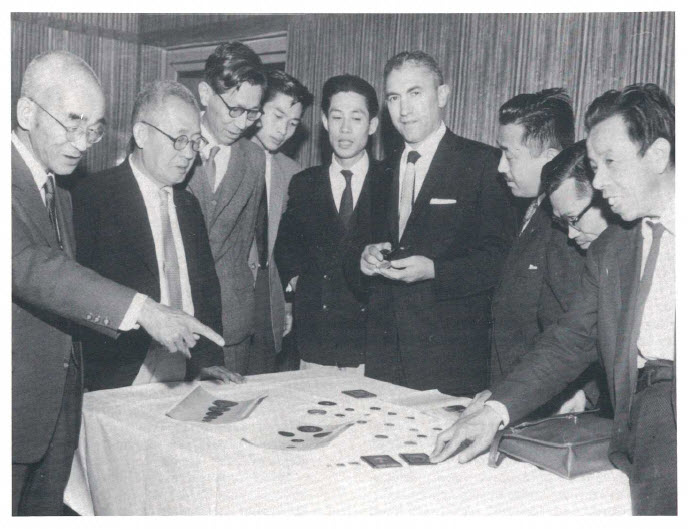
Abe Kosoff during a visit with Japanese numismatists in 1960.
From Tel Aviv, the next stop on the map was Istanbul, Turkey, a land rich in history and antiquities. At the time of Abe Kosoff's 1960 visit, the Turkish lira was officially pegged at nine to the American dollar. However, on the black market ne could buy as many as 165 lira per dollar. Turkish merchants were not permitted to take dollars, so they had to be paid in lira, obtainable only at the high official rates. Those buying lira n the black market were subjected to extreme penalties, which the Kosoffs decided not to investigate! Further rules stated that ancient coins and other antiquities could be sold only to Turks and not to those desiring to export them.
So, the Kosoff trio was in the position of "see but do not touch." The items observed were impressive: "The displays of gold in the form of modern coins of Turkey and as bracelets are fabulous. Store windows were piled high. Pyramids of gold bracelets by the hundreds and gold coins by the thousands are not unusual. In fact, such displays are characteristic of hundreds and hundreds of shop windows in the Covered Bazaar-a project of some 3,000 shops selling -jewelry, rugs, silverware, furniture, clothing, etc.
"It would be difficult to describe the antiques we saw, yes, including ancient coins. Suffice it to ay that the owners are obliged to deal within the country with people who will keep the items there. If it becomes possible to deal legitimately, I have feeling that Turkey could become the source of tarry numismatic gems."