Abe Kosoff: Dean of Numismatics
Q. David Bowers
The March 1962 issue of Kosoff's Coin Bulletin offered a large selection of gold coins, including numerous scarce and rare pieces. Among the Proofs were the following. Gold dollars: 1858 $1,000; 1859 $600; 1860 $500; 1861 $475; 1864 $850; 1866 $575; 1875 $1,750; 1877 $475; and 1889 $150.
Proof quarter eagles: 1858 $1,200; 1860 $600; 1861 $575; 1863 $4,000; 1864 $1,000 1876 $450; 1884 $700; 1889 $375; 1891 $350; 1896 through 1905 $325 each; 1911 $450; 1912 $450.
Proof $3 pieces: 1862 $1,000; 1863 $1,000; 1864 $1,100; 1873 $4,000; 1879 $1,200; 1886 $900; and 1888 $800.
Proof half eagles: 1858 $2,050; 1864 $1,300; 1877 $1,050; 1882 $450; 1891 $375; and 1898 $400.
Proof $10 eagles; 1864 $1,300, 1869 $1,150; 1872 $1,100; 1873 $1,600; 1891 $650; 1900 $550; and 1904 $550.
Proof double eagles: 1860 $3,250; 1865 $3,750; 1866 $3,750; 1869 $3,400; 1873 $4,000; 1879 $3,250; 1882 $3,600; 1887 $4,750; 1893 $3,250; 1901 $2,750.
Perhaps in response to the increased emphasis on investment, Abe Kosoff wrote: "You cannot invest more wisely than in numismatic books," a sentiment that was echoed by many of his colleagues, particularly the old-timers who were eager to spread knowledge and to have customers enjoy what they were buying.
Abe Kosoff was always willing to give advice and to help youngsters. During the preparation of the present book, the author received a letter from Reed Hawn, who by 1985 was firmly established as one of America's leading numismatic connoisseurs and the owner of a fine cabinet containing a 1913 Liberty Head nickel, an 1804 silver dollar and other rarities. The letter is self-explanatory:
"Dear Dave,
"Since you are doing a book about Abe Kosoff, I thought you might be interested in the enclosed letter copy. The coin in question is a goloid metric pattern dollar that I had acquired at some local coin show. I don't remember the actual circumstances, and at the time I didn't know what it was. So, I had my father-I was all of 12 years of age at the time-write to the premier authority on coins in the United States. Abe Kosoff's response was wonderful, because the coin was very heavily circulated and, back then, even a Proof goloid pattern dollar was worth very little. So, he took the time to help a 12 year old kid to get interested in collecting coins.
"Who was to know that the same kid would some day own an 1804 silver dollar and a 1913 Liberty Head nickel, have many friends in the business, as well as a company that buys and sells coins, and have a passion for numismatics! If Abe had treated me indifferently, as some dealers would have, I may never have gotten any further involved with coins.
"Reed Hawn."
Abe Kosoff's letter to Reed Hawn's father, dated December 5, 1962, reads as follows:
"Thank you for your inquiry of November 20th.
The coin of which you describe is undoubtedly a pattern, and we should have no difficulty in giving you the details if you would send the coin to me. Just enclose return postage, there will be no charge for our appraisal. If you care to sell the coin, we would be happy to make an offer subject to your acceptance."
In December 1962, nearly a year after the death of Lewis M. Reagan, the long-term secretary of the American Numismatic Association, Abe Kossoff and Sol Kaplan announced the establishment of the Lewis M. Reagan Memorial Fund. Reagan (1904-1962) served as general secretary of the ANA from 1944 until his death. This was in the era in which he literally carried his office in his suitcase the time before the headquarters in Colorado Springs had been built. Known as "Mr. ANA" b) collectors and dealers alike, Reagan often mad: on-the-spot decisions affecting ANA policy. Although the ANA occupied much of his extra time, his profession was being a professor at Kansas University.
The purpose of the Memorial Fund was to assist the ANA in the establishment and continuation of awards for exhibits and meritorious accomplishments and to encourage the publication of reference books. Concerning the latter, Kosoff noted:
"Frequently the numismatic world remains in the dark about worthwhile subjects simply because the expert who can write about it and often has already written about it cannot afford to publish his work. The fund will undertake to publish such works and make them available to collectors. Such a service cannot be valued in dollars and cents.'
In an era in which investment was increasingly dominating market news, Kosoff noted:
"True numismatic students are becoming the exception rather than the rule. If we are proud of our hobby we should strive to keep it on a high scientific pedestal. In order to do this, the Lewis M. Reagan Memorial Fund will provide scholar-ships for worthy young men and women to study numismatics."
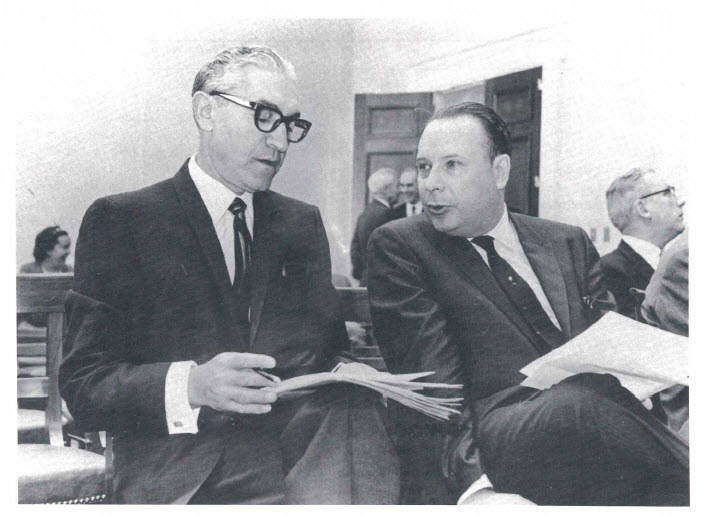
Abe Kosoff and Hans Schulman discuss counterfeit coins during a Congressional hearing which lead to the Hobby Protection Act.