Abe Kosoff: Dean of Numismatics
Q. David Bowers
Appearing on the market were bags of these three New Orleans dates. Prices plummeted, and before long bags of 1903-O dollars were available at $17 or so per coin, and 1898-O and 1904-O dollars were available for $2 each or less. Many other scarce dates turned up-some of them by the millions. At least three Uncirculated bags of the highly-prized 1889-CC made an appearance as did bags of 1895-S, 1896-S, 1903-S, 1904-S, and other delicacies. Much of this saga is related in Adventures With Rare Coins, a book written by Q. David Bowers and published in 1979.
Hundreds of millions of dollars spewed forth from Federal Reserve and bank vaults. Finally, when the stock was nearly depleted, the government analyzed the situation and discovered it had on hand approximately three million early dollars, of which over two million were highly-prized issues from Carson City. Some of these quantities were immense in proportion to the numbers originally minted. For example, of 1,133,000 1882-CC dollars originally struck, the government found itself holding 470,000 Uncirculated pieces! Of the 1883-CC and 1884-CC coins, pieces which had been originally struck to the extent of slightly more than one million coins for each issue, the government found that it had 599,000 and 675,000 specimens respectively! And, of the 1885-CC, a coin of which 228,000 were made, the government found it possessed about half the mintage, or 122,000 pieces.
What to do with the dollars? A number of proposals were advanced. Congressman Wright Patman, Chairman of the House Committee on Banking and Currency, introduced a bill, H.R. 13150, which authorized the sale of the Treasury dollars at face value to the American Cancer Society and the American Heart Association. The entire cost of moving the coins, protection and insurance could be borne by the purchasers. Both organizations had agreed in advance that the proceeds from the sales of the dollars would be used for research.
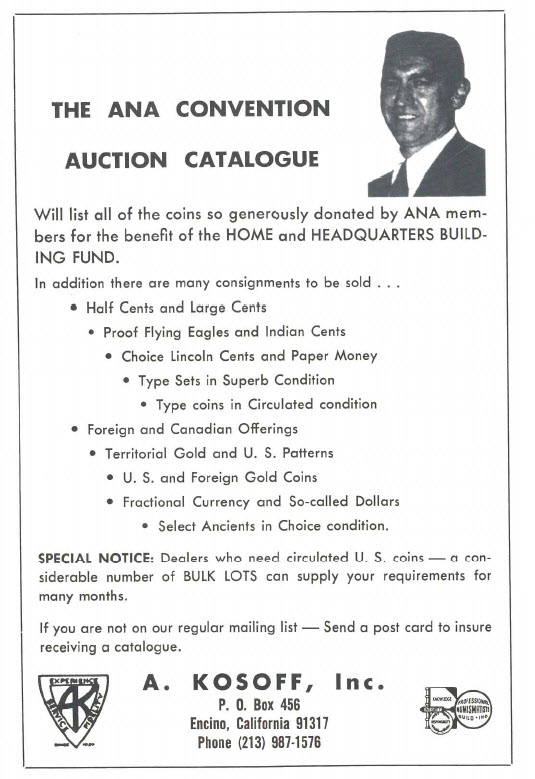
More than any other rare coin dealer of his era, Abe Kosoff helped with projects of the American Numismatic Association. This June 1966 advertisement in "The Numismatist" notes that many donations for the ANA home and Headquarters Building Fund will be featured in a forthcoming auction catalogue. ("The Numismatist," June 1966)
On April 22, 1966, Abe Kosoff received a letter naming him as chairman of a special advisory committee to the American Heart Association and the American Cancer Society. His services were enlisted to reassure numismatists everywhere that advice of the highest integrity and professional quality was being made available to these two health agencies concerning the coins for public sale and, equally important, to help evolve a plan for the orderly disposal of the pieces.
Opinions concerning the proposal were divided. Some figured that the sale to two national health agencies was an ideal solution, while others suggested that they be sold in bulk to a professional numismatic firm, and still others advocated a lottery or sale by the United States Mint, in the manner that yearly Proof sets and Uncirculated coins were sold. Some felt that as American citizens they were entitled to get the pieces for face value, while hers felt that the government or private agencies were entitled to a profit. Many expressed concern that the release be done in an orderly manner, so that the value of similar pieces in collectors' cabinets would be protected. Another proposal was for a National Silver Dollar Day to be proclaimed by President Lyndon Johnson to inaugurate the sale of the coins.
In what was probably one of the classic understatements of his career, Abe Kosoff, who as observing the situation, stated: "I don't suppose the three million silver dollars will ever be handled to everyone's satisfaction."
As it turned out, the initial proposals were scrapped, and the General Services Administration (GSA), a government agency associated with le purchase and resale of various federal properties, was enlisted for the task. Distribution was made through banks and by mail on an allotment basis. President Richard Nixon proclaimed them to be "a good investment," which provoked criticism, as some felt that the matter of invest lent in coins was not the government's area of expertise. Still others complained that people buying silver dollars were not allowed to return them for any reason, despite the fact that some coins were heavily nicked, gouged, or scratched. The sale was held in several stages over a period of me. Later, Abe Kosoff observed:
"The sale of the Carson City silver dollars has proved to be a very successful operation from the standpoint of the government. That there was a lot of waste was, perhaps, inevitable. So let us at least give the General Service Administration credit for not bungling the deal. The way coins were in demand in the 1970s, success was preordained, but government agencies are unpredictable, and someone could have botched the job. Some collectors received coins that they would have returned if the seller had been a professional numismatist. Many of the coins were scratched and undesirable, certainly not up to the quality the collector should have a right to expect. However, collectors were warned that this might happen and that there would be no right to return any coins.