Abe Kosoff: Dean of Numismatics
Q. David Bowers
In conclusion, Abe Kosoff submitted the following statement in conjunction with the appraisal report:
"There is no doubt in this appraiser's mind that the Lilly Collection of United States pioneer and territorial gold coins and ingots is the outstanding collection of its kind.
"There is one private collection of United States coins which is comparable to that section of the Lilly Collection. The Eliasberg Collection, in fact, includes the unique $3 gold piece of 1870 minted in San Francisco. This is, therefore, lacking in the Lilly Collection. However, the unique 1797 half eagle with the 16 star obverse and large eagle reverse is in the Lilly Collection and in no other.
"The Lilly Collection of pioneer and territorial gold coins and ingots is far superior to any other similar collection, and when it is added to the coinage of United States mints, the combination defies comparison.
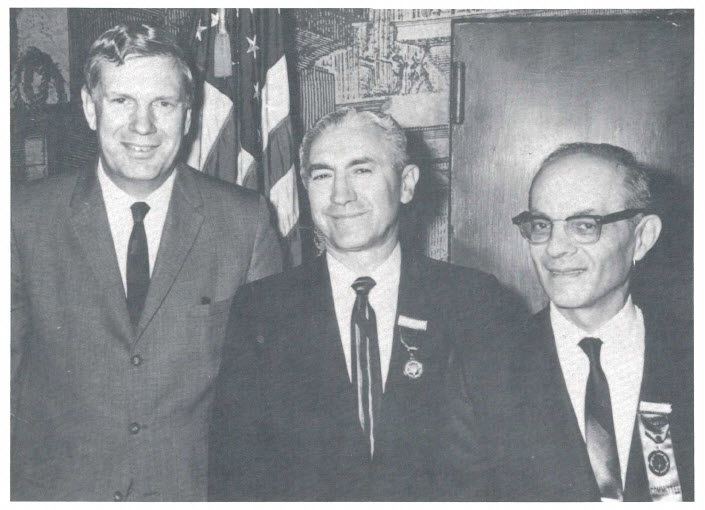
Taken at the Smithsonian Institution, this photograph shows Robert Wallace (assistant Secretary of the Treasury), Abe Kosoff, and Dr. Vladimir Clain-Stefanelli (curator of the United States Coin Collection at the Smithsonian)
"I have also examined the magnificent collection of foreign gold coins and, while I have not aade a study in depth of this section of the Lilly collection it, too, is obviously one of the finest of its kind.
"Taken as a whole, it is safe to say that the Lily Collection is foremost among the collections of its kind in the world. I cannot emphasize too strongly the importance and rarity of the pioneer and territorial ingots. In my experience of 38 years as a professional numismatist, I have never seen anything like it. This is the most important consideration which establishes rarity beyond question.
"In the world of the arts, it has been customary to consider the value of an outstanding collection to be in excess of the aggregate of the values of the individual items of which it is comprised. When the collection is so extraordinary that it may e called the finest of its kind then there is a further consideration increasing its value.
"While collectors are not expected to be reimbursed for the time they spent acquiring objects of art or paintings or coins, and most never realize my profit for the time beyond the enjoyment of their pursuits, still when, on the rare occasion, a collector succeeds in surmounting the obstacles leading to the assembling of the finest of its kind, then the exception is the rule. Then there is an added value. Be it twice or three times the aggregate value of the individual items, that must depend on a meeting of the minds between a buyer and seller.
"Nevertheless, in determining the appraisal value, I had been instructed to keep in mind that 'e were trying to find a fair sales price by a collector to a museum. I was told that rulings had been recorded involving similar situations that these rulings were submitted to me for my consideration.
"After a conference with the appraiser of the foreign collection, Hans Schulman and with you (Mr. Rawley) as well as with Mr. Rauch, I was impressed with the attempts to be conservative, and I reluctantly agreed to a 20 % premium. This the most conservative approach despite the high values placed on the unique pioneer and territorial coins and ingots.
"Much time and research was spent on this fabulous collection of pioneer and territorial gold coins and ingots. Among the ingots are 41 unique pieces, many of them heretofore unpublished. By contrast, the Smithsonian Institution has but two ingots. Inventories of the most famous and most complete collections known were studied and compared. There is no doubt that the Lilly Collection is the outstanding collection of its kind. The acquisition of the Lilly Collection by the Smithsonian Institution will put the United States Collection in the forefront as the finest numismatic collection in the world. The numismatist and the lay citizen will indeed take pride in this acquisition. I have never seen anything like the Lilly Collection in all my experience. I have also examined the collection of foreign gold coins and agree that this, too, is most extraordinary.
"I am certain that the members of this honorable congressional committee are concerned with the appraisal value. As a citizen, I would certainly hope so. An appraisal report has been prepared, but is much too lengthy to introduce here during the limited period of time allotted me.
"In the world of art, the value of an extraordinary collection is obtained by evaluating the individual items of which it is comprised, then adding to the total such additional values which, in the opinions of experts, should apply. When a collection is so extraordinary that it may be called the finest collection of its kind, then there is a further consideration increasing its value. Had this procedure been followed, the appraisal would have been on a much higher level.