Abe Kosoff: Dean of Numismatics
Q. David Bowers
Through 1969 the project gained momentum, additional donations were received, but things were still in the "thinking stage." By early 1970 about $20,000 had been raised. Although the American Numismatic Association had expressed support of the idea, it had not offered to sponsor it. Abe Kosoff wrote to Herbert M. Bergen, just prior to his installation as president of the American Numismatic Association, stating that the American Numismatic Authentication Trust was formed "because the responsibility, which I believe falls at the step of the American Numismatic Association, had not been recognized by that organization. The Trust really should not have been necessary. The Association should have taken steps to provide the necessary authentication service long ago. It seems incredible that millions of dollars changed hands for old coins, counterfeiting is an ever-growing menace, collectors and dealers are being fleeced-and no one does anything about it!
"Here is an organization of some 25,000 members, the strongest and wealthiest organization of its kind in the world -and it does nothing about it. Well, that nonsense has prevailed long enough! Some of us are getting a little impatient. It is time that the American Numismatic Association recognizes its responsibilities and takes the reins into its own hands."
Herbert Bergen agreed, and the vice-president of the ANA, John Jay Pittman, also concurred.
Eventually, the ANA did get behind the project, and the effort, renamed the American Numismatic Association Certification Service (ANACS), was set up in Washington, D.C. in order to be near the Smithsonian Institution and its reference collection displayed there. Charles Hoskins, a competent numismatist and administrator, was put in charge. Later, ANACS was moved to ANA headquarters in Colorado Springs.
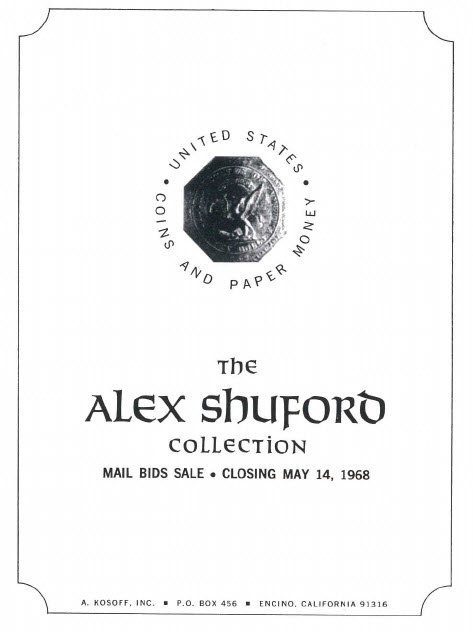
The collection of Alex Shuford, a North Carolina textile executive, formed the basis for an auction by mail bids which closed May 14, 1968. In the front of the sale was a note regarding grading:
"I have long admired the excellent book by Dr. William H. Sheldon on early American cents. One of the excellent features involved a scale for grading condition from 1 to 70. 70 is perfection, 65 is Mint State, 60 is Mint State (yes, one Uncirculated coin can certainly be more attractive than another). About Uncirculated is 55 or 50, etc. One cannot but agree that when a coin is described as Very Fine-20 and another is Very Fine-30, the comparative picture is better than if both were merely described as 'Very Fine' ... I hope you approve and that other cataloguers will follow suit." This and other early Abe Kosoff and Numismatic Enterprises catalogues represented some of the first widespread usage of the Sheldon system.
The Shuford Collection sale consisted of a comprehensive run of United States coins from cents through double eagles, plus commemoratives, paper money, and other items. Many of the coins had problems of one sort or another, as indicated in the catalogue, reflective of the growing difficulty of putting together a cabinet in which all coins were a combination of Choice Uncirculated and Choice Proof. The days of the World's Greatest Collection (F.C.C. Boyd), Louis Eliasberg, and other numismatic greats were long gone. Now, even the most advanced collectors had to be con-tent with a generous number of lesser-condition pieces in order to attain completion within a reasonable length of time.
During the preparation of the Alex Shuford Collection catalogue, Abe Kosoff was particularly enamored with the 1841 quarter eagle, which he suggested should be called the "Little Princess," as the 1804 dollar was already known as the "King of American coins," but that title was being challenged by the 1913 Liberty Head nicke1. The "Queen" of coins had never been decided. "Princess" seemed to be appropriate for the 1841 quarter eagle. Abe Kosoff then wrote:
"The 'Little Princess' is the rare 1841 quarter eagle. Peculiarly, I have been involved with 1841 $2.50 gold piece several times, so much so that I have probably earned commissions which would amount to even more than the current value of this rarity." He then recounted the example in the World's Greatest Collection sale, which went to J.F. Bell with Louis Eliasberg being the underbidder. The same coin appeared in 1948, and then a couple years later it showed up a third time. In 1950 he had still another piece, and subsequently, about 1957, a third example. Abe Kosoff then discussed the Shuford coin, another piece:
"The little gem I just held in my hands came out of the Wolfson Collection where I purchased it because I thought it was going too cheaply, $15,000. It did not last long. Nor did its new owner keep it for any length of time.
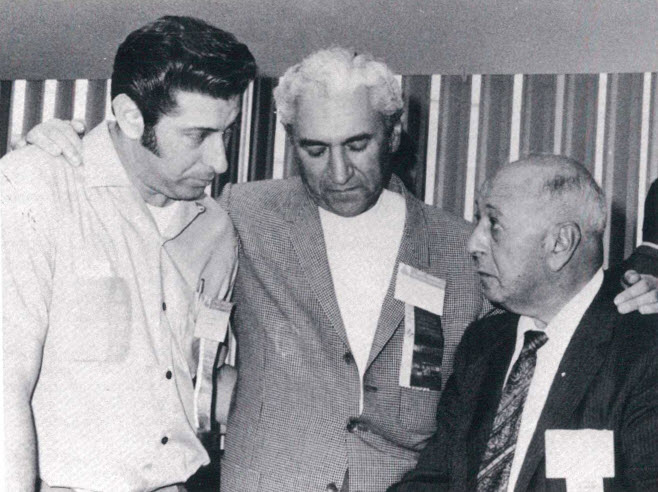
Mike Kliman, Abe Kosoff, and Max Schwartz huddle at the 1968 ANA convention.
Mike Kliman, Abe Kosoff, and Max Schwartz huddle at the 1968 ANA convention.