Abe Kosoff: Dean of Numismatics
Q. David Bowers
He further proposed that Proof coins, which had been sold to collectors at a premium, should be exempted from this demonitization.
Abe Kosoff's suggestions were to no avail. Silver coins continued to be withdrawn from circulation and soon all were selling at a premium. For a time there was a coin scarcity, which Eva Adams, director of the Mint, sought to alleviate by removing mintmarks on currently-issued coins, feeling the they would be less attractive to speculators. A it later turned out, by the time several years had elapsed, this situation had taken care of itself pieces were no longer widely hoarded, and enough clad-metal dimes, quarters, and half dollars has been made to replace the former silver pieces.
Abe Kosoff's schedule in the summer of 196 included PNG Day on August 24th at the Houston convention, followed by the ANA convention then to Hawaii October 7-10 for the Hawaii Numismatic Association convention, then back t Los Angeles October 14-17 for the PNG show Numismatic Enterprises and A. Kosoff, Inc. con ducted twin auctions, one for the Hawaii convention and another in Los Angeles the day before the PNG show.
On Wednesday, October 13, 1965 an offering, titled 'United States Gold Coins" crossed the block at the Statler-Hilton Hotel in Los Angeles. Abe Kosoff commented on the sale and on the market:
"We are delighted to be on the 'auction trail again with such an extraordinary offering 0 United States gold coins. Finally, after many of us wondered for years when United States gold coins and mintmarked issues would rise to the level of comparative rarities, the time has come when collectors are seeking out the dates needed for their collections. They now recognize that there were so many items struck in small numbers that the sooner these are acquired, the better. Actually, these are just getting 'off the ground floor' and should continue a steady upward trend. The sale had been planned for earlier scheduling but extracurricular activities prevented the execution, and we must apologize for the delay.
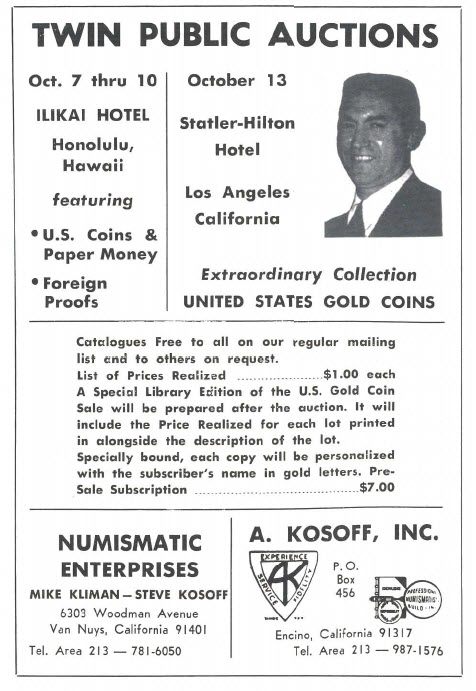
Twin public auctions were conducted in 1965 by Numismatic Enterprises and A. Kosoff, Inc., as advertised in the September issue of "The Numismatic Scrapbook Magazine."
'The present occasion, however, is fitting and we take the opportunity to schedule the auction so it will attract those who would attend the Hawaii Numismatic Association Convention in Honolulu October 7th through 10th or the Professional Numismatists Guild show in Los Angeles; October 14th through 17th. Many are taking in both shows and this sale-all within a 10-day span which includes two weekends. While you are in Honolulu, you may also attend an auction by Numismatic Enterprises which will offer United States paper money, United States and foreign coins, and Hawaiian tokens. Because of our keen interest in the success of both of the abovementioned shows and the writer's close and official contact with the Professional Numismatists Guild, may we point out that this auction sale is an enterprise of A. Kosoff, Inc., and full and complete responsibility rests solely with this company. No other member of the PNG is responsible in any way for any part of the sale."
The auction featured a listing in denomination and date order of gold coins from the dollar through the double eagle, plus a special appended section of Proof gold coins. In the latter category, an 1859 Proof gold dollar fetched $610, while Proof examples of 1860 brought $600, 1861 $500, 1866 $700, and 1889 $220 in the same denominations.
Among quarter eagles, an 1883 Proof fetched $1,075, while an 1886 brought $710 and a Matte Proof 1908 sold for $640. A Proof 1892 $5 realized $650, followed in the sale catalogue by a Proof 1907 of the same denomination at $625. An 1869 Proof $10 sold for $1,575, and a Proof 1892 $10 brought $1,200. There were seven Proof double eagles in the sale which brought the following prices: 1869 $2,400, 1888 $3,100, 1890 $2,600, 1892 $2,800, 1894 $2,800, 1898 $2,425, and 1907 $2,575.
By January 1966, the coin market had stumbled badly, and many collectors and dealers were licking their wounds. In the Numismatic Scrapbook Magazine issue of January 1966, Abe Kosoff commented on the market for the coming year:
"A lot will depend on how much of the gambling (so-called investment) and speculative element has been cleaned out. Much speculative money has been lost on rolls and sacks."