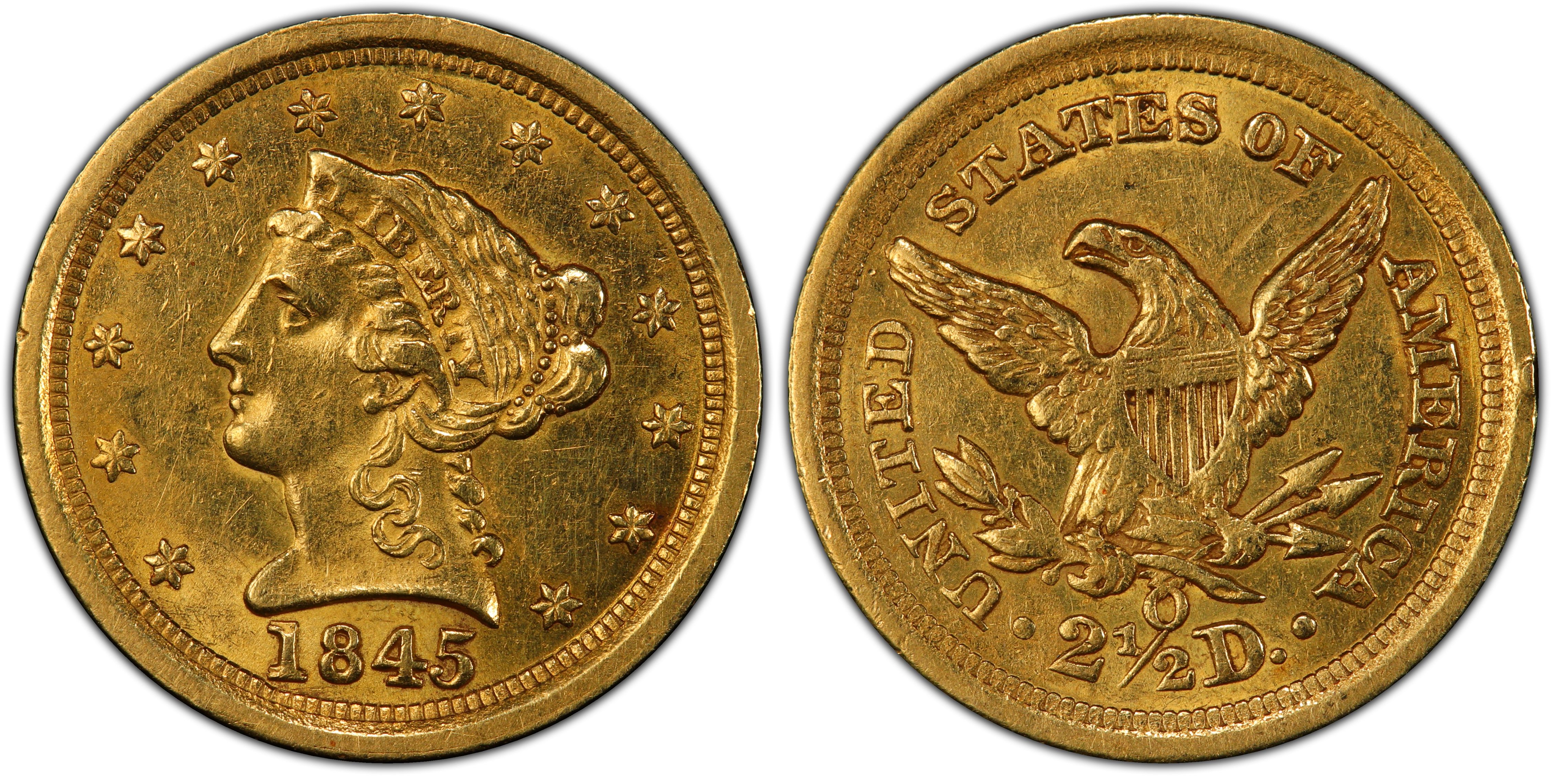
PCGS AU58
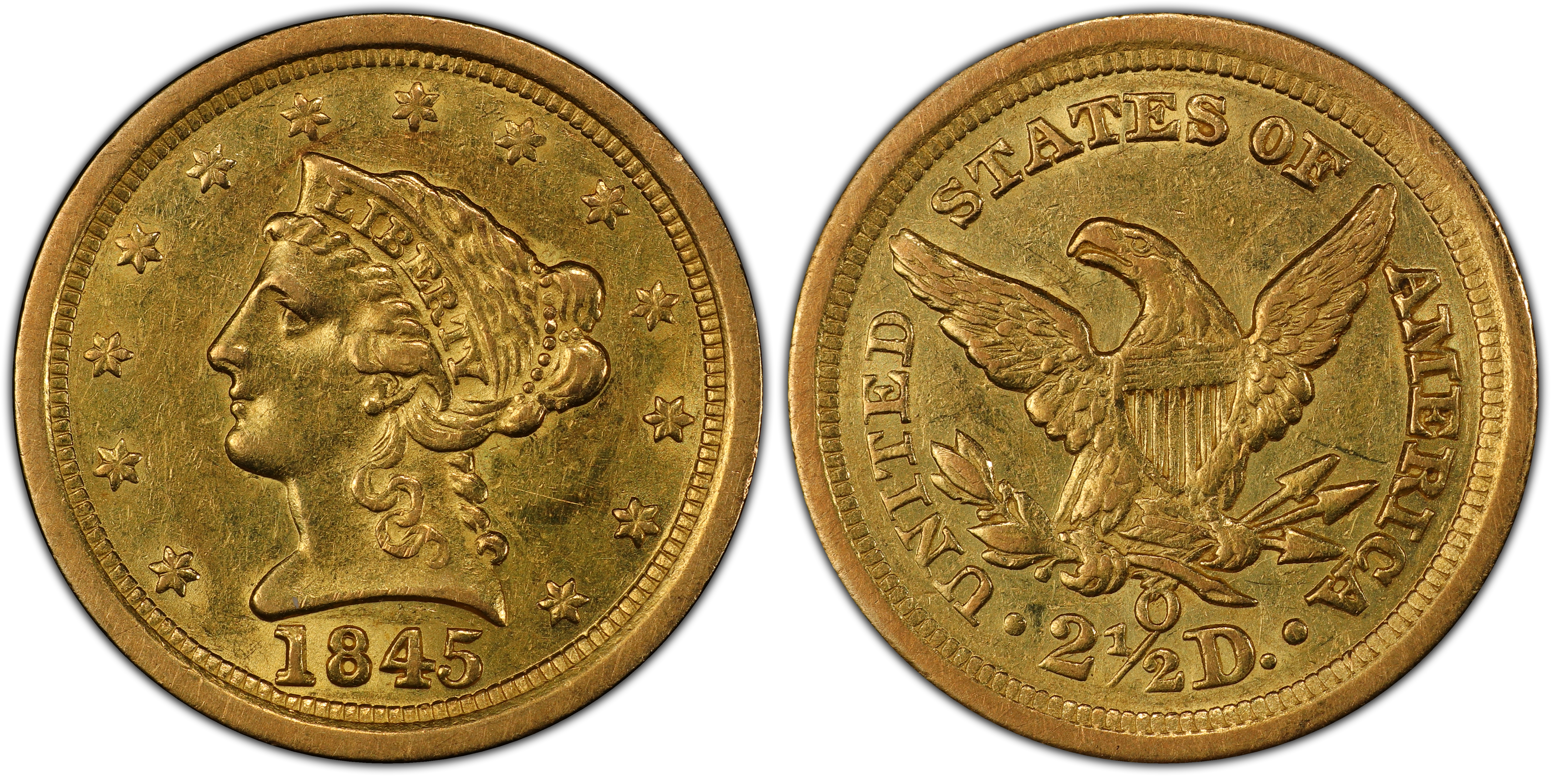
PCGS AU55
- PCGS #:
- 7739
- Designer:
- Christian Gobrecht
- Edge:
- Reeded
- Diameter:
- 18.00 millimeters
- Weight:
- 4.18 grams
- Mintage:
- 4,000
- Mint:
- New Orleans
- Metal:
- 90% Gold, 10% Copper
- Auction Record:
- $117,000 • MS63 • 03-31-2021 • Stack's Bowers
Major Varieties
- 1845-O $2.50
Rarity and Survival Estimates Learn More
| Survival Estimate | |
|---|---|
| All Grades | 75 |
| 60 or Better | 3 |
| 65 or Better | |
| Numismatic Rarity | |
|---|---|
| All Grades | R-8.2 |
| 60 or Better | R-9.8 |
| 65 or Better | R-10.1 |
| Relative Rarity By Type All Specs in this Type | |
|---|---|
| All Grades | 19 / 147 TIE |
| 60 or Better | 5 / 147 TIE |
| 65 or Better | 1 / 147 |
| Relative Rarity By Series All Specs in this Series | |
|---|---|
| All Grades | 19 / 147 TIE |
| 60 or Better | 5 / 147 TIE |
| 65 or Better | 1 / 147 |
Condition Census What Is This?
|
#1 PCGS MS63
J.C. Mitchelson; Mitchelson to Virgil Brand, by sale, March 1909 – $150; “The Virgil Brand Collection, Part I,” Bowers and Merena, October 1983, Lot 110 – $8,800; “The Bebee Collection, Part I,” Bowers and Merena, August 1987, Lot 538 – $14,300; Ronald W. Brown; “The Ronald W. Brown Acadiana Collection,” Heritage Auctions, August 1999, Lot 7836 – $57,500; Heritage Rare Coin Galleries and Douglas Winter Numismatics. PCGS MS63 #4727167: “The A.J. Vanderbilt Collection,” Stack’s Bowers, March 25, 2021, Lot 4140 – $117,000. |
|
#2 Est. MS62
As NGC MS62 #4837014-001. Don Bonser, CDHCD (Facebook Group), October 26, 2018 - Offered at $55,000. Described by Bonser as "a totally fresh coin to the market." |
|
#3 PCGS MS61
Bowers and Merena, June 1986, Lot 149 – $2,640. As “Uncirculated 60.” “Auction ’87,” Paramount, July 1987, Lot 386 – $6,875. As “Mint State 60.” “The Charles Kramer Collection,” Stack’s, December 1988, Lot 126 – $7,700; As PCGS AU50. Bowers and Merena, November 1990, Lot 477 – $8,800; Gary Verner Collection; As PCGS MS61 #22049198. Doug Winter / Spectrum Numismatics; Louisiana Collection; Heritage Auctions, February 3, 2012, Lot 4636 – $29,900. |
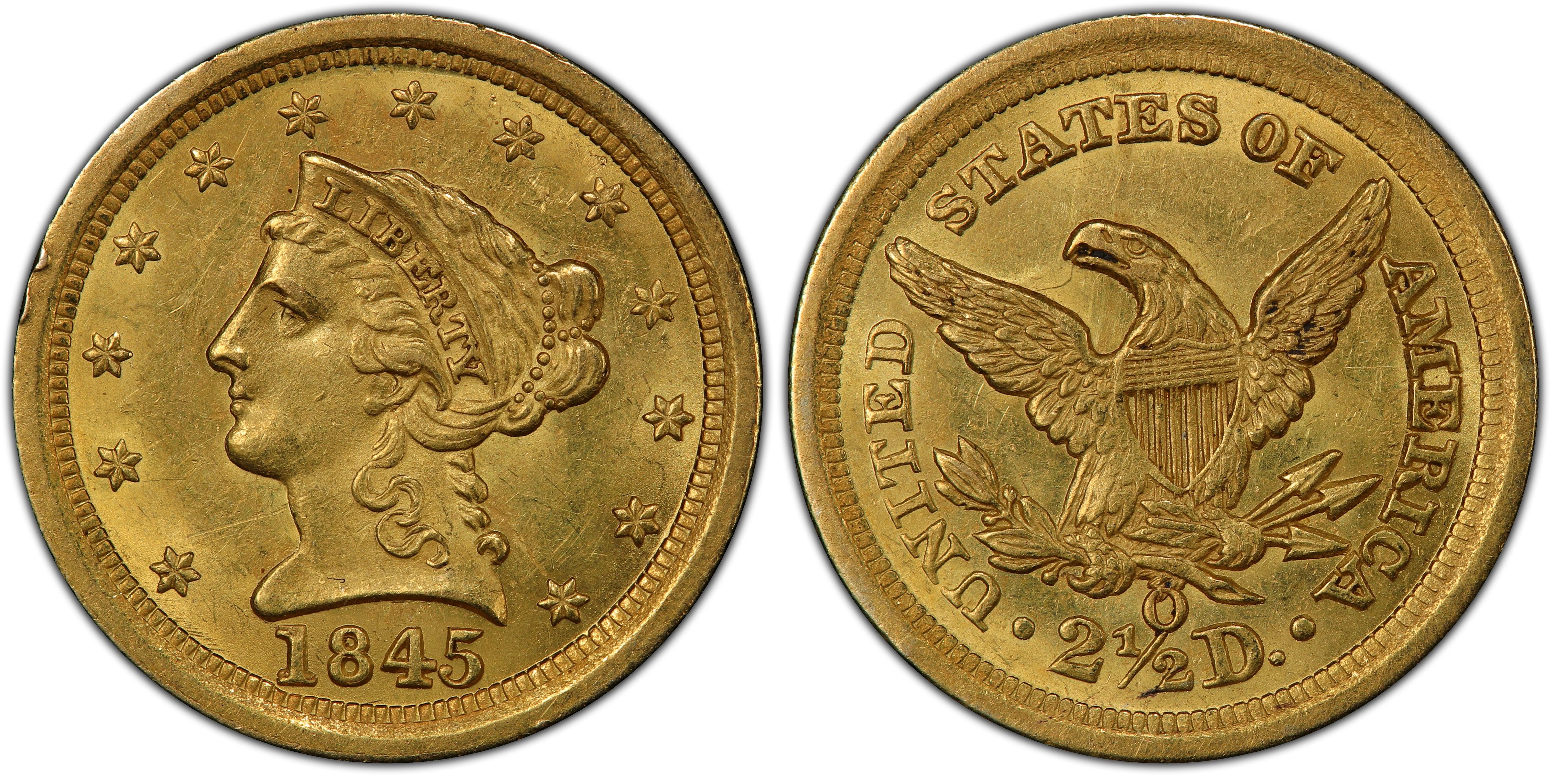 #3 PCGS MS61
Tiny carbon spot to the immediate left of the diadem. Two significant rim hits at 10 o’clock on the obverse. Dentincles weak at the top of the reverse. Clashed dies. |
|
#3 PCGS AU58
Stack’s Bowers, March 26, 2024, Lot 4238 – $15,600. Toned obverse. Small ticks below star 1. Tiny spot below star 4. Reverse denticles are better than average. |
|
#3 PCGS AU58
“The Twelve Oaks Collection,” Heritage Auctions, September 9, 2016, Lot 13952 – $21,737.50. "400 Esplanade" by Hinkle (PCGS Set Registry). Softness on the reverse. Two marks in the field above the eagle’s outstretched left wing. |
|
#3 PCGS AU58
|
| #3 PCGS AU58 |
| #3 PCGS AU58 |
The 1845-O is the rarest New Orleans-struck Liberty Head Quarter Eagle. It is as rare—or even rarer—than all but a handful of the Charlotte and Dahlonega quarter eagles of this era, yet it typically sells for considerably less.
The issue's entire mintage of 4,000 coins was struck using a single die pair and was not delivered until January 22, 1846, just two days before a shipment of 1846-O dies arrived from Philadelphia. Consequently, there was no record of the 1845-O Liberty Head Quarter Eagle in the 1845 Mint Director’s Annual Report.
“Discovery” and Market History
Curiously, the existence of the 1845-O went unnoticed by collectors until the late 19th century, when the issue was first published in the December 1894 issue of The Numismatist. In 1909, Virgil Brand purchased an example of this date from collector J.C. Mitchelson for $150 (a value exceeding $5,000 in today’s money). The Mitchelson-Brand coin remained off the market until 1987 and is now regarded as the finest known.
Texas dealer B. Max Mehl, often credited with its "discovery," was particularly fond of the coin and gave the 1845-O his full promotional treatment whenever it appeared in one of his auctions. Even as examples began trickling into the market starting in the 1950s, the 1845-O remains scarce in all grades and is the rarest New Orleans Quarter Eagle.
PCGS population data adds market clarity for the issue. It is estimated that between 80 and 100 are known, with the highest concentration of coins falling in the VF-XF grade range. To date, PCGS has certified only three examples in Mint State.
Varieties
Doug Winter identifies just one die marriage for the date.
Obverse: The date is large and heavily impressed. It is placed to the left, about midway between the truncation and the denticles. The "18" in the date shows repunching at its base; on later die states, this repunching may not be as evident on the "8."
Reverse: The mintmark is large and placed high in the field. The feathers touch the top of the mintmark. The numerator touches the middle of the mintmark at its base. There are a series of raised die scratches inside of the first star on the obverse and a diagonal bar on the face of Liberty that is visible only on higher grade coins. Some show a mint-made depression on the reverse from the "F" in "OF" down to the back of the eagle’s neck.
1845-O Liberty Head Quarter Eagle: Physical Characteristics.
According to Doug Winter...
The 1845-O generally exhibits average surface quality, with most known examples grading between Very Fine and Extra Fine.
- Strike: This is generally a reasonably well-struck issue. On the obverse, the hair has good detail, with the exception of the curls above the ear. The stars are sharp, with most showing full radial lines. The denticles tend to be softly impressed, and those located from 4:00 to 8:00 may not be fully distinct. The reverse is less well-detailed. The feathers on the legs and wingtips are often weak, and the denticles are sharper than those on the obverse, although the ones from 5:00 to 7:00 are sometimes weak.
- Surfaces: All 1845-O Liberty Head Quarter Eagles exhibit a diagonal depression (strike through) that runs from the area between the curls to the thirteenth star. In addition, nearly all known examples are heavily abraded, with many cleaned examples showing heavy hairlines. Premium examples are seldom encountered.
- Luster and Coloration: The handful of unimpaired examples that exist exhibit slightly Prooflike luster. The typical example will exhibit little luster due to wear or cleaning. Color typically ranges from coppery-orange to light orange-gold or green-gold.
* * *