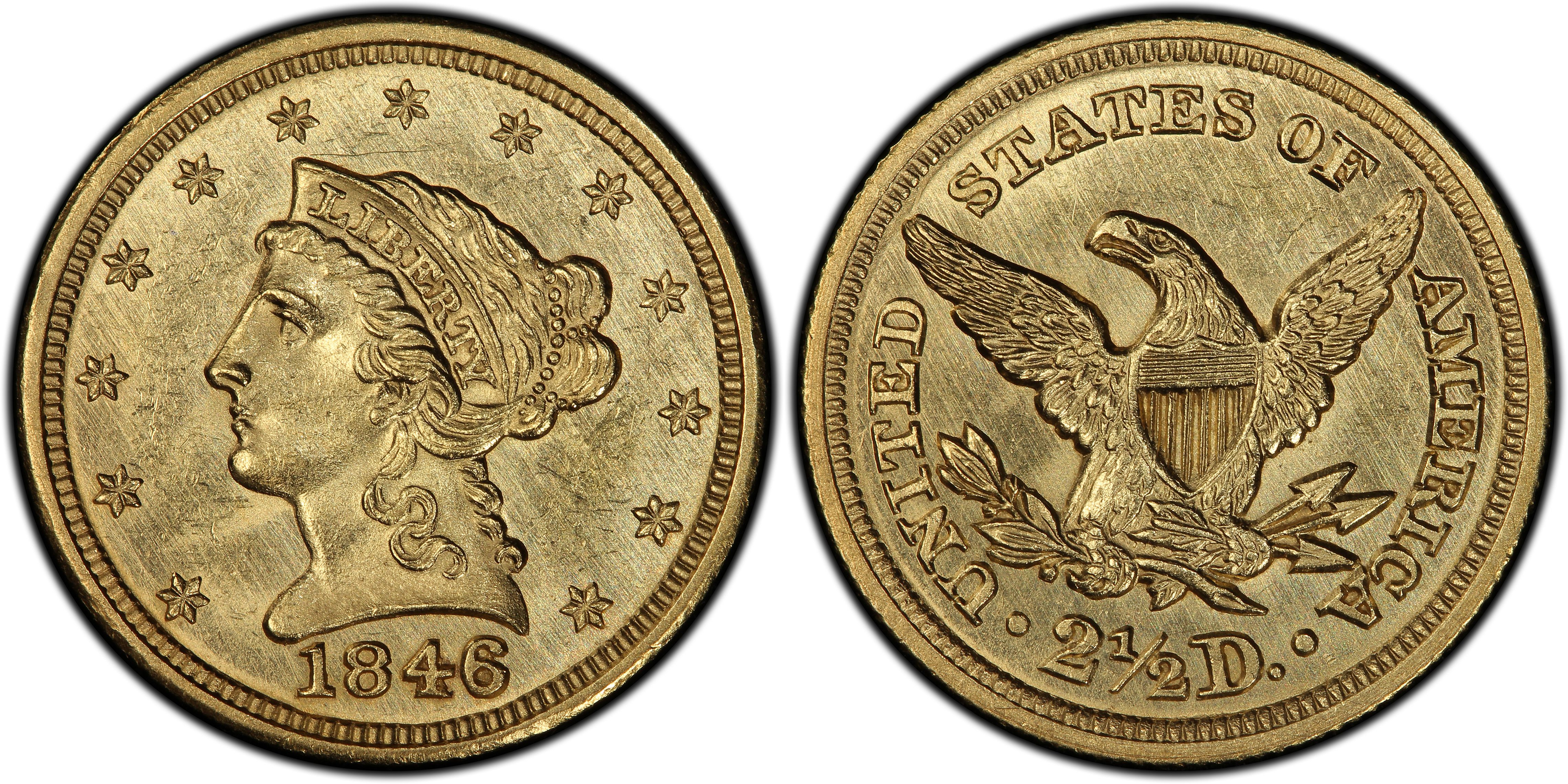
PCGS MS63

PCGS MS62
- PCGS #:
- 7740
- Designer:
- Christian Gobrecht
- Edge:
- Reeded
- Diameter:
- 18.00 millimeters
- Weight:
- 4.18 grams
- Mintage:
- 21,598
- Mint:
- Philadelphia
- Metal:
- 90% Gold, 10% Copper
- Auction Record:
- $36,425 • MS63 • 07-28-2022 • Legend Rare Coin Auctions
Major Varieties
- 1846 $2.50
Rarity and Survival Estimates Learn More
| Survival Estimate | |
|---|---|
| All Grades | 100 |
| 60 or Better | 6 |
| 65 or Better | |
| Numismatic Rarity | |
|---|---|
| All Grades | R-8.0 |
| 60 or Better | R-9.7 |
| 65 or Better | R-10.1 |
| Relative Rarity By Type All Specs in this Type | |
|---|---|
| All Grades | 32 / 147 TIE |
| 60 or Better | 27 / 147 TIE |
| 65 or Better | 1 / 147 |
| Relative Rarity By Series All Specs in this Series | |
|---|---|
| All Grades | 32 / 147 TIE |
| 60 or Better | 27 / 147 TIE |
| 65 or Better | 1 / 147 |
Condition Census What Is This?
 #1 PCGS MS63
Legend Rare Coin Auctions, July 28, 2022, Lot 361 - $36,425. Tick over eyebrow. Tick on rim at 6 o'clock. |
|
#1 PCGS MS63
As PCGS MS62 #13668899. Heritage, March 29, 2009, Lot 2608 - $10,925; Heritage Auctions, March 26, 2010, Lot 2079 - $10,925. As PCGS MS63 #25345466. Heritage, April 23, 2014, Lot 5692 - $18,800; Heritage, December 4, 2014, Lot 3722 - $17,037.50. The second MS63 certified by PCGS. Diagonal die line across the cheek. Tick above. Tick between 4 and 6. Planchet disturbance to the left of the forehead. Semi-Prooflike. |
|
#1 PCGS MS63
Mid-American, May 1987, Lot 1068 - $2,750; Heritage, September 19, 2003, Lot 7709 - $21,850. Top pop, pop one when offered in 2003. 7-shaped scratch between stars 3 and 4. Tick on chin. Reddish toning. |
|
#4 PCGS MS62
Heritage, June 3, 2011, Lot 4483 - $10,350; "The Prospect II Collection," Heritage, May 2, 2025, Lot 4069 - $13,200. Small curve tick touching the bottom right of star 3. Thin diagonal marks from the eagle's right wing to each T in STATES. |
|
#4 PCGS MS62
Stack's Bowers, August 25, 2021, Lot 4172 - $11,400. Shallow dimple on cheek to the left of the ear. Small tick near the lower right tip of star 5. Tick in bottom right obverse field under bun. Cluster of hits around eagle’s head. Diagonal hairline mark from A to beak. |
|
#4 PCGS MS62
Stack's Bowers, November 2013, Lot 3520 - $9,400. Tick on cheek. Diagonal tick between 4 and 6. Tick between stars 10 and 11. |
| #4 PCGS MS62 |
Demand for quarter eagles was down sharply in 1846 and production was more-or-less evenly split between Philadelphia and Dahlonega. Despite this production parity, far more Philadelphia pieces survive than branch mint issues and in Mint State the 1846 is only slightly more available than the 1846-D Liberty Head Quarter Eagle (#7746).
PCGS Market Insights
Numismatic expert David Akers once noted that the 1846 Liberty Head Quarter Eagle is "a very scarce and generally underappreciated date." This assessment remains accurate today, as evidenced by its small population. The PCGS population report lists just over 100 grading events, with the majority falling in the XF (Extremely Fine) to AU (About Uncirculated) range. Only fifteen examples are reported in Mint State, with none grading finer than MS63.
Recoveries from Famous Shipwrecks
The scarcity of this coin is juxtaposed by its connection to two of the most famous shipwrecks in American history, illustrating how some of these low-mintage coins were distributed and ultimately preserved:
The SS Central America: The "Ship of Gold"
At least one example of the 1846 Quarter Eagle was recovered from the most recent salvage operation of the SS Central America shipwreck. Known as the "Ship of Gold," the steamer is one of the most famous maritime disasters in U.S. history due to the immense treasure it carried from the California Gold Rush.
The ship regularly transported gold bullion and passengers on the Atlantic portion of the Panama-to-East-Coast route. On September 12, 1857, it was caught in a Category 2 hurricane off the coast of the Carolinas, sinking in 100-mile-per-hour winds. The sinking took with it approximately 21 tons of gold, valued at about $8 million at the time. Much of this treasure was in the form of newly-minted Liberty Head Double Eagles and gold bars. The considerable financial impact of the sinking contributed to the Panic of 1857.
The coin PCGS certified is graded VF35 and was placed in a special holder along with a pinch of gold.
The SS New York
Another example of the 1846 Quarter Eagle was recovered from the wreckage of the SS New York. This steamer was lost on September 6, 1846, when it sank during a hurricane while en route to New Orleans from Galveston. Seventeen people perished in the tragedy.The wreckage was discovered in 1990, and following lengthy legal proceedings, the site was finally salvaged in 2007. While the majority of the recovered coins were silver, the effort also yielded hundreds of gold pieces from the Charlotte, Dahlonega, and New Orleans Mints.
At least one example was recovered from the SS New York, shipwreck. The steamer was lost on September 6, 1846, in a hurricane en route to New Orleans from Galveston. Seventeen onboard perished in the tragedy. The wreckage was discovered in 1990 and after lengthy legal proceedings, the site was salvaged in 2007. While most of the coins recovered were silver, hundreds of gold pieces from Charlotte, Dahlonega, and New Orleans were also found.
* * *