
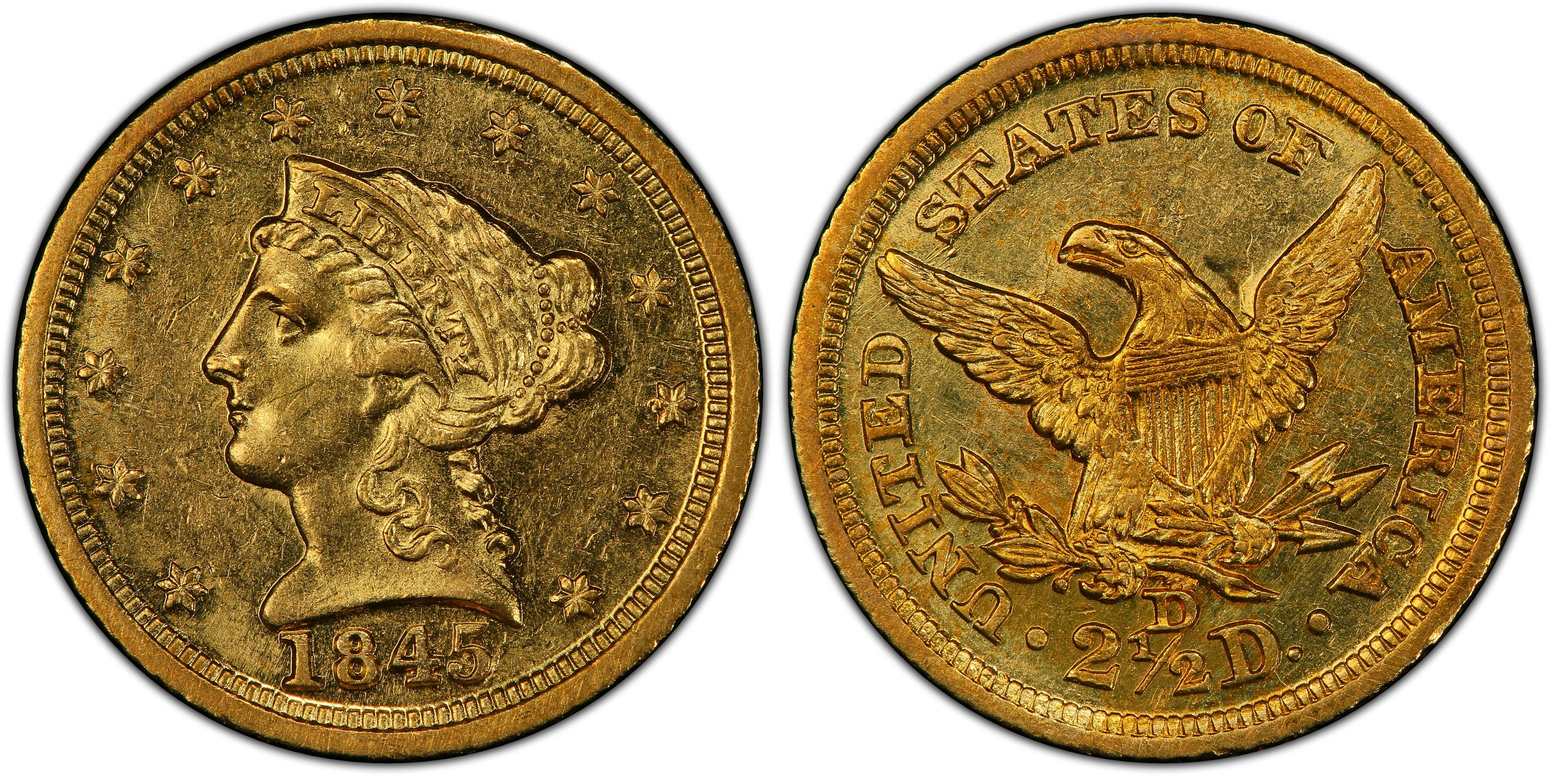
PCGS AU58+

PCGS AU58
- PCGS #:
- 7738
- Designer:
- Christian Gobrecht
- Edge:
- Reeded
- Diameter:
- 18.00 millimeters
- Weight:
- 4.18 grams
- Mintage:
- 19,460
- Mint:
- Dahlonega
- Metal:
- 90% Gold, 10% Copper
- Auction Record:
- $63,250 • MS64 • 07-27-2008 • Stack's
Major Varieties
- 1845-D $2.50
Rarity and Survival Estimates Learn More
| Survival Estimate | |
|---|---|
| All Grades | 200 |
| 60 or Better | 7 |
| 65 or Better | |
| Numismatic Rarity | |
|---|---|
| All Grades | R-7.0 |
| 60 or Better | R-9.6 |
| 65 or Better | R-10.1 |
| Relative Rarity By Type All Specs in this Type | |
|---|---|
| All Grades | 74 / 147 TIE |
| 60 or Better | 43 / 147 TIE |
| 65 or Better | 1 / 147 |
| Relative Rarity By Series All Specs in this Series | |
|---|---|
| All Grades | 74 / 147 TIE |
| 60 or Better | 43 / 147 TIE |
| 65 or Better | 1 / 147 |
Condition Census What Is This?
|
#1 PCGS MS64
As NGC MS64. S.S. New York shipwreck recovery; Stack’s July 2008, Lot 2015 - $63,250. As PCGS MS64 #16935143 "The Cuyahoga Collection of Charlotte and Dahlonega Mint Gold," Bowers & Merena, February 2010, Lot 3600 - $63,250; Stack's Bowers, November 2011, Lot 9227 - $54,625. Die clash image on the reverse. Tick below the eagle's left wing. Tick on D of UNITED. |
| #2 PCGS MS63 |
|
#2 Est. MS63
Superior, August 1975, Lot 1361; "The Harry W. Bass, Jr. Collection, Part II," Bowers and Merena, Lot 376; Hancock and Harwell. As NGC MS63. "The Duke's Creek Collection of Dahlonega Gold," Heritage Auctions, April 2006, Lot 1501; "The Grand Lake Collection," February 6, 2009, Lot 2465 - $23,000; Heritage Auctions, January 9, 2014, Lot 5360 - $35,250; "The Georgia Peach Collection," August 2015, Lot 10184; "The Magnolia Collection," Stack's Bowers, August 3, 2017 - $36,425. Small ticks to the right of star 1. Thin tick to the right of the gap between stars 2 and 3. Thin scrape above D. and the right interpunct. At the time this coin was offered, Doug Winter had the piece at #2 in his condition census. |
|
#3 PCGS MS62
Stack's, December 1972, Lot 304; Dr. Phillip Weinstein; Superior, January 1989, Lot 304; Wynn Carner; Doug Winter to private collector, July 1999. As PCGS MS62 #21026472. "The Green Pond Collection," Heritage Auctions, January 7, 2004, Lot 1021 - $19,550. As PCGS MS62 #50152402. Heritage Auctions, April 24, 2014, Lot 5691 - $27,025. Series of hits along the front of Liberty's neck. Two ticks below eagle's right wing. |
|
#3 PCGS MS62
"The Chestatee Collection," Heritage Auctions, August 13, 1999, Lot 7643 - $12,6450. |
|
#6 PCGS MS61
As PCGS MS61 #13516129. March 29, 2009, Lot 2607 - $8,625. As PCGS MS61 #14752959. Heritage Auctions, August 1, 2009, Lot 2357 - $8,912.50; Bowers and Merena, January 4, 2011, Lot 1336 - $10,062.50. Two rim hits in the field to the left of Liberty's chin. Rim hits between stars 6 and 7. Thin ticks between stars 9 and 10. Diagonal scrape across nose and cheek. Clash image on the reverse.
|
 #6 PCGS MS61
Bowers and Merena, August 7, 2010, Lot 1479 - $8,625; Bowers and Merena, November 4, 2010, Lot 4820 - $9,487.50; Heritage Auctions, November 1, 2016, Lot 5448 - $9,987.50. Two diagonal ticks between stars 6 and 7. Dimple on jaw. Two touching diagonal scratches in left obverse field to the right of Liberty's eye. Thin diagonal tick on Liberty's cheek. Diagonal scratch along the back of the bust truncation. |
|
#6 PCGS MS61
Heritage Auctions, January 6, 2012, Lot 6110 - $9,775. Tick at the left edge of the coronet. Small diagonal tick on liberty's chin. Diagonal ticks above the eagle's left and right wing. |
| #6 PCGS MS61 |
| #6 PCGS MS61 |
The 1845-D quarter eagle is usually seen in Very Fine and Extremely Fine grades. It is very scarce in About Uncirculated and it becomes rare in strictly graded About Uncirculated-55. This date is very rare in properly graded About Uncirculated-58 and it is extremely rare in Uncirculated.
STRIKE: This date generally shows an average quality strike for a Dahlonega quarter eagle produced during the 1840’s. On the obverse, the curls near the ear and eye of the Liberty are mostly full, though they show some weakness. The border is sharp with many of the stars displaying full radial lines. The milling is completely defined with no weakness. The reverse is a bit less well struck. The eagle’s neck and right leg are nearly always weak as are the top of the shield and the base of the claws. The border is sharp and the milling is full.
SURFACES: The 1845-D quarter eagle is often found with noticeable marks on the surfaces. These are usually very detracting. Interestingly, most of the higher grade examples of this date I have seen have very obvious marks which significantly reduce their eye appeal (and subsequent value).
LUSTER: The luster on high grade examples is slightly subdued and it shows a somewhat grainy texture. It is not as good as that seen on the 1843-D or 1844-D quarter eagles.
COLORATION: Uncleaned, original 1845-D quarter eagles have light to medium green-gold coloration. This is among the hardest issues from the 1840’s to locate with original color. This was even true before the current mania for bright and shiny branch mint gold coins began in the 1990’s.
EYE APPEAL: Most 1845-D quarter eagles show poor eye appeal. This is primarily due to the fact that so many have serious marks and subdued luster. Locating a high grade example with good eye appeal is extremely difficult.
DIE VARIETIES: Only one die variety is known.
Variety 6-I: On the obverse, the 18 in the date shows light repunching. The 1 is very close to the bust and the denticles while the 5 is equally spaced between the bust and the denticles. The reverse is the same as described for 1844 Variety 5-H.
The Dahlonega Mint struck 19,460 Liberty Head Quarter Eagles in 1845. This was a decent mintage for the North Georgia facility, but it paled in comparison to the 91,051 pieces struck at Philadelphia. Of the two branch mint $2.50 gold coins produced this year, the 1845-D is often overshadowed by the much scarcer 1845-O issue (#7739). Nevertheless, the 1845-D is a tough date overall but remains a logical choice for collectors assembling a set of Liberty Head Quarter Eagles that includes one coin from each mint. Two naked-eye visible varieties are noted by Doug Winter. The more common one, Winter 12-I, exhibits a left shift of the date. A survey of known examples reveals that many were struck with clashed dies and die scratches underneath the tip of the eagle’s right wing. Die Rust visible between date and star 1. Often found with a pronounced clash image on reverse.
Only One Die Variety Known
Only one die variety is currently known (Variety 6-I).
On the obverse, the "18" in the date shows light repunching. The 1 is very close to the bust and the denticles, while the 5 is equally spaced between the bust and the denticles. The reverse is the same as the one described for 1844 Variety 5-H.
Survival Estimates
Market clarity for the 1845-D Liberty Head Quarter Eagle has improved considerably since David Akers published his narrative in the landmark United States Gold Coins, An Analysis of Auction Records, Volume I (1975). At that time, Akers estimated a surviving population of just 64 pieces and noted that the date was rare above Extra Fine. Today, more than 200 examples are recorded in the PCGS Population Report. Even allowing for duplicate submissions, the extant population of 1845-D Quarter Eagles likely falls short of 350 pieces, with an estimated 250 to 300 examples that would grade out. The PCGS Condition Census tops out at MS64, which is consistent with most 1840s issues. The finest known example, recovered from the wreck of the S.S. New York, last sold at auction in 2011 for $54,625. We wrote more about that fateful shipwreck in our narrative of the 1846 Liberty Head Quarter Eagle (#7740).
1845-D Liberty Head Quarter Eagle: Physical Characteristics
This date generally exhibits an average quality strike for a Dahlonega quarter eagle produced during the 1840s. On the obverse, the curls near Liberty's ear and eye are mostly full, though they show some minor weakness. The border is sharp, with many of the stars displaying full radial lines. The milling (edge reeding) is completely defined with no weakness. The reverse is typically less well struck. The eagle's neck and right leg are nearly always weak, as are the top of the shield and the base of the claws. Despite the weakness in the central motifs, the reverse border is sharp, and the milling is full.
Surfaces and Luster
Surfaces: The 1845-D quarter eagle is often found with noticeable, detracting marks on the surfaces. Interestingly, most of the higher-grade examples I have encountered bear obvious marks that significantly reduce both their eye appeal and subsequent value.
Luster: The luster on high-grade examples is slightly subdued and exhibits a somewhat grainy texture. It is generally not as attractive as the luster found on the 1843-D or 1844-D quarter eagles.
Coloration and Eye Appeal
Coloration: Uncleaned, original 1845-D quarter eagles display light to medium green-gold coloration. This is among the hardest issues from the 1840s to locate with original color, a difficulty that existed even before the current widespread practice of dipping branch mint gold coins began in the 1990s.
Eye Appeal: Most 1845-D quarter eagles show poor eye appeal. This is primarily due to the combination of severe marks and subdued luster. Locating a high-grade example with good eye appeal is extremely difficult.
* * *
The Dahlonega Mint struck 19,460 Liberty Head Quarter Eagles in 1845. This was a decent mintage for the North Georgia facility, but it paled in comparison to the 91,051 pieces struck at Philadelphia. Of the two branch mint $2.50 gold coins produced this year, the 1845-D is often overshadowed by the much scarcer 1845-O issue (#7739). Nevertheless, the 1845-D is a tough date overall but remains a logical choice for collectors assembling a set of Liberty Head Quarter Eagles that includes one coin from each mint. Two naked-eye visible varieties are noted by Doug Winter. The more common one, Winter 12-I, exhibits a left shift of the date. A survey of known examples reveals that many were struck with clashed dies and die scratches underneath the tip of the eagle’s right wing. Die Rust visible between date and star 1. Often found with a pronounced clash image on reverse.
Only One Die Variety Known
Only one die variety is currently known (Variety 6-I).
On the obverse, the "18" in the date shows light repunching. The 1 is very close to the bust and the denticles, while the 5 is equally spaced between the bust and the denticles. The reverse is the same as the one described for 1844 Variety 5-H.
Survival Estimates
Market clarity for the 1845-D Liberty Head Quarter Eagle has improved considerably since David Akers published his narrative in the landmark United States Gold Coins, An Analysis of Auction Records, Volume I (1975). At that time, Akers estimated a surviving population of just 64 pieces and noted that the date was rare above Extra Fine. Today, more than 200 examples are recorded in the PCGS Population Report. Even allowing for duplicate submissions, the extant population of 1845-D Quarter Eagles likely falls short of 350 pieces, with an estimated 250 to 300 examples that would grade out. The PCGS Condition Census tops out at MS64, which is consistent with most 1840s issues. The finest known example, recovered from the wreck of the S.S. New York, last sold at auction in 2011 for $54,625. We wrote more about that fateful shipwreck in our narrative of the 1846 Liberty Head Quarter Eagle (#7740).
1845-D Liberty Head Quarter Eagle: Physical Characteristics
This date generally exhibits an average quality strike for a Dahlonega quarter eagle produced during the 1840s. On the obverse, the curls near Liberty's ear and eye are mostly full, though they show some minor weakness. The border is sharp, with many of the stars displaying full radial lines. The milling (edge reeding) is completely defined with no weakness. The reverse is typically less well struck. The eagle's neck and right leg are nearly always weak, as are the top of the shield and the base of the claws. Despite the weakness in the central motifs, the reverse border is sharp, and the milling is full.
Surfaces and Luster
Surfaces: The 1845-D quarter eagle is often found with noticeable, detracting marks on the surfaces. Interestingly, most of the higher-grade examples I have encountered bear obvious marks that significantly reduce both their eye appeal and subsequent value.
Luster: The luster on high-grade examples is slightly subdued and exhibits a somewhat grainy texture. It is generally not as attractive as the luster found on the 1843-D or 1844-D quarter eagles.
Coloration and Eye Appeal
Coloration: Uncleaned, original 1845-D quarter eagles display light to medium green-gold coloration. This is among the hardest issues from the 1840s to locate with original color, a difficulty that existed even before the current widespread practice of dipping branch mint gold coins began in the 1990s.
Eye Appeal: Most 1845-D quarter eagles show poor eye appeal. This is primarily due to the combination of severe marks and subdued luster. Locating a high-grade example with good eye appeal is extremely difficult.
* * *