- PCGS #:
- 9195
- Designer:
- Augustus Saint Gaudens
- Edge:
- Lettered
- Diameter:
- 34.00 millimeters
- Weight:
- 33.40 grams
- Mintage:
- 445,500
- Mint:
- Philadelphia
- Metal:
- 90% Gold, 10% Copper
- Auction Record:
- $18,872,250 • MS65 • 06-08-2021 • Sotheby's
Major Varieties
- 1933 $20
Rarity and Survival Estimates Learn More
| Survival Estimate | |
|---|---|
| All Grades | 16 |
| 60 or Better | 16 |
| 65 or Better | 6 |
| Numismatic Rarity | |
|---|---|
| All Grades | R-9.3 |
| 60 or Better | R-9.3 |
| 65 or Better | R-9.7 |
| Relative Rarity By Type All Specs in this Type | |
|---|---|
| All Grades | 1 / 49 |
| 60 or Better | 1 / 49 TIE |
| 65 or Better | 2 / 49 TIE |
| Relative Rarity By Series All Specs in this Series | |
|---|---|
| All Grades | 1 / 54 |
| 60 or Better | 1 / 54 TIE |
| 65 or Better | 2 / 54 TIE |
Condition Census What Is This?
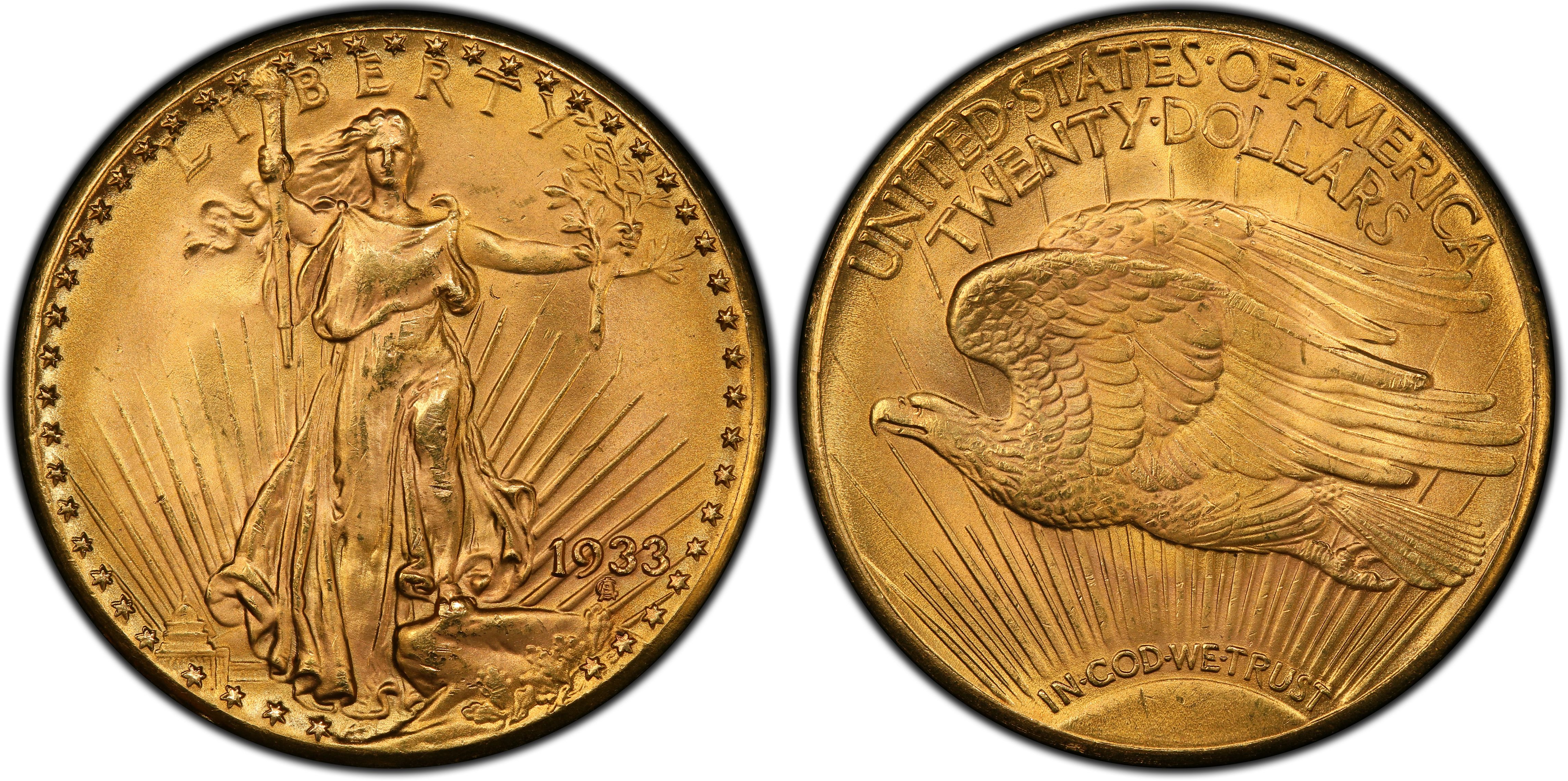 #1 PCGS MS65
United States Mint; George McCann to Israel Switt, February 1937; James G. Macallister, July 1, 1937 - $500; B.L. Taylor, July 1937; Max Berenstein; R.H. Smith; Ira S. Reed, 1941; J.F. Bell (Jake Shapiro), 1942; B. Max Mehl, February 23, 1944; Mehl to King Farouk of Egypt, February 23, 1944 - $1,575; Republic of Egypt, July 23, 1952 (via military coup); "The Palace Collection of Egypt," Sotheby's, February 24, 1954, Part of Lot 185 - Withdrawn; Unknown intermediary (likely an Egyptian national); Stephen Fenton (via Andre de Clermont), October 3, 1995 - $210,000; United States Mint (by seizure), January 25, 2001; Sotheby's / Stack's, July 30, 2002 - $7,590,000 (Plus $20 monetization fee); Stuart Weitzman. As PCGS MS65. "Three Treasures - Collected by Stuart Weitzman," Sotheyb's, June 8, 2021, Lot 1 - $18,872,250. As PCGS MS65 #42095232. The Elite Collection (PCGS Set Registry). The only example legal to own. |
|
#2 Gem Uncirculated
National Numismatic Collection - Smithsonian Institution |
|
#3 Choice Uncirculated
National Numismatic Collection - Smithsonian Institution |
|
#4 Uncirculated
Known specimens 4-14. Seized by the government and held at Fort Knox as "Heritage Assets." |
The 1933 Saint-Gaudens Double Eagle stands as one of the most storied and notorious artifacts in American numismatics. The Philadelphia Mint struck 445,500 examples, but the issue was never legally monetized. Following an Executive Order from President Franklin Roosevelt, the entire mintage was ordered to be melted down. Nearly all were, but an uncertain number of examples survived and were smuggled out of the mint, becoming instant rarities and illegal tender that sparked one of the longest-running legal battles in U.S. history. Only a single specimen was ever legally monetized and made lawful to own. That sole survivor holds the record as the most valuable coin ever sold.
The Saint-Gaudens Masterpiece: The Birth of a Design
The Double Eagle's spectacular design is the work of world-renowned American sculptor Augustus Saint-Gaudens. His involvement was the result of a personal crusade by President Theodore Roosevelt to revitalize American coinage, making it rival the artistry of ancient Greece.
Roosevelt's "Pet Crime," as he called the project, began in January 1905 when the President, leveraging his persuasive power, secured a commitment from the often-cantankerous Saint-Gaudens. Despite the artist's serious distaste for the bureaucracy of the United States Mint and its Chief Engraver, Charles Barber, and the grim reality of his own declining health (he had been secretly diagnosed with rectal cancer), the collaboration flourished. Roosevelt's enthusiastic correspondence provided the conceptual fuel for the artist's work.
Saint-Gaudens, however, died on August 3, 1907, with only two designs finalized for production: the Indian Head $10 gold coin and the Double Eagle $20 gold coin. Both designs required significant modifications before they could be mass-produced for commerce.
The initial ultra-high-relief striking of the Double Eagle, although artistically magnificent, was impractical, requiring multiple powerful strikes to bring up the full detail. Miscommunication and delays led Saint-Gaudens's assistant, Henry Hering, to produce a lower-relief model. But the Mint's Chief Engraver, Charles Barber, ultimately took it upon himself to adapt the design further, creating a low-relief version that could be struck with a single, efficient blow from the coining presses.
The lower-relief Saint-Gaudens Double Eagle entered regular production in late 1907, continuing through the 1910s, '20s, and into the early '30s at the Philadelphia Mint and its branches. Given its $20 face value—an enormous sum when a loaf of bread cost 12 cents—the coin was primarily used for large transactions, international trade, or as a store of value, generally backed by paper currency rather than used in daily commerce.
The End of Gold: The Death of the Double Eagle Program
The cascading global economic crises that culminated in the Great Depression led to massive deflation, bankruptcies, and widespread job loss across the United States. When Franklin Delano Roosevelt decisively defeated incumbent Herbert Hoover in the 1932 presidential election, he promised a New Deal and radical economic solutions.
The Suspension of the Gold Standard
A cornerstone of the New Deal's strategy was to untether the U.S. dollar from its fixed gold value, giving the Federal Reserve System the necessary mechanism to reflate the national currency and inject liquidity into the banking system. The U.S. gold coin program was terminated not because of any artistic or production flaw, but due to a fundamental shift in national monetary policy.
The critical actions taken by President Roosevelt and his Treasury Department in 1933 were:
- March 6, 1933: President Roosevelt issued Proclamation 2039, which instituted a four-day bank holiday and forbade the payment in gold, the hoarding of gold coin or bullion, and the exportation of gold. This effectively halted the distribution of gold coins.
- April 5, 1933: The prohibition was formalized with Executive Order 6102, which mandated the surrender of all but small amounts of privately held gold coin, gold bullion, and gold certificates to the Federal Reserve or the U.S. Treasury. Exceptions were made only for legitimate industrial, professional, or artistic uses, and for gold coins of recognized special value to collectors (numismatic rarities).
- January 30, 1934: The Gold Reserve Act of 1934 formally ratified Executive Order 6102 and established a new, lower gold content for the U.S. dollar. It sealed the fate of all gold coins held by the Treasury, mandating their melting down into gold bars.
The Fateful 1933 Mintage and Destruction
Despite the March 6 Proclamation halting their circulation, the Philadelphia Mint continued to strike 1933 Double Eagles as production dies were ready and in use.
- Total Mintage: 445,500 pieces were struck between March 15 and May 19, 1933.
- Monetization Status: Crucially, none of these 445,500 coins were officially monetized, authorized for release, or entered the channels of commerce. They remained in the custody of the Mint's Cashier's Vaults.
As confirmed by researcher David Tripp in his review of government documents, the Mint meticulously tracked every coin. A small number (500) were set aside for internal Mint assay and the 1934 Assay Commission (a committee that annually tested the fineness and weight of newly minted coins).
With the Gold Reserve Act of 1934, the command was issued to melt down the Treasury's gold holdings.
- Late 1934: Mint Director Nellie Tayloe Ross ordered two examples of the 1933 Double Eagle transferred to the Smithsonian Institution's National Numismatic Collection for preservation as historical artifacts, acknowledging their rarity.
- 1937: Between February and June, the remaining 445,498 pieces were systematically melted down.
Or rather, they should have been.
The Illegal Exodus: The Switt Connection and Subsequent Seizures
The reason the 1933 Double Eagle became a numismatic legend is that a small number—likely around 20 pieces—were illicitly removed from the Philadelphia Mint.
The Theft and Discovery
Investigators from the U.S. Secret Service later determined that Mint Cashier George McCann was the most probable source of the missing coins. McCann had access to the Cashier's Vault and was the official responsible for shipping the two examples to the Smithsonian.
The coins entered the numismatic market primarily through Philadelphia jeweler Israel Switt, who began offering them to dealers like James Macallister in 1937, just as the official melting process was concluding. The government remained unaware of the theft until 1944.
The Farouk Coin: The One That Got Away (Temporarily)
The most famous 1933 Double Eagle is the one that became known as the Farouk Coin.
- 1944 Transaction: Texas dealer B. Max Mehl purchased the coin and immediately sold it to an agent representing King Farouk of Egypt.
- The Export License: On February 27, 1944, a State Department official—unaware the coins had never been officially released—issued Export License TGL-11-170, effectively sanctioning the coin's departure from the U.S. The license was signed by Treasury Secretary Henry C. Morgenthau, Jr.
- The Seizure in Egypt: Though the U.S. government quickly realized the error and sought its return, the coin remained in Farouk's massive collection. Following Farouk's overthrow in 1952, his collection was consigned to auction at Sotheby's in 1954. The 1933 Double Eagle was withdrawn at the last minute after numismatist John Jay Pittman informed the auction house of its illicit status. Its whereabouts were then unknown for decades.
Government Confiscations (1944–1956)
News of the 1933 Double Eagle's rarity and questionable status was ignited by the proposed sale of the Colonel James W. Flanagan specimen at a Stack's auction in March 1944. An inquiry by columnist Ernest A. Kehr prompted the Secret Service to launch an investigation.
Over the next decade, the government successfully seized 10 1933 Double Eagles from prominent collectors and dealers, including Max Berenstein, F.C.C. Boyd, T. James Clarke, Charles Williams, and Louis Eliasberg, Sr. Except for the two Smithsonian pieces, all 10 were officially melted down in August 1956.
The Seizures of Specimens 4-12
4. Colonel James W. Flanagan (Seized at Stack's) | Melted in 1956
5. Max Berenstein | Melted in 1956
6. F.C.C. Boyd | Melted in 1956
7. J.F. "James" Bell (Shapiro) | Melted in 1956
8. T. James Clarke | Melted in 1956
9. Charles Williams | Melted in 1956
10. James A. Stack | Melted in 1956
11. Louis Eliasberg, Sr. | Melted in 1956
12. L.G. Barnard | Melted in 1956
The Legal Battle to "Legalize" the Farouk Coin
The incredible story of the 1933 Saint-Gaudens Double Eagle revolves around a coin initially deemed illegal, which ultimately became the only specimen granted legal private ownership by the U.S. government.
In 1996, the Farouk Coin resurfaced in London in the hands of dealer Stephen Fenton. This unique coin traces its lineage back to King Farouk of Egypt. It had originally been stolen from the Philadelphia Mint, as part of a group of 1933 Double Eagles that first appeared on the market in 1937. Farouk acquired his coin in 1944, securing an export license just weeks before a formal Secret Service investigation began seizing other known examples. This license essentially placed the coin beyond U.S. legal reach. Following Farouk's abdication, the coin was withdrawn from its February 1954 auction appearance, and disappeared for decades.
Upon hearing rumors that the coin had resurfaced, U.S. authorities set up a sting operation that led to the coin's seizure from Fenton. However, the subsequent legal battle was mounted successfully by Fenton. His defense argued that the 1944 export license signed by the Treasury Secretary constituted legal authorization for the coin's release, effectively placing it beyond the legal arm of the United States.
While the case was pending, the coin was stored in a Secret Service vault at the World Trade Center in New York City. The legal status of the King Farouk specimen was resolved, and the coin was subsequently removed from the building just before the terrorist attacks of September 11.
The Settlement and Unique Monetization
The government ultimately settled the case, agreeing to allow the coin to be sold at public auction under unique terms:
- 2002 Auction: Consigned by the U.S. Mint to Sotheby's and Stack's, the coin sold for a then-record $7,590,000.
- Monetization: The winning bidder paid an additional $20 to the U.S. government. At that point, Mint Director Henrietta Holsman Fore signed a Certificate of Monetization, making it the only 1933 Double Eagle legally permitted for private ownership.
This necessity for monetization stemmed from the coin's origin: the U.S. Mint had produced 445,500 double eagles in 1933, but due to President Franklin Delano Roosevelt’s decision to ban the payout of gold coins and end the gold standard, the entire mintage was recalled and melted, except for two specimens sent to the Smithsonian. The Farouk coin was effectively a stolen item that the government had to "un-steal" and make legal.
The 1933 Double Eagle's Second Auction Appearance Shatters Records Again
Fashion shoe designer Stuart Weitzman acquired the coin in the historic 2002 Sotheby's & Stack's sale. While Weitzman was not a typical coin collector—he was not known in numismatic circles and did not purchase the coin to build a collection—his interest was based solely on the 1933 Double Eagle's notorious and unique status. In 2021, he consigned the coin for sale alongside two other legendary rarities from his collection: the fabulously rare British Guiana One-Cent Black on Magenta stamp and a plate block of the famous Inverted Jenny 24-cent stamp error.
The 1933 Double Eagle sold for a world record $18.9 million.
Leading up to the sale, PCGS was selected by Sotheby’s in New York to officially certify and grade the coin. Due to the unique circumstances and rarity, PCGS took the unusual step of, at the auctioneer’s request, grading and certifying, but not holdering the rarity in its standard tamper-evident plastic holder. This non-holder certification was reserved only for this coin and the Walton specimen of the 1913 Liberty Nickel.
The Farouk specimen remains the only example of the 1933 Saint-Gaudens Double Eagle legally obtainable by a private collector. All other known examples are currently in custody of the United States government, in addition to the two original specimens impounded at the Smithsonian.
The Langbord-Switt Hoard
The controversy was reignited in 2004 when the heirs of Philadelphia jeweler Israel Switt, Joan and Roy Langbord, voluntarily surrendered ten 1933 Double Eagles to the U.S. Mint for authentication, claiming they were doing so provisionally.
- Authentication: The Mint authenticated the coins, confirming they were from the same cache and dies as the others.
- Legal Battle (2005–2016): The Mint immediately claimed the coins were stolen government property and refused to return them, leading to a protracted legal fight. After a jury trial that sided with the government in 2011, the case reached the Third Circuit Court of Appeals.
- Final Ruling: The Court eventually ruled en banc (by the full court) in the government's favor, stating the coins were stolen property, and the Mint was simply recovering its own assets. The U.S. Supreme Court declined to hear a final appeal.
The ten Langbord-Switt coins, along with an 11th example voluntarily surrendered in 2017 (rumored to be the Naftzger-Browning Specimen), are now held as "heritage assets" by the government, preserved for their historical and numismatic value but not monetized.
* * *