
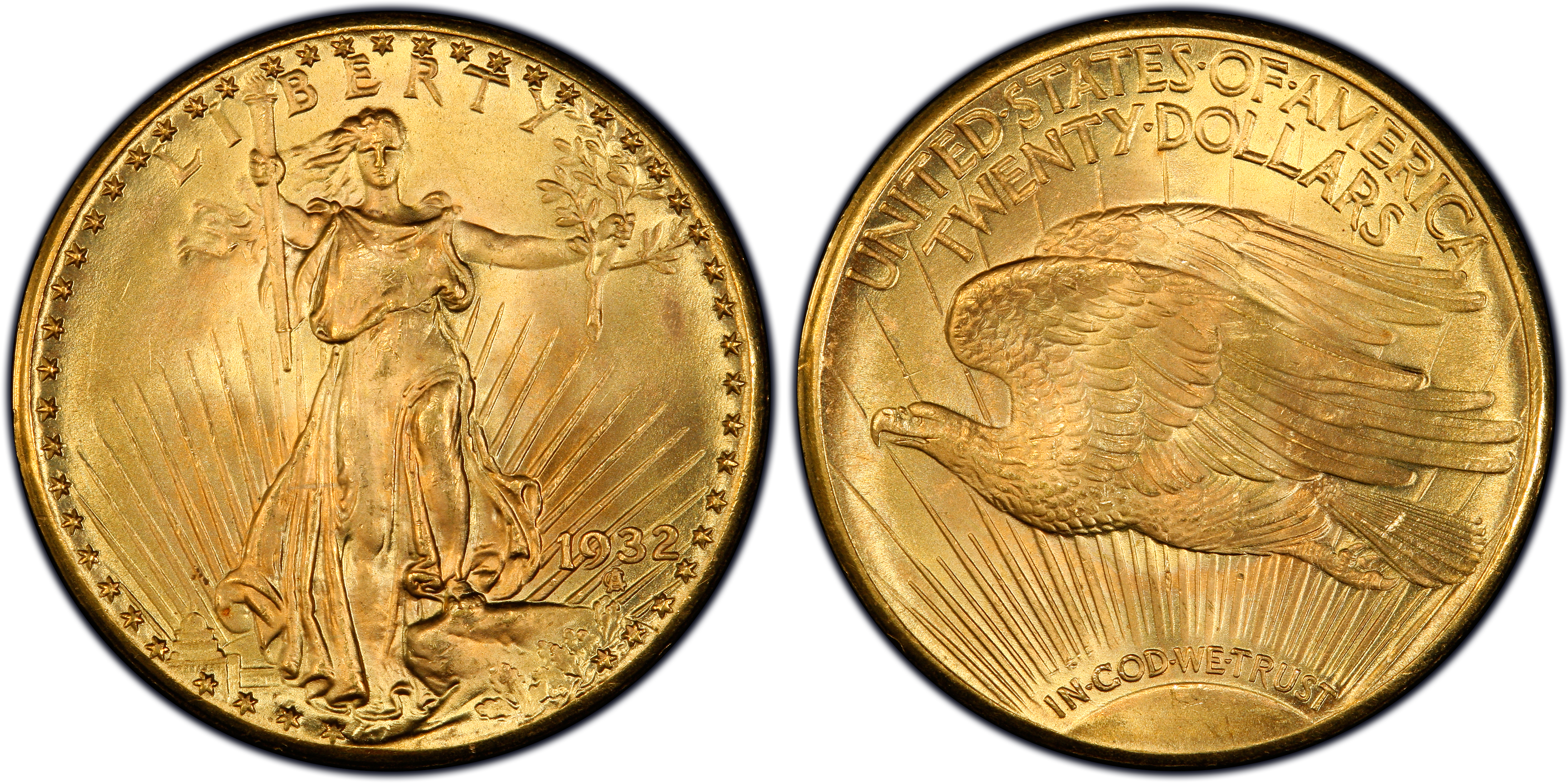
PCGS MS66+

PCGS MS66+
- PCGS #:
- 9194
- Designer:
- Augustus Saint Gaudens
- Edge:
- Lettered
- Diameter:
- 34.00 millimeters
- Weight:
- 33.40 grams
- Mintage:
- 1,101,750
- Mint:
- Philadelphia
- Metal:
- 90% Gold, 10% Copper
- Auction Record:
- $312,000 • MS66 • 01-15-2023 • Heritage Auctions
Major Varieties
- 1932 $20
Rarity and Survival Estimates Learn More
| Survival Estimate | |
|---|---|
| All Grades | 93 |
| 60 or Better | 86 |
| 65 or Better | 52 |
| Numismatic Rarity | |
|---|---|
| All Grades | R-8.0 |
| 60 or Better | R-8.1 |
| 65 or Better | R-8.4 |
| Relative Rarity By Type All Specs in this Type | |
|---|---|
| All Grades | 4 / 49 |
| 60 or Better | 6 / 49 |
| 65 or Better | 22 / 49 TIE |
| Relative Rarity By Series All Specs in this Series | |
|---|---|
| All Grades | 4 / 54 |
| 60 or Better | 6 / 54 |
| 65 or Better | 22 / 54 TIE |
Condition Census What Is This?
|
#1 MS66+ PCGS grade
Kevin Lipton, 1984 - David Akers - Dr. and Mrs. Steven L. Duckor Collection - Heritage 1/2012:4652, $184,000 - A&A Saints Collection (PCGS Set Registry) |
 #2 MS66 PCGS grade
Pierson MacDonald Grieve Collection - Heritage 7/2008:2133, $126,500 |
 #2 MS66 PCGS grade
Ralph P. Muller Collection - Heritage 1/2010:2341, $161,000 |
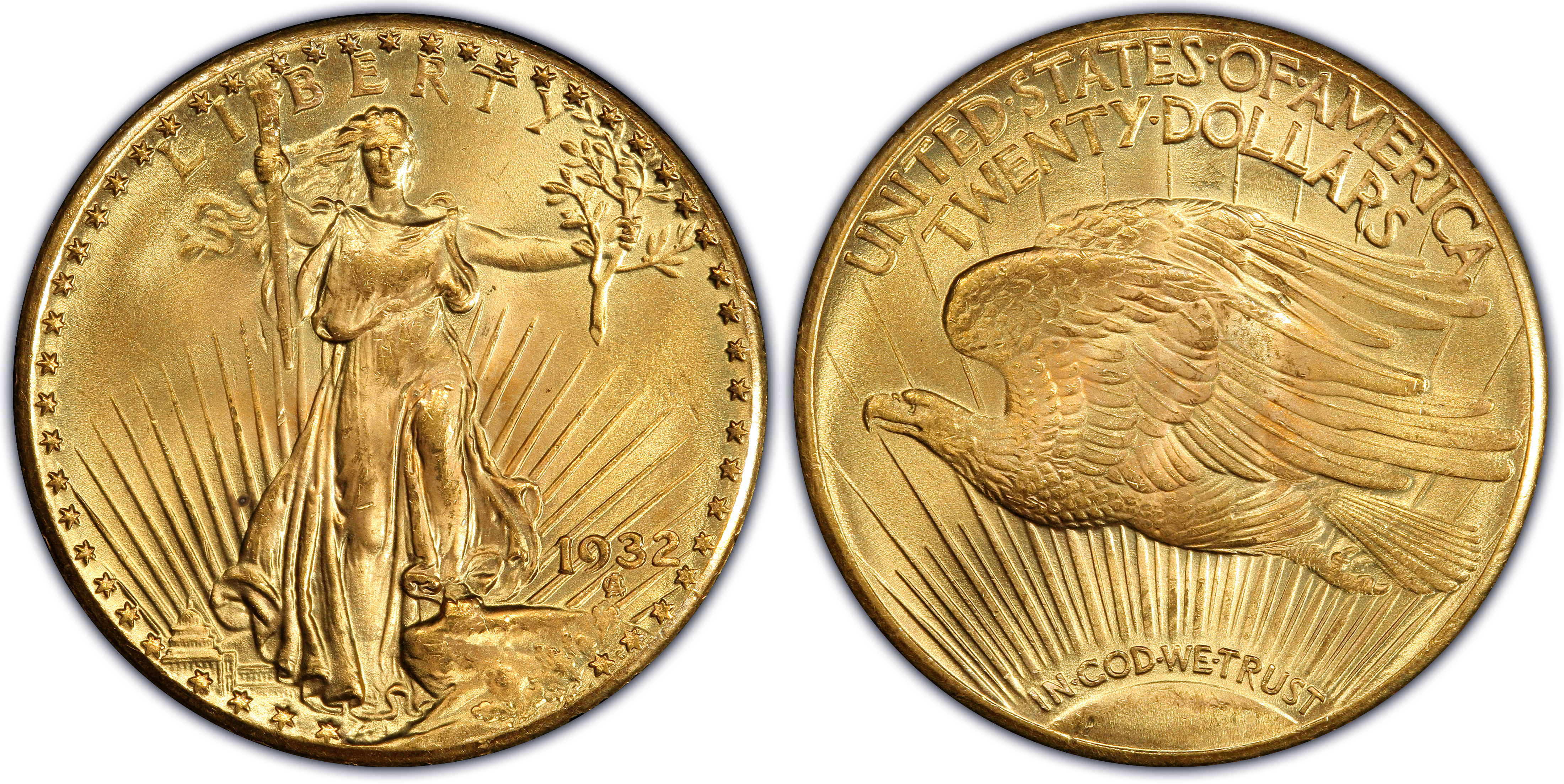 #2 MS66 PCGS grade
Richmond Collection, Part I - David Lawrence 7/2004:2438, $92,000 - John Kutasi Collection - Heritage 1/2007:3310, $138,000 - Carter Family Collection - Heritage 4/2010:2370, $126,500 |
 #2 MS66 PCGS grade
Heritage 8/2010:3653, $126,500 |
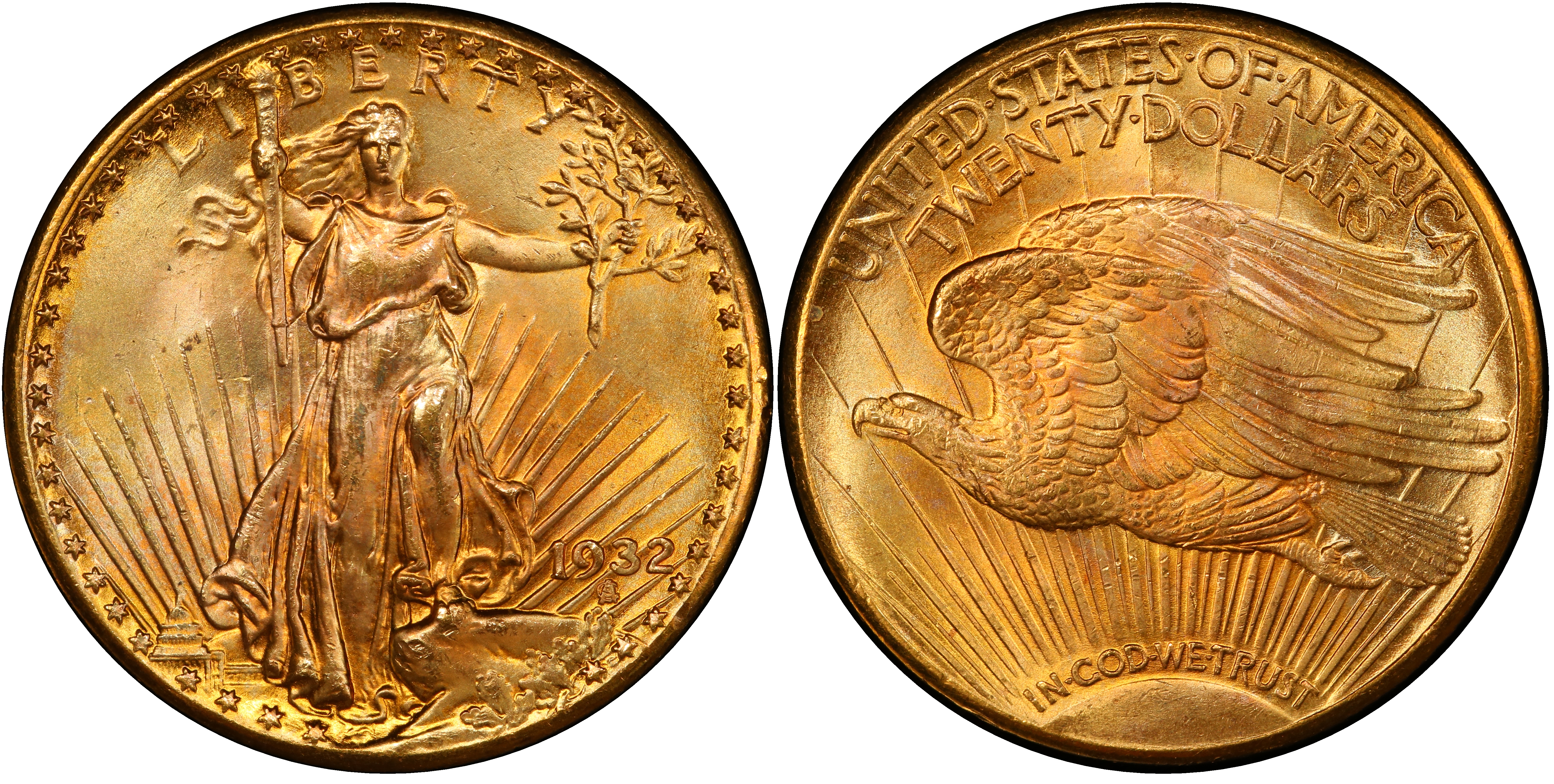 #2 MS66 PCGS grade
Dr. Robert Hesselgesser Collection - Goldbergs 9/2007:3549, $143,750 - Ohringer Family Trust - Goldbergs 5/2008:4490, $126,500 - D.L. Hansen Collection |
 #2 MS66 PCGS grade
|
|
#2 MS66 PCGS grade
Heritage 4/2006:4750, $103,500 - Jacob Collection - Heritage 1/2008:3408, $132,250 |
 #2 MS66 PCGS grade
Phillip H. Morse Collection - Heritage 11/2005:6714, $138,000 - Heritage 4//2008:2526, $161,000 |
|
#2 MS66 PCGS grade
Park Avenue Collection - Cherny Collection - Heritage 11/2016:5648, $129,250 |
For some unknown reason, the 1932 has been generally regarded over the past 10 to 15 years as being the rarest issue of the five late issues from 1929 to 1932. In my experience, this is not correct, and I feel that it is more rare than only the 1929, although admittedly there is probably very little difference in overall population rarity between the 1931, 1931-D and 1932. the 1930-S is distinctly more rare than the 1932 overall and both the 1930-S and 1931-D are considerably arer in gem condition. The 1931 and even the 1929 are also seen less often in MS-65 condition than the 1932. So rather than being the rarest of the five issues in gem condition, it is actually the most common. (Of course, one must keep in mind that "common" is a very relative term here. The 1932 is by no means "common" in any absolute sense and, in fact, it is very rare in any condition.) The 50 to 60 known examples are spread rather evenly over the Mint State grades from MS-60 to MS-64, and even true gems (MS-65 quality coins) are not appreciably rarer than lower grade Mint State ones. Several known examples of this issue are distinctly better than MS-65, at least MS-65+ if not full MS-67.
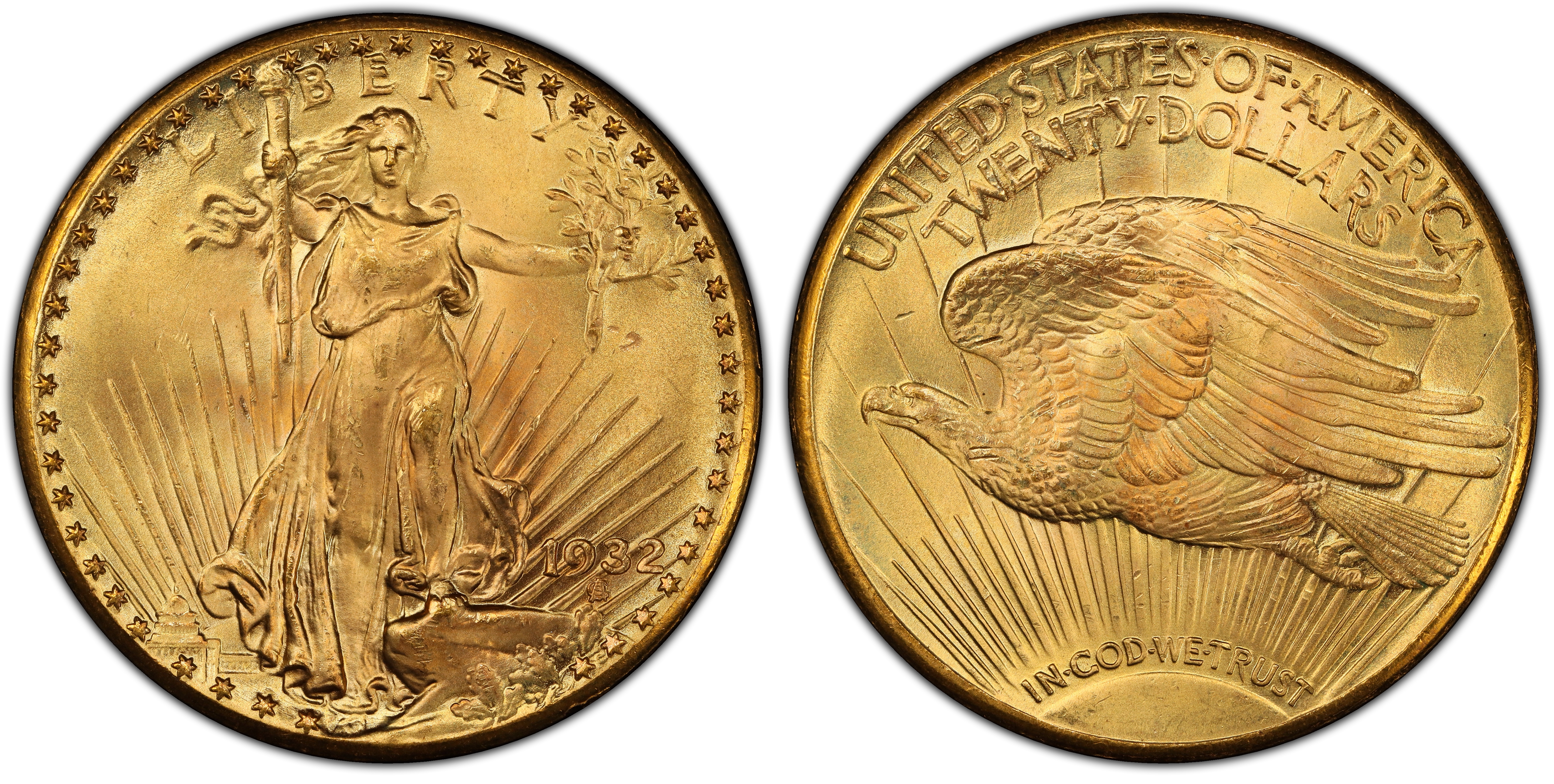
Most 1932 double eagles are very frosty, but some have a definite satiny texture to the surface. Typically, the 1932 is very sharply struck, although it is not unusual to find a specimen, usually one of the satiny ones, with a softness or lack of definition on the figure of Liberty. Some specimens have obvious signs of metal flow near the rims. As a rule, a high-grade 1932 is a great looking coin with otustanding lustre and color. The 1932 is superior in this regard to the other late issues except possibly the 1930-S. The color on most specimens is a medium to rich yellow or greenish gold but there are also a number of examples with light to medium orange and greenish gold color. "Eye appeal" for this issue is well above average for the series.
The 1932 $20 is one of the final six issues of the St. Gaudens Double Eagles (the others being 1929, 1930-S, 1931, 1931-D, and 1933). All are very rare, especially the famous 1933. Among these six, the 1932 is near the middle of the pack in terms of rarity. The 1929 has the largest population, followed by the 1931-D, then the 1932. Akers thought that 50 to 60 1932 Double Eagles survived, and we estimate that there are roughly 100 survivors, but this might be slightly low based on the numbers in the PCGS Population Report and the NGC Census. There may be as many as 125 to 150 examples "out there" but they are so widely dispersed, and they appear on the market so infrequently, and the demand for the coins is so strong, that collectors continue to push the prices higher for this date.
The grade distribution for the 1932 $20 is not as wide as Akers believed. In fact, the majority of the known population huddles around the MS64 to MS65 level, with a few coins on either side. No truly superb (MS67) has been identified yet, but there are perhaps a dozen that qualify at the MS66 level.
Akers' comments concerning luster, eye appeal, color, and strike characteristics remain accurate.