
PCGS MS62
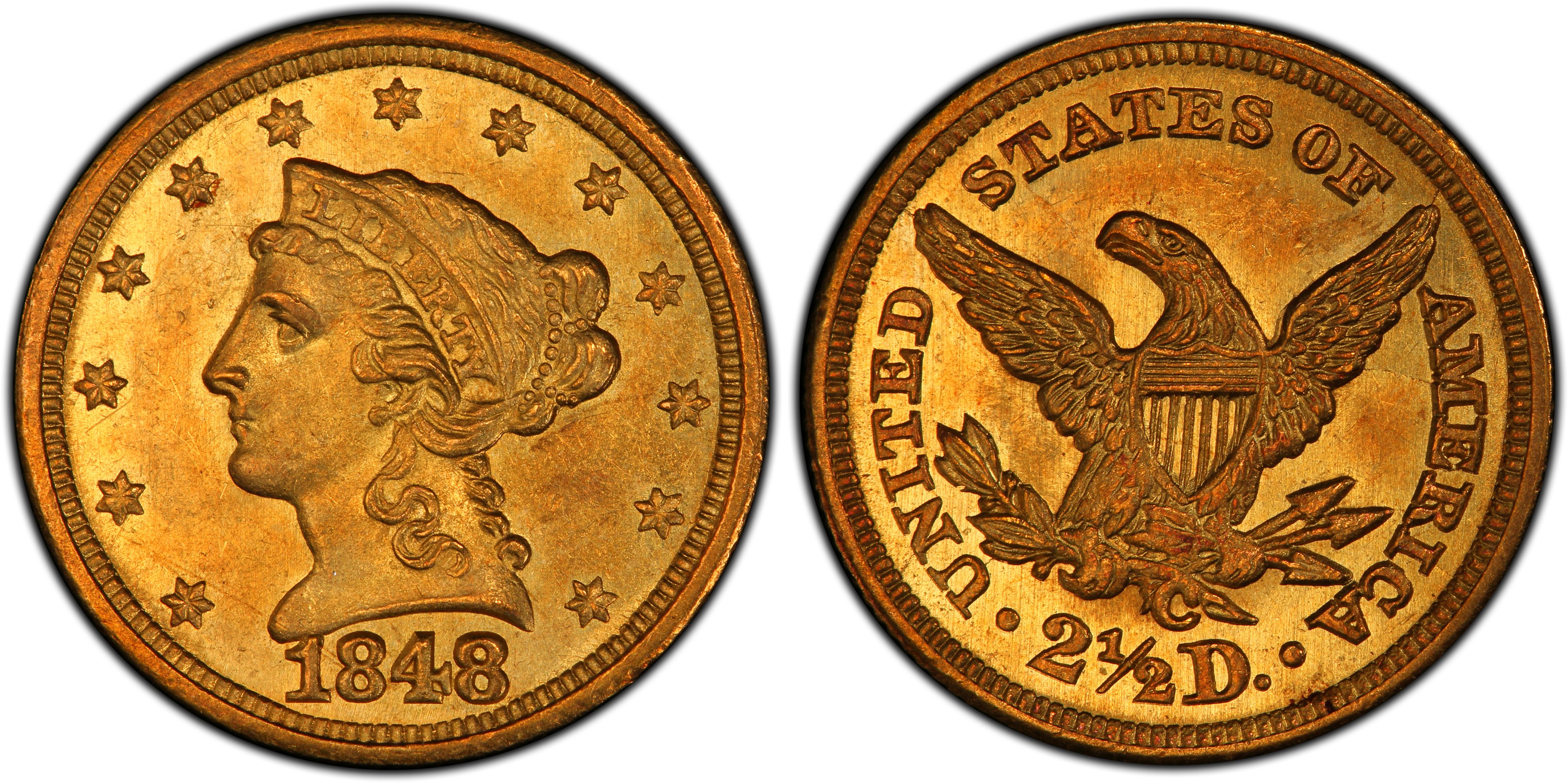
PCGS MS62
- PCGS #:
- 7750
- Designer:
- Christian Gobrecht
- Edge:
- Reeded
- Diameter:
- 18.00 millimeters
- Weight:
- 4.18 grams
- Mintage:
- 16,788
- Mint:
- Charlotte
- Metal:
- 90% Gold, 10% Copper
- Auction Record:
- $16,100 • MS62 • 07-25-2003 • American Numismatic Rarities
Major Varieties
- 1848-C $2.50
Rarity and Survival Estimates Learn More
| Survival Estimate | |
|---|---|
| All Grades | 175 |
| 60 or Better | 3 |
| 65 or Better | |
| Numismatic Rarity | |
|---|---|
| All Grades | R-7.2 |
| 60 or Better | R-9.8 |
| 65 or Better | R-10.1 |
| Relative Rarity By Type All Specs in this Type | |
|---|---|
| All Grades | 68 / 147 TIE |
| 60 or Better | 5 / 147 TIE |
| 65 or Better | 1 / 147 |
| Relative Rarity By Series All Specs in this Series | |
|---|---|
| All Grades | 68 / 147 TIE |
| 60 or Better | 5 / 147 TIE |
| 65 or Better | 1 / 147 |
Condition Census What Is This?
 #1 PCGS MS62
As NGC MS62 #563685-005. “The Soluna Collection,” Heritage Auctions, January 5, 2017, Lot 5808 – $14,100. As PCGS MS62 #83224908. Dell Loy Hansen. Variety 1. Scattered gold toning. Diagonal tick to the upper right of star 1. |
|
#1 PCGS MS62
As PCGS MS62. Goldberg Auctioneers, October 2001, Lot 2037; Stack’s, March 2002, Lot 1034; American Numismatic Rarities, July 25, 2003, Lot 650 – $16,100. Goldberg Auctioneers, February 2006, Lot 946 – $16,100; Goldberg Auctioneers, May 2006, Lot 3684 – $16,100; “The Horseshoe Collection,” Bowers and Merena, August 7, 2010, Lot 1495 – $14,490; Stack’s Bowers, August 13, 2011, Lot 7612 – $13,800. The first 1848-C $2.50 graded MS62 by PCGS. Tiny rim hit near 5 o’clock. Radials full. Nicely struck for date. Die striae on both sides. Well struck for the date. |
|
#1 PCGS MS62
Tiny tick between star 1 and the numeral 1. Diagonal line from tip of bust truncation to below star 2. Two ticks to the left of Liberty’s eye. Scattered coppery toning. |
|
#4 PCGS MS61
Goldberg Auctioneers, September 2017, Lot 1096 – $11,163. Small diagonal cut to the left of the mouth. Nick on nose. Full radial detail, but eagle is weakly struck, especially head and neck. |
|
#4 PCGS MS61
Heritage Auctions, March 2, 2000, Lot 463 – $11,500; “The Ashland City Collection,” Heritage Auctions, January 11, 2003, Lot 4683 – $10,637.50; Goldberg Auctioneers, February 2006, Lot 947 – $13,800. 9-F. Tiny tick on the lower jaw. Planchet void to the right of star 11. |
| #4 PCGS MS61 |
In 1848, the Charlotte Mint struck two gold coin denominations: the 1848-C Liberty Head Quarter Eagle and the 1848-C Liberty Head Half Eagle. Demand was higher for the $5 gold coin, and this trend of higher half eagle production would continue through the early 1850s. The Quarter Eagle, conversely, saw more modest mintages. Despite this, the 1848-C Quarter Eagle is among the more commonly encountered Charlotte Mint $2.50 gold issues, although it is less common than both the 1847-C and the 1843-C Large Date variety. While many auction catalogers suggest the majority of these coins grade Extra Fine (XF) or below, the data from the current certified population is more concentrated in the XF to About Uncircuated (AU) range.
As for Mint State examples, classic U.S. gold coin expert Doug Winter points to the issue’s weak strike as being the main impediment to determining whether a coin is uncirculated or lightly circulated. This challenge is not unique to the 1848-C, and is something that the PCGS graders consider when evaluating high end examples of this date.
Charlotte Mint Gold Coin Production in 1848
- 1848-C Liberty Head Quarter Eagle | Mintage: 16,788
- 1848-C Liberty Head Half Eagle | Mintage: 64,472
The Two Die Varieties of the 1848-C Liberty Head Quarter Eagle
To produce the mintage of 16,788 coins, the Charlotte Mint utilized two of the four obverse dies the Philadelphia Mint had prepared for the branch. The reverse die was a reused one, having also been deployed in 1846 and 1847. On the 1848-C issue, a thin die crack running from the bottom of the "M" in AMERICA to the left wing is now more prominent. Furthermore, a crack from the tip of the eagle’s right wing to the denticles, which first appeared in 1846, is also pronounced on this issue.
The two obverse dies can be differentiated by the position of the second "8" in the date:
- Variety 1: The date is slightly slanted downward, and the second "8" is closer to the denticles.
- Variety 2: The date is level (does not slope), and the second "8" is closer to the bust.
Market Analysis
The value of the 1848-C Liberty Head Quarter Eagle appears to have softened over the past 20 years. This pricing trend may be related to an increase in the number of certified uncirculated examples available to collectors. From 2003 to 2017 (the last public auction appearance of a Mint State 1848-C), prices realized for MS62 coins declined by 34%, and MS61 coins dropped by 32%. While it's likely that some loss was recovered during the bull market of 2020-22, current prices are not believed to meet or exceed historic highs. Having said that, current levels suggest that the 1848-C presents a good opportunity for future thinking collectors.
Shipwreck Coin
An 1848-C Liberty Head Quarter Eagle was recovered from the S.S. Central America shipwreck. This coin was certified by PCGS at AU58 and famously encapsulated alongside a poke of gold dust.
1848-C Liberty Head Quarter Eagle: Physical Characteristics
(per Doug Winter)
The strike quality on the 1848-C Quarter Eagle varies widely. Sharply struck pieces are quite scarce, totaling only around 25% of the surviving population. These better examples may still exhibit minor weakness at the top of Liberty’s head and the eagle’s right leg, while other details are sharp. The typical strike, accounting for about 60% of the surviving population, shows more weakness at the centers, often appearing soft on Liberty’s head and the lower obverse. The remaining 15% were struck from fully buckled dies and are considered rare. On these buckled die coins, the obverse is very weak, with the "ER" in LIBERTY being especially faint, and a noticeable lack of detail in the stars and hair. The reverse on these pieces usually appears sharper, with the exception of the eagle’s head and neck, which are almost completely void of detail. While interesting, 1848-C Quarter Eagles struck from buckled dies are not generally desirable to collectors and typically sell at a discount compared to well-detailed examples.
Surfaces and Luster
Surfaces: The 1848-C Quarter Eagle is prone to heavy abrasions. Many display mint-made striations in the fields, particularly on the obverse. This is one of the most difficult Charlotte Quarter Eagles to find with choice surfaces.
Luster: This date generally exhibits below-average luster. On some higher-grade coins, the luster is satiny with a pronounced grainy texture. A few late-die-state coins, specifically those struck from buckled dies, are seen with reflective, semi-prooflike fields. Overall, this is one of the most difficult Charlotte Quarter Eagles to find with good luster.
Coloration and Eye Appeal
Coloration: Natural coloration is often a dark and less-appealing hue, frequently appearing as a dark green-gold. A lighter yellow-gold shade is sometimes seen and is considered more desirable by collectors. Most surviving pieces have been cleaned or repeatedly dipped, making pieces with nice, original hues very rare.
Eye Appeal: Only 1848-C Quarter Eagles with a good strike possess strong eye appeal. This issue is extremely hard to locate with above-average eye appeal, and the few high-quality pieces that exist typically command substantial premiums over typical low-end examples.
* * *