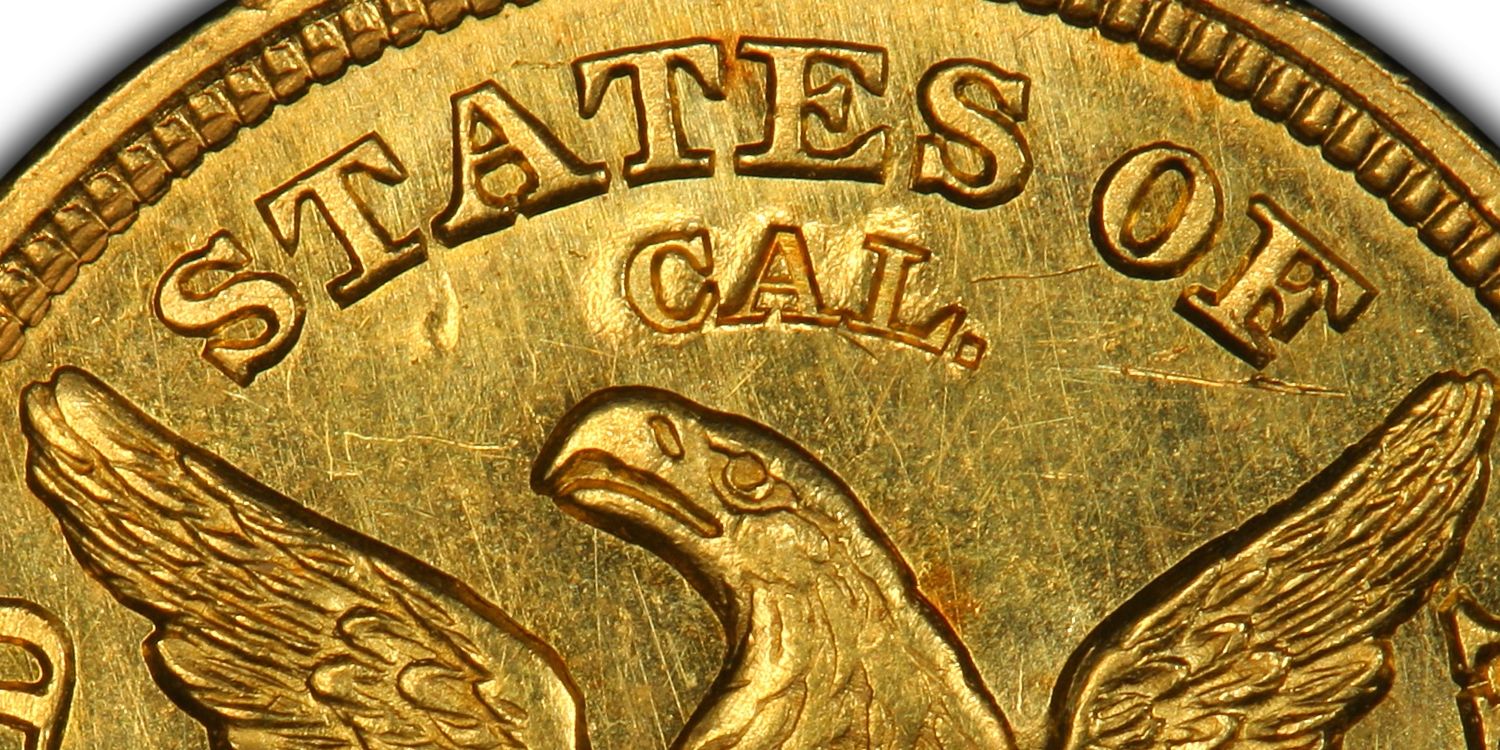
CLOSEUP OF CAL. PUNCH

PCGS MS64
- PCGS #:
- 7749
- Designer:
- Christian Gobrecht
- Edge:
- Reeded
- Diameter:
- 18.00 millimeters
- Weight:
- 4.18 grams
- Mintage:
- 1,389
- Mint:
- Philadelphia
- Metal:
- 90% Gold, 10% Copper
- Auction Record:
- $552,000 • MS64 • 09-29-2022 • Heritage Auctions
Rarity and Survival Estimates Learn More
| Survival Estimate | |
|---|---|
| All Grades | 162 |
| 60 or Better | 37 |
| 65 or Better | 10 |
| Numismatic Rarity | |
|---|---|
| All Grades | R-7.3 |
| 60 or Better | R-8.7 |
| 65 or Better | R-9.5 |
| Relative Rarity By Type All Specs in this Type | |
|---|---|
| All Grades | 67 / 147 |
| 60 or Better | 98 / 147 TIE |
| 65 or Better | 42 / 147 TIE |
| Relative Rarity By Series All Specs in this Series | |
|---|---|
| All Grades | 67 / 147 |
| 60 or Better | 98 / 147 TIE |
| 65 or Better | 42 / 147 TIE |
Condition Census What Is This?
| #1 PCGS MS68 |
 #2 PCGS MS67+
Light diagonal mark on cheek. Coppery color below star 1, below 4, and to the left of Liberty's nose. |
|
#3 Est. MS67
“The Franklinton Collection,” American Numismatic Rarities, August 11 2006, Lot 1201 – $322,000. As NGC MS68* #1787965-004. Stack’s Bowers, August 16, 2023, Lot 5103 – $575,000 Reserve Not Met. Light frost on the devices. Light planchet disturbances between stars 5 and 6 and 6 and 7. |
|
#3 Est. MS67
"The Clausen Family Collection," Heritage, January 2006, Lot 3419 - $402,500; "The Madison Collection," Heritage, January 2008, Lot 3091 - $345,000; Heritage Auctions, April 23, 2020, Lot 3774 – $300,000. Rim hit to the right of star 4. Two small depressions located near Star 3. Tick between stars 12 and 13. Frosty devices. |
|
#5 PCGS MS66
Bowers & Merena 8/1998:291, $156,500 |
| #5 PCGS MS66 |
| #5 PCGS MS66 |
|
#5 Est. MS66
Heritage Auctions, January 7, 2004, Lot 3007 – $161,000. Scattered marks between Stars 3 and 4. |
| #8 PCGS MS65 |
| #9 PCGS MS65 |
| #9 PCGS MS65 |
The 1848 "CAL" Liberty Head Quarter Eagle is one of the most historically significant coins in American numismatics, intimately tied to the California Gold Rush, though its status as the first coin struck from California gold is highly doubtful. The commercial extraction of gold in California had been underway for six years before James Wilson Marshall’s famous 1848 discovery at Sutter’s Mill. In fact, $344.75 worth of coins were struck at the Philadelphia Mint from 18.34 ounces of California gold delivered by Abel Stearns in the spring of 1842.
While hundreds of hopeful prospectors trickled into California over the preceding years, the 1848 gold discovery at Sutter’s Mill profoundly changed the course of Californian and American history
The "CAL" Inscription and Mintage
The specific gold used for the 1848 "CAL" quarter eagles was part of a larger shipment sent by War Secretary William L. Marcy—who had received it from California Military Governor Richard Mason—and arrived at the U.S. Mint on December 15, 1848. The refined metal totaled $3,910.10. Of this, 1,389 “CAL” quarter eagles were struck, most likely in the final week of December 1848. The unique incuse inscription “CAL,” which appears above the eagle’s head, was not part of the initial striking. It was added later by Chief Engraver James B. Longacre, using a single "CAL." punch, either when the coins were still in the press, or, as John Dannreuther believes, in a chuck that held the obverse die. The position of the CAL. will vary, but the shape of the letters and spacing will not. The work was completed on January 4, 1849.
While the coin commemorates the gold discovery, it does not rise to the level of a congressionally approved commemorative issue, a distinction that wouldn't arrive until 1892 with the World’s Columbian Exposition Commemorative Half Dollar.
Rarity and Survival
Today Most of the 1848 "CAL" quarter eagles entered circulation, resulting in a low survival rate for high-grade pieces. Numismatic researchers estimate that only 200 or slightly more examples survive today, with the overwhelming majority in circulated condition. By the late 1860s, the issue was already difficult for collectors to find. The surviving population significantly exceeds the early 1975 estimate of just 54 pieces by David Akers in his book, United States Gold Coins, An Analysis of Auction Records, Volume I.
It’s likely that fewer than 50 Mint State examples remain, with about ten of those in Gem or better.
The 1848 “CAL” is highly valued for its historical connection, ranking 54th in 100 Greatest U.S. Coins by Ron Guth and Jeff Garrett. Gold expert Doug Winter calls the issue a “stretch date” that serious collectors should pursue.
Possible Proof Strikings
Proof strikings of the regular 1848 Liberty Head Quarter Eagle are rare, with only three known. In contrast, Proof strikings of the 1848 “CAL.” Liberty Head Quarter Eagle have been the subject of much speculation among collectors and numismatic researchers for decades. One such example was reportedly sold in the 1870 Thomas & Sons sale of the James B. Longacre Collection.
Recent scholarship by John Dannreuther, published in United States Proof Coins, Volume IV: Gold. Part One, suggests that some of these coins received extra attention from the Mint. Dannreuther notes that the planchets on certain 1848 “CAL.” examples were burnished and polished, indicating they may have been specially prepared for presentation. The J.K. Lilly specimen, which is permanently housed in the National Numismatic Collection at the Smithsonian Institution, is the most convincing "Proof" he has examined. This Lilly coin, he speculates, may possibly be traced back to the Longacre auction.
* * *