- PCGS #:
- 8139
- Designer:
- Robert Scot & John Reich
- Edge:
- Reeded
- Diameter:
- 25.00 millimeters
- Weight:
- 8.75 grams
- Mintage:
- 25,375
- Mint:
- Philadelphia
- Metal:
- 91.7% Gold, 8.3% Copper
- Auction Record:
- $763,750 • MS66+ • 05-24-2016 • Stack's Bowers
Major Varieties
- 1829 $5 Large Size
Rarity and Survival Estimates Learn More
| Survival Estimate | |
|---|---|
| All Grades | 7 |
| 60 or Better | 5 |
| 65 or Better | 1 |
| Numismatic Rarity | |
|---|---|
| All Grades | R-9.6 |
| 60 or Better | R-9.7 |
| 65 or Better | R-10.0 |
| Relative Rarity By Type All Specs in this Type | |
|---|---|
| All Grades | 4 / 22 TIE |
| 60 or Better | 4 / 22 TIE |
| 65 or Better | 1 / 22 TIE |
| Relative Rarity By Series All Specs in this Series | |
|---|---|
| All Grades | 6 / 42 TIE |
| 60 or Better | 7 / 42 TIE |
| 65 or Better | 1 / 42 TIE |
Condition Census What Is This?
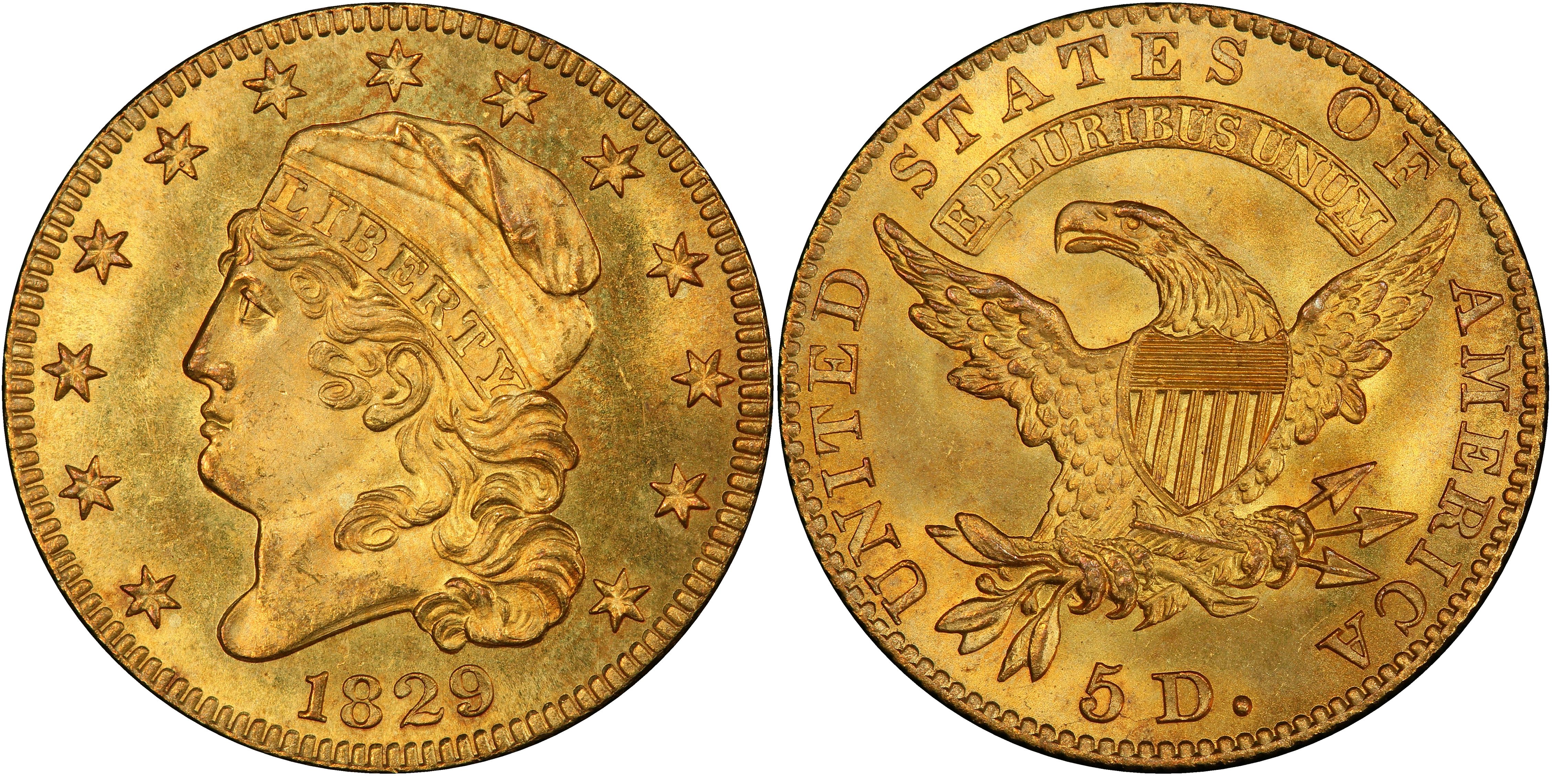 #1 PCGS MS66+
"The Harlan P. Smith Collection," S.H. & H. Chapman, May 1906, Lot 218 - $240; "The John H. Clapp Collection"; Clapp Collection, sold intact in 1942 to Louis E. Eliasberg, Sr.. via Stack's; "The United States Gold Coin Collection (Eliasberg)," Bowers & Ruddy October 1982, Lot 387 - $82,500; "The Marvin Browder Collection"; RARCOA, sold privately in September 1987; "The D. Brent Pogue Collection," Stack's/Bowers & Sotheby's, May 24, 2016, Lot 4036 - $763,750. Faint thin abrasian on Liberty's cheek. Apparent fingerprint toning at the upper obverse. Small planchet flaw near star 4. Die crack connects 5 and D. |
|
#2 Est. MS65
As Uncirculated. "The Magnificent Rare Coin Collection of the Late Peter Mougey, ESQR. of Cincinnati Ohio," Thomas L. Elder, September 1-3, 1910, Lot 1075 - $75; "The William Woodin Collection"; "The Waldo Newcomer Collection," inventory cost at $750; "The Col. E.H.R. Green Collection"; "The King Farouk of Egypt Palace Collection," Sotheby's, February 1954, included in Lot 244; "The Dr. Clifford Smith Collection," Stack's, May 1955, Lot 1691 - $11,000; "1976 ANA Sale," Stack's, August 1976, Lot 2945 - $65,000. As PCGS MS65. "The Harry Bass, Jr. Collection," Bowers & Merena, October 1999, Lot 820 - $241,500. Small scratch before mouth. |
|
#2 Est. MS65
"The William C. Atwater Collection," B. Max Mehl, June 1946, Lot 1646; "The Josiah K. Lilly, Jr. Collection"; Lilly Collection donated to the Smithsonian Institution, 1968; National Numismatic Collection at the Smithsonian Institution. |
|
#4 Est. MS64
(Possibly) W.E. Woodward, March 1865, Lot 2780; "The George Seavey Collection," William Strobridge, June 1873, Lot 490 - Sale cancelled after Lorin G. Parmelee purchased the entire collection before the sale took place; "The Lorin G. Parmelee Collection," New York Coin & Stamp Co., June 1890, Lot 988 - $52; "The Byron Reed Collection"; Reed Collection donated to the Omaha City Library / Western Heritage Museum, 1891; The Durham Museum (Omaha, Nebraska).
|
|
#5 Est. VG08
Coen & Messer (New York); William Fox Steinberg; Edwin Shapiro; Federal Brand Enterprises (Michael Kolman), August 1964, Lot 2863; Berube's January 1966, Lot 552; Paramount, November 4-6, 1966, Lot 718; Kagin's, November 1-2, 1974, Lot 1617; Mid-American Numismatic Auction, January 1986, Lot 2029 - $10,000; Heritage Auctions, July 1997, Lot 5203. Described as having Fine details, ex jewelry (brooch or tie clip). |
The Philadelphia Mint struck Half Eagles in two styles in 1829. The 1829 Capped Head Left Half Eagle, Large Date was produced to the same standards as all Half Eagles issued since 1795, featuring John Reich’s mature portrait of Liberty, a design first struck in 1807.
The second style was a reduced-diameter version that shaved approximately 1.2 mm off the design. To offset the reduction in canvas, the Mint prepared dies with smaller dates, letters, and stars.
Survival Rate
While all early gold issues are scarce—a former PCGS expert famously used the term “Beach Front Property” to describe them—the survival rate of Half Eagles from the 1820s is minuscule. This low survival rate reflects how severely out of balance America’s bimetallic experiment had become.
Mintage and Known Examples
The mintage for the 1829 Capped Head Left Half Eagle, Large Date reports a total of 25,375 coins. This total reflects deliveries made on March 31 (7,781 coins), May 1 (5,584 coins), and June 30 (12,010).
From this total mintage, we have tracked only five business strikes in our condition census:
- Only one is currently in our holder.
- A second Gem, traced to the Bass Collection, is slated for a 2026 Heritage Sale.
- Two are impounded in permanent museum collections.
- One heavily circulated example features sign of having been previously used in jewelery (ex-jewelery).
Two Proof strikes are also known. One Proof coin features a Deep Cameo Proof obverse paired with a frosty reverse, while the other features a fully mirrored obverse and reverse.
* * *