Silver Dollars & Trade Dollars of the United States - A Complete Encyclopedia
Q. David Bowers
1973 Copper-Nickel Clad $1
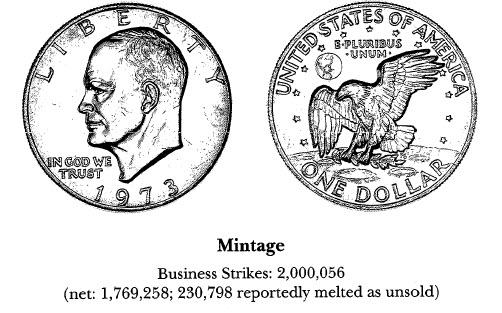
Coinage Context
Mint sets only: The 1973 copper-nickel Eisenhower dollars from the Philadelphia Mint were not made for general circulation, and were included only in this year's Mint sets. The Mint was overly optimistic concerning the number it would sell, and 230,798 unsold pieces were later sent to the melting pot. (Or so the Mint said. Thomas K. DeLorey reported that numerous circulated pieces have turned up, possibly indicating they were placed into commercial channels.)Mint set sale price: $6.00 (set contained one each of all business strike issues, cent through dollar).
Numismatic Information
Availability: Eisenhower dollar specialist DaveMcHenry noted this:
1973: These were sold only in 1973 Mint sets. Most have many bagmarks. Considering that relatively few 1973 Philadelphia dollars were made, I consider this to be underpriced on the current market.
Certification: As of January 1993, PCGS had certified just 15 examples of this date at the MS-65 level, with no coins graded higher.
Varieties
Business strikes:
1.1973 copper-nickel clad
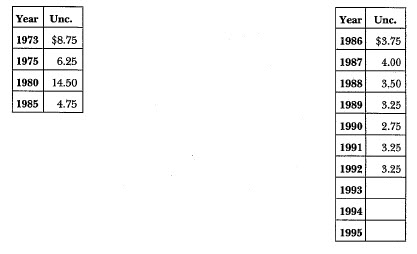
1973 Eisenhower: Market Values
1973 Eisenhower: Summary of Characteristics
Business Strikes:
Enabling legislation: Act of July 23, 1965 (clad metal), Act of December 31, 1970, and others.
Weight (copper-nickel clad): ·350 grains (tolerance 4%); outer layers of .750 copper-and .250 nickel bonded to inner core of pure copper.
Dies prepared (approximate): Obverse: 20; Reverse: 10.
Business strike mintage: 2,000,056. Number melted at the mint: 230,798. Net number distributed: 1,769,258.
Comment on availability, MS-65 or better: Quite scarce in this category.
Comment on availability, MS-64: Scarce.
Comment on availability, MS-63: Readily available, but scarce as a date.
Comment on availability, MS-60 to 62: Most surviving specimens are in this category.
Comment on availability, VF-20 to AU-58: Few coins of this date are found in circulated grades, as the Mint sold them at a premium to collectors.
Characteristics of striking: Usually well struck, With strong design details and lustrous surfaces.
Proofs:
None.
Commentary
Due to its low mintage, the issue is fairly scarce. Most are in lower Mint State levels and have many bagmarks.
Additional Information
The Year 1973 in History
On January 28, 1973, a cease-fire in Vietnam ended the direct involvement of United States ground troops in the military action there. The Watergate scandal grew and presidential aides John Ehrlichman and H.R. Haldeman resigned. In hearings chaired by Senator Sam J. Ervin, Jr., former White House legal advisor John Dean implicated other Nixon staffers. Nixon appointed Harvard law professor Archibald Cox as special Watergate prosecutor, but dismissed him on August 20, when Cox insisted that Nixon turn over secret tape recordings. The recordings were eventually released, but they contained suspicious gaps, and some tapes were missing. Still proclaiming his high morals, honesty, religious scruples, and other lofty attributes, Nixon sank in a quagmire of disgrace. On October 10, 1973, Vice President Spiro T. Agnew resigned under pressure and pleaded nolo contendere to income tax evasion, a charge resulting from kickback and bribery schemes during his term as governor of Maryland. President Nixon chose Gerald R. Ford, House Republican leader, to be vice president, and Ford took office on December 3.
Trading in the stock of the Equity Funding Corporation of America was halted on the New York Stock Exchange. The company was subsequently found to have falsified documents and created over $100 million worth of phony assets. In April 1973 a committee of United States manufacturers and grocers recommended the adoption of a Universal Product Code, which became known as the bar code, a system designed to permit electronic scanning of labels to create invoices and to monitor inventories.
At Wounded Knee, South Dakota, members of the American Indian Movement (AIM) seized the town and barricaded themselves within to protest the mistreatment of Native Americans. The town was later stormed by police and the National Guard, but not before AIM and its leader Russell Means had gotten their message to the world.
On the lighter side of the news, Willie Mays, the "Say Hey Kid," retired from professional baseball after spending his entire career with the New York (later San Francisco) Giants. His illustrious career included several Most Valuable Player awards; his 660 career home runs place him third on the all time list, behind Hank Aaron (744) and the legendary Babe Ruth (714). Popular books of the year included Breakfast of Champions, The Onion Field, Serpico, Marilyn, and The Taking of Pelham One Two Three.
In the Mideast, Arabs and Israelis continued hostilities which had been intense since the formation of the Jewish state in 1948. Little would be done in the way of a peaceful settlement in ensuing decades.
The oil crisis began in earnest, with prices rocketing sky-high and mile-long lines forming at service stations; rationing and gas purchase limits were right around the corner. Inflation continued, and the value of gold bullion rose sharply on international markets. In the United States a flurry of interest in gold coins caused the value of both common and rare pieces to escalate sharply. A year later, on December 31, 1974, when American ownership of gold bullion became legal for the first time since the early 1930s, the news was a letdown, and the prices of gold coins dropped, to remain low for the next several years. In the meantime, commemoratives, silver dollars, "type" coins, and other series-especially coins in Uncirculated and Proof grades-were becoming popular once again as an investment. Increasing emphasis was being paid to coins in outstanding preservation, and early (especially pre-1860) pieces with legitimate claims to being "condition rarities" began to sell for record prices in auctions.
In October, the Numismatic Museum at the old San Francisco Mint (operated for coining purposes c. 1870-1937) was dedicated. On November 1, the Bureau of the Mint began accepting orders for 1974-dated Proof sets, and later in that month, President Nixon signedthe Hobby Protection Act, making it the law of the land.