Silver Dollars & Trade Dollars of the United States - A Complete Encyclopedia
Q. David Bowers
1977 Copper-Nickel Clad $1
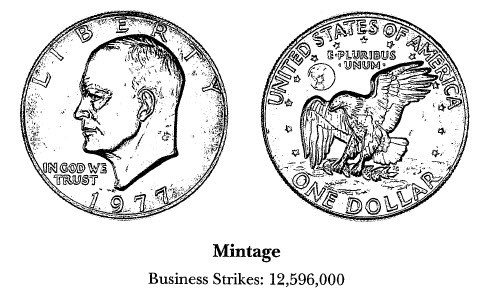
Coinage Context
Eagle reverse resumed: With the passing of the Bicentennial celebration, the original reverse design was restored to the Eisenhower dollar, and would remain in use through the demise of the series in 1978. From this point forward, the few remaining varieties in the series would all be struck in copper-nickel clad metal.
Mint sets, sold at $7.00 each, contained one each of all business strike issues, cent through the Eisenhower dollar; 2,006,869 sets were sold.
Numismatic Information
Availability: Eisenhower dollar specialist Dave McHenry noted this:
1977: Eisenhower dollars; of this variety are usually well struck, but most have many bagmarks.
Varieties
Business strikes:
1. 1977 copper-nickel clad.
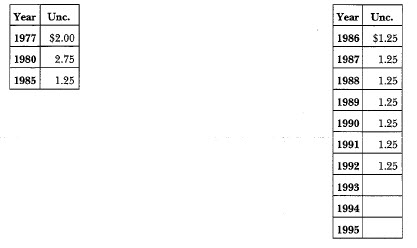
1977 Eisenhower: Market Values
1977 Eisenhower: Summary of Characteristics
Business Strikes:
Enabling legislation: Act of July 23, 1965 (clad metal), Act of December 31, 1970, and others.
Designer: Frank Gasparro.
Weight (copper-nickel clad): 350 grains (tolerance 4%); outer layers of .750 copper and .250 nickel bonded to inner core of pure copper.
Dies prepared (approximate): Obverse: 126; Reverse: 63.
Business strike mintage: 12,596,000.
Comment on availability, MS-65 or better: Scarce.
Comment on availability, MS-64: Scarce in relation to lower Mint State grades.
Comment on availability, MS-63: Readily available.
Comment on availability, MS-60 to 62: Most Mint State coins are in this category.
Comment on availability, VF-20 to AU-58: Common.
Characteristics of striking: The typical 1977 Eisenhower dollar is well struck and lustrous, but has many bagmarks.
Known hoards of Mint State coins: Most, if not all, bag quantities have been dispersed.
Proofs:
None.
Commentary
Mint State coins are readily available, although most pieces grade from MS-60 through MS-63.
Additional Information
The Year 1977 in History
As one of his first official acts after inauguration, President Jimmy Carter pardoned most of the draft resisters to the Vietnam War. On September 7, Carter signed two treaties transferring control of the Panama Canal to Panama, an act that caused great dissent among United States citizens, who felt that Carter was wrong in giving away rights to that strategic area. On June 6, 1977, the Washington Post reported that the United States had developed a neutron bomb that would kill people with its radiation but would do minimal damage to property.
The stock market was in a slump, and the Dow Jones Industrial Average declined more than 165 points during the year. Unemployment remained high at 7%. Coffee prices rose and hit $5 per pound retail, causing an increase in tea consumption. On March 9 the Food and Drug Administration suggested that saccharin might cause cancer and proposed a ban that was postponed for 18 months pending new tests. On June 28, Robert Hall, the largest retail clothing store chain in America, closed the doors of over 300 stores following a loss of $100 million for the preceding three years. On July 28, the 799-mile Trans-Alaska oil pipeline connected Prudhoe Bay to the port of Valdez.
Two films were hits at the box office-Star Wars and Close Encounters of the Third Kind. The Thorn Birds, a novel by Colleen McCullough, became a best seller. Former Secretary of State Henry Kissinger sold his memoirs for $2 million, matching the figure guaranteed in a contract signed on September 29, 1976, by Richard Nixon for his memoirs. On March 9, former President Gerald R. Ford and his wife Betty were reported to have signed contracts for their memoirs for about $1 million each. Attendance at professional sports burgeoned, with an increase of 24% in baseball attendance over the preceding year.
Rocket scientist Wernher Von Braun passed away in 1977, as did the "King of Rock 'n Roll," Elvis Presley, who died in his palatial Graceland estate in Memphis, the victim of a drug overdose; and two of the greatest funnymen of all time passed away, Charlie Chaplin and Groucho Marx.
Exhibition of the famed Eliasberg collection was extended through June, 1977 at the Philadelphia Mint, where it had been on display since April, 1976. On January 28, the Old Mint in San Francisco was declared a California State Historical Landmark. For the first time in nearly a century, no members of the general public were appointed to the 1977 U.S. Assay Commission. On February 11, Mary Brooks resigned as director of the Mint, after more than seven years in that position. On October 26, President Jimmy Carter appointed Stella B. Hackel director of the Mint; her appointment was approved by the Senate on November 4. On November 15, Milferd H. Bolender, well-known numismatic personality, passed away at the age of 83.
The coin market was hot, prices continued to rise, and anyone buying coins for investment no matter what the price, could do no wrong-or so it seemed at the time.