Silver Dollars & Trade Dollars of the United States - A Complete Encyclopedia
Q. David Bowers
1974 Copper-Nickel Clad $1
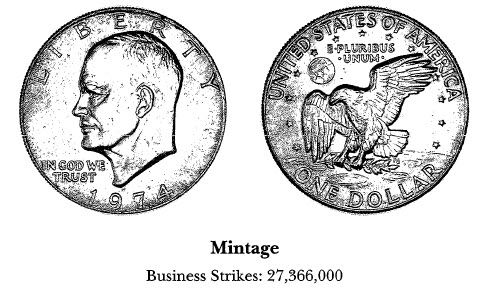
Coinage Context
A familiar coin: By 1974, the Eisenhower dollar was a well-known item on the American numismatic scene, and equally as well known to the general public. While the coin still did not circulate to the extent the government had anticipated, there was some use of the coin in everyday commerce, especially in the West. However, when Eisenhower dollars were spent by customers, merchants generally tended to place them back in circulation whenever possible to avoid keeping them in cash registers that were manufactured with only five divisions for coins, the cent through half dollar (a curious fact, as the half dollar is another coin that has not readily circulated for decades). Many Eisenhower dollars were put aside by the customers who received them, effectively ending their circulation life.
Mint sets, sold at $6.00 each, contained one each of all business strike issues, cent through the Eisenhower dollar; 1,975,981 sets were sold.
Numismatic Information
Availability: Eisenhower dollar specialist Dave McHenry noted this:
1974: Most pieces are well struck. However, most are bagmarked, and MS-64 and MS-65 coins are quite scarce. This date was around in bag quantities. A few years ago I purchased a total of 50 hags of Mint-sealed Eisenhower dollars from a coin dealer. He was obtaining them from a bank in Colorado that had held them for many years. I have long since dispersed that hoard.
Attractive issue: The 1974 Philadelphia copper-nickel Eisenhower dollar is usually one of the most attractive pieces in an Eisenhower dollar set, with a sharp strike and nice lustre the rule, not the exception. By January 1993, PCGS had certified just 24 specimens of this date at the MS-64 level, with only 15 MS-65 pieces graded, and none higher.
Varieties
Business strikes:
1. 1974 copper-nickel clad.
1974 Eisenhower: Market Values
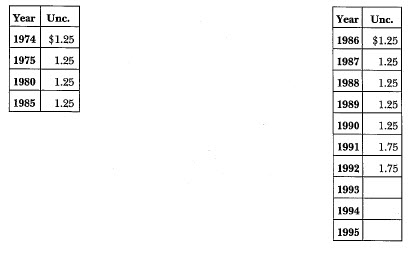
Business Strikes:
Dies prepared (approximate): Obverse: 274; Reverse: 137.
Business strike mintage: 27,366,000.
Comment on availability, MS-65 or better: Fairly scarce. Most are in lower grades.
Comment on availability, MS-64: Somewhat scarce. Comment on availability, MS-63: Readily available. Comment on availability, MS-60 to 62: Most Mint State coins are in this category.
Comment on availability,VF-20 to AU-58: Common.
Characteristics of striking: The typical 197 4 copper nickel Eisenhower dollar is well struck, with strong design details and lustrous surfaces.
Known hoards of Mint State coins: A number of bags are known, but as years go by, they continue to be broken up.
Proofs:
None.
Commentary
Although this issue is common overall, high-grade pieces are scarce.
Additional Information
The Year 1974 in History
The early part of 1974 was dominated by the growing Watergate scandal. One by one, Nixon staffers were implicated in massive lies and cover-ups, and the president's credibility was undermined. Nixon, standing above it all, did little to help those who had tried to help him, and finally resigned the presidency on August 9th. Gerald R. Ford, who had been named by Nixon to the office of vice president and who had served since December 1973, took office as the 38th president of the United States. Ford became the first person ever to achieve that position without being elected either to the vice presidency or the presidency. Ford's tenure would be shortlived, and in 1976 he would be narrowly beaten in his bid for election by Democratic contender Jimmy Carter. President Ford pardoned Nixon on September 8, 1974, for any crimes he may have committed while in office-an action widely condemned by American citizens who realized that no ordinary law-abiding person would ever receive the same treatment. Public faith in the executive office hit an all-time low.
Revelations that the Federal Bureau of Investigation had carried on operations against civil rights groups in the United States, and that the Central Intelligence Agency had attempted to overthrow foreign governments, did nothing to enhance the government's reputation. Meanwhile, Secretary of State Henry Kissinger did much for American foreign policy and helped bring an element of stability to the Middle East.
Israeli Prime Minister Golda Meir resigned her position, and Spain's Generalissimo Franco named King Juan Carlos as his political successor, the first signs that the aging Franco was relinquishing the fascist stranglehold he had maintained on
Spain since the 1930s. In California, Patty Hearst, heiress to the William Randolph Hearst fortune, was kidnapped by members of the Symbionese Liberation Army (SLA), a radical political splinter group. Meanwhile, in the sports world, the irrepressible Muhammad Ali won the World Heavyweight boxing title for the second time.
A 10.3% inflation rate contributed to a 20% slump in automobile sales, while housing starts dropped 40% and unemployment hit 7.2% by December 1974. The threat of a depression loomed great, but it did not materialize. On October 8, President Ford announced a program called Whip Inflation Now (WIN) to help stem rising oil prices. The "energy crisis" gripped the country and would dominate much of America's economy and international politics over the next 15 years. On the lighter side, on April 18, Henry "Hank" Aaron of the Atlanta Braves hit his 715th career home run, beating Babe Ruth's earlier record; he would go on to achieve 744 runs.
Noted Cincinnati numismatist Sol Kaplan passed away in January. He had been one of the most important figures in the growth of the Professional Numismatists Guild. An announcement was made by Mint Director Mary Brooks, regarding possible coinage of aluminum cents this year, in view of the rising price of copper. She gave away a number of aluminum test strikings to politicians and others, and when she realized that they might have great value on the coin market, made a partially successful effort to recall them. The three final designs in the 1776-1976 Bicentennial coinage design competition were announced March 6 by Mint Director Brooks and Treasury Secretary George Schultz. For the first time ever, a proclamation was issued by the president of the United States designating April 21-27 as National Coin Week.