Silver Dollars & Trade Dollars of the United States - A Complete Encyclopedia
Q. David Bowers
1776-1976 Copper-Nickel Clad $1
VARIETY 1
Coinage Context
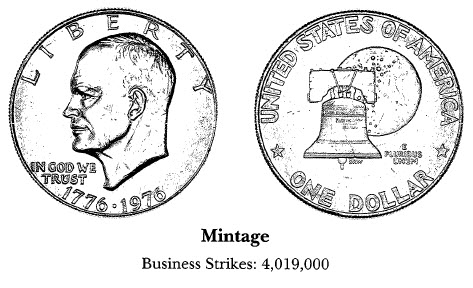
No 1975-dated dollars: Although the Mint was actively producing dollar coins in 1975, the Ikes they made bore the 1974 date or the dual-date 1776-1976, the latter in honor of the nation's Bicentennial celebration.
A new reverse, designed by Dennis R. Williams, was combined with Frank Gasparro's obverse portrait of Eisenhower. This design type was minted (with some slight design modifications later) throughout 1975 and 1976.
On October 13, 1975, the first pre-struck 1776-1976 dated Eisenhower dollars were released into circulation. In the January, 1976 issue of The Numismatist, it was announced that the Variety II copper-nickel Eisenhower dollar would be included in the Mint and Proof sets for 1976.
Numismatic Information
Variety I: The Variety I of 1976 was minted in 1975. It is distinguished by having the 0 letters thick and round; on Variety II the O's are thin, tall ovals.
Proof rarities: All minted were business strikes, save for three or more "Philadelphia" coins created when a Proof die, lacking the intended S mintmark, was used to strike three or more coins for exhibit purposes. I was on hand at the ceremony at the San Francisco Mint when these were displayed to the press, organization officials, and others, and an alert numismatist pointed out that the coins lacked an S mintmark. Mint officials were not aware of this, and had no explanation.
Thomas K. DeLorey recalls being told that the coins were 40% silver, not copper-nickel clad, and may have been struck in Philadelphia on August 12th and shown at the ANA Convention in Bal Harbour, Florida the next day.(Special contribution by Thomas K. DeLorey to this book.) "I recall seeing them under a plastic dome in areception room at the San Francisco Mint later, but I did not think to consider their metallic composition."
Availability: Eisenhower dollar specialist Dave McHenry noted this: 1976 Variety I: This issue is very underrated, and is scarcer than market prices indicate. It is not a match for the 1971 Philadelphia Ike in terms of elusivity, but it probably comes in second, right after the 1971. The strike is usually below average or average. Most coins are bagmarked. The 1976 Variety I is quite difficult to find in higher grades.
Varieties
Business strikes:
VARIETY I: ISSUES OF 1974-1975 THICK, ROUND LETTER D's.
1776-1976 Issue of 1975. Copper-nickel clad. Issue began July 7, 1975.
Proofs:
VARIETY I: ISSUES OF 1974-1975 THICK, ROUND LETTER D's.
1. 1776-1976 Issue of 1974. Proofs only. Nomintmark. May have been struck in silver composition. Untraced; possibly survives. Three or more struck August 12, 1974. These were shown at the ANA Convention, and later were placed on exhibit under a plastic dome at the San Francisco Mint during ceremonies in which dignitaries viewed the new design. Where the coins went after that, has always been a mystery. There lingers the possibility that they may have been added to the 1976-S Proof supply, and inadvertently packaged as part of a Proof set.
1776-1976 Eisenhower: Market Values
1776-1976 Eisenhower: Summary of Characteristics
COPPER-NICKEL CLAD, VARIETY
Business Strikes:
Enabling legislation: Act of July 23, 1965 (clad metal), Act of December 31, 1970, Act of October 18, 1973, Act of December 26, 1974, and others.
Designer of obverse: Frank Gasparro.
Designer of reverse: Dennis Williams.
Weight (copper-nickel clad): 350 grains (tolerance 4%); outer layers of .750 copper and .250 nickel bonded to inner core of pure copper.
Dies prepared (approximate): Obverse: 41; Reverse: 21.
Business strike mintage: 4,019,000.
Comment on availability, MS-65 or better: Quite scarce; second only to the 1971 Philadelphia dollar in this grade.
Comment on availability, MS-64: Scarce.
Comment on availability, MS-63: Somewhat scarce.
Comment on availability, MS-60 to 62: Most extant specimens are in this category.
Comment on availability, VF-20 to AU-58: Relatively few reached circulation. Worn specimens are rare.
Characteristics of striking: Although occasional weakness is seen in some specimens, the typical 1776-1976 Variety I dollar coin is usually encountered well struck.
Known hoards of Mint State coins: None.
Proofs:
None
Commentary
This issue is somewhat of a sleeper, and is rarer than generally recognized.