Silver Dollars & Trade Dollars of the United States - A Complete Encyclopedia
Q. David Bowers
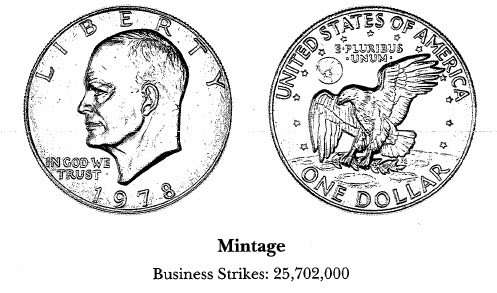
1978 Copper-Nickel $1
Coinage Context
Final year of mintage: After a brief eight years on the American numismatic scene, the Eisenhower dollar series was discontinued following the 1978 coinage.
Mint sets, sold at $7.00 each, contained one each of all business strike issues, cent through the Eisenhower dollar; 2,162,609 sets were sold.
Numismatic Information
Availability: Eisenhower dollar specialist Dave McHenry noted this:
1978: This date is fairly scarce. However, of those that do exist, many are in higher grades such as MS-64 and MS-65.
Varieties
Business strikes:
1. 1978 copper-nickel clad.
1978 Eisenhower: Market Values
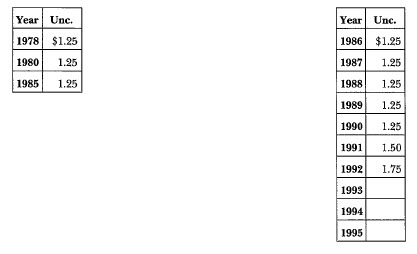
Business Strikes:
Enabling Legislation: Act of July 23, 1965 (clad metal), Act of December 31, 1970, and others.
Designer: Frank Gasparro.
Weight (copper-nickel clad): 350 grains (tolerance 4%); outer layers of .750 copper and .250 nickel bonded to inner core of pure copper.
Dies prepared (approximate): Obverse: 257; Reverse: 129.
Business strike mintage: 25,702,000.
Comment on availability, MS-65 or better: Readily available, but scarcer than lower grades.
Comment on availability, MS-64: Same comment as preceding.
Comment on availability, MS-63: Common.
Comment on availability, MS-60 to 62: Most surviving Mint State coins are in this category.
Comment on availability, VF-20 to AU-58: Common.
Characteristics of striking: The typical 1978 Eisenhower dollar is well struck.
Known hoards of Mint State coins: None.
Proofs:
None.
Commentary
Final year of mintage for the Eisenhower dollar series. Common in Mint State.
Additional Information
The Year 1978 in History
On January 6, President Jimmy Carter returned from a tour of Europe, India, and the Middle East. The troubled economy at home would plague Carter's administration from beginning to end. Inflation continued rampant, and on April 11, Carter stated that federal employees would be given pay increases no greater than 5.5%. The Panama Canal Treaty was ratified by the Senate on March 16, with a second treaty approved on April 18. On May 6, President Carter declared that organized medicine and the American Medical Association were barriers to better health care. Meanwhile, and continuing for years after, medical costs rose and government programs were beset with inefficiency and ballooning costs. Doctors became enmeshed in a morass of red tape, all of which cost patients more money and did nothing to advance medical progress. Welfare programs were very inefficient as well, and often it cost the government $2 in expenses to administer $1 worth of aid. American taxpayers footed the bill.
New York City, facing bankruptcy, received a federal loan guarantee of $1.65 billion for its bonds. On December 15, Cleveland, Ohio could not pay $15.5 million in short-term notes, becoming the first of several cities to default in modern times-nothing like this had happened since the 1930s. Inflation rose to 8%, but productivity increased only 0.4%. The annual U.S. trade deficit increased and continued to be a problem. General Motors led the roster of United States corporations in 1978 with sales of more than $63 billion.
President Jimmy Carter and Egyptian President Anwar Sadat met with Israeli Prime Minister Menachim Begin in what would prove to be the most significant meeting of its kind in history. By year's end, Sadat and Begin would share the Nobel Peace prize. In Iran, the first ugly signs of what was to come surfaced when students began rioting against the Shah of Iran.
In January a blizzard crippled the Midwest, and in early February a New England blizzard idled activities in Boston for a week. On May 20, the space probe Pioneer Venus 1 was launched to Venus, and on December 4 it began sending back data on the planet second-closest to the sun. On August 8, Pioneer Venus 2 was launched to the same planet, and on December 9 it sent probes to the surface. The world's first test tube baby was born in London.
Books published during the year included The World According to Carp by John Irving, American Caesar by William Manchester (a biography of Douglas MacArthur), War and Remembrance by Herman Wouk, and Chesapeake by James Michener.
The value of the United States dollar fell on the international markets, and President Carter announced steps to counter this, including large sales of United States gold from federal reserves.
The coin market went wild, all bets were off, and investors fell alloverthemselves in the scramble to buy anything that was round in shape, with a brilliant surface. The greatest coin market boom in history was in progress. Now, articles on rare coins were commonplace in financial journals, and watchers of financial news on television were apt to see convincing actors, or even rare coin dealers, pitching double eagles, silver dollars, and other sure-fire profit makers.