Silver Dollars & Trade Dollars of the United States - A Complete Encyclopedia
Q. David Bowers
1971 Eisenhower: Market Values
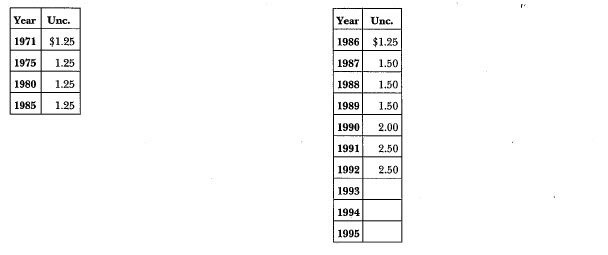
1971 Eisenhower: Summary of Characteristics
Business Strikes:
Enabling legislation: Act of July 23, 1965 (clad metal), Act of December 31, 1970, and others.
Designer: Frank Gasparro.
Weight (copper-nickel clad): 350 grains (tolerance 4%); outer layers of .750 copper and .250 nickel bonded to inner core of pure copper.
Dies prepared (approximate): Obverse: 478; Reverse: 239.
Business strike mintage: 47,799,000.
Comment on availability, MS-65 or better: Very hard to find at this level. Relatively few survive. Quite probably the most elusive of all Eisenhower dollars at this grade level.
Comment on availability, MS-64: Very scarce at this level as well and, likewise, probably the most elusive variety in the series.
Comment on availability, MS-63: Somewhat scarce in the context of Eisenhower dollars; probably, scarcer than any other variety.
Comment on availability, MS-60 to 62: When Mint State coins are found, they are apt to fall in this category. Not rare in an. absolute sense, but among Eisenhower dollars it is the hardest to find.
Comment on availability, VF-20 to AU-58: Most pieces originally minted still survive, and most are in this grade category.
Characteristics of striking: Average striking quality.
Frequently seen with some obverse design weakness.
Known Hoards of Mint State coins: Some probably exist, but original bags are very scarce.
Proofs:
None.
Commentary
Of all business strike Eisenhower dollars, the 1971 is the scarcest today in higher Mint Statelevels. If there is a "key" issue among Eisenhower dollars, the 1971 is it. One reason for this is that they were never directly sold to collectors by the Mint.
Additional Information
The Year 1971 in History
In 1971 President Richard Nixon, elected in 1968, occupied the White House. War was raging in Vietnam and inflation was rampant in the United States. Gold began to rise in value on the international market, although American citizens still could not legally hold it-the result of regulations imposed by the government in 1933. In an attempt to stop inflation, President Nixon imposed a 90-day freeze on wages and prices on August 15, 1971. As an indication of national priorities, a study found that the average American taxpayer gave the United States government $7 for medical research (part of $315 for health-related activities), $30 for space exploration, $30 for highway construction, but $400 for defense and $125 for the Vietnam War. American research was halted on the SST (Supersonic Transport plane), leaving the field open to Russia with its TU-104 and to Britain and France with their Concorde. As it turned out, only the Concorde ever saw commercial use.
On September 26, Japanese emperor Hirohito met President Richard Nixon in Anchorage, Alaska, the first time a .Japanese monarch and a United States president ever exchanged greetings.
On the Vietnam front, the South Vietnamese Army failed in its invasion of Laos, suffering a costly defeat and subsequent retreat back to South Vietnam. Back in the States, all enlisted men were cleared in the My Lai massacre case, although Lieutenant William Calley was found guilty and sentenced to a short prison term. A group of 700 Vietnam War veterans gathered at the Capitol Building in Washington, D.C. and threw their battle medals at the building to show their growing disgust with the war.
The Food and Drug Administration advised Americans not to eat swordfish when it was found that the majority of 853 samples contained excess amounts of mercury. The United States ceased giving licenses for commercial whale hunting on March 1, 1971. The Apollo 14 space probe was launched on January 31 and landed on the moon on February 5-6, returning to earth on February 9. Mariner 9 was launched from Cape Kennedy, Florida on May 30, 1971, toward Mars, and sent back many photographs during its journey. Space exploration had been made a national priority by President Kennedy early in the previous decade, when it was realized that America lagged severely behind Russia in this technology. By 1971, the contest had been evened somewhat.
Popular books of the year included The Exorcist, Eleanor and Franklin, Bury My Heart at Wounded Knee, Honor Thy Father, The Winds of War, and Rabbit Redux. Beginning on June 13, 1971, excerpts from The Pentagon Papers were printed in The New York Times, revealing an inside view of United States defense activities. Films included A Clockwork Orange, Woody Allen's Bananas, Carnal Knowledge, The French Connection, Fiddler on the Roof, and The Last Picture Show.
Mainland China joined the United Nations at the expense of Taiwan, which was forced out of the UN as a result of mainland China's admittance; the state of Bangladesh was carved out of Pakistan; and the bloodthirsty dictator Idi Amin seized power in Uganda.
London Bridge was moved in pieces to its new home in Lake Havasu City, Arizona; George Frazier became the new heavyweight boxing champion of the world, and astronauts David Scott and James Irwin took a ride in the first vehicle to travel on the moon's surface.
The director of the Mint in 1971 was Mary Brooks, from Idaho, who served from September 1969 to February 1977. The coin market had been in the doldrums since its peak in 1964 and subsequent crash in 1965-1966. The late1960s were difficult times for dealers and investors used to the heady times earlier in the decade. However, as time went on, new collectors and investors appeared, and by 1971 there was a revival of interest in many series, with emphasis on United States gold coins. Indeed, gold and silver bullion captured the public interest. At the time, the American public was not allowed to hold gold bullion, but investment in the yellow metal could be accomplished easily by acquiring one-ounce krugerrands minted by the government of South Africa, or by buying Mexican 50-peso gold coins, British gold sovereigns, or other quasi-numismatic gold investment media.
The coin market of the 1970s would accelerate in enthusiasm and price until about 1973, when it stumbled, but not seriously. In 1975-76 it picked up momentum, and in 1977-1979 the greatest bull market in rare coins in history took place. Tens of thousands, if not hundreds of thousands, of new faces appeared-and eagerly wrote out checks to buy coins, especially if they were in Uncirculated or Proof grades. Many issues doubled, tripled, or quadrupled in price during the decade. This boom, too, came to a crashing halt, this time in March 1980. Prices drifted downward for two or three more years, then began an upward climb, cresting in early 1989, and then falling after that. Boom and bust. The subject of the coin market and its cycles is not appropriate for exhaustive study here. However, it is appropriate to mention that Morgan and Peace dollars were front row center in investment activity after they became available in large quantities in the early 1960s. By 1971, they were the most popular of all American series.