The History of United States Coinage As Illustrated by the Garrett Collection
Q.David Bowers
Connecticut Copper Coinage 1785-1788
The first native coinage of Connecticut appears to be the unofficial threepence pieces produced by Dr. Samuel Higley and his successors circa 1737-1739. In the latter year John Read, of Boston, Massachusetts, proposed to the Connecticut General Court assembled in New Haven that he be granted a patent to produce copper halfpennies and farthings from native Connecticut ore mined in the Simsbury-Granby area. William Cradock and Rev. Timothy Woodbridge, who are believed to have been associated with the Higley coppers of 1739, joined him in the proposal.
The Read petition came to naught, so the first authorized coinage did not occur until several decades later.
On October 18, 1785, Samuel Bishop, James Hill-house, Joseph Hopkins, and John Goodrich petitioned the General Assembly of Connecticut to authorize the production of copper coins. It was stated in the petition that there was a great scarcity of small circulating coins in the state, and those that were seen were apt to be counterfeits.
On October 20, 1785, the petitioners were granted the right to establish a mint under the direction and superintendence of the General Assembly, with a royalty of one twentieth part of all copper coins to be paid into the treasury of the state.
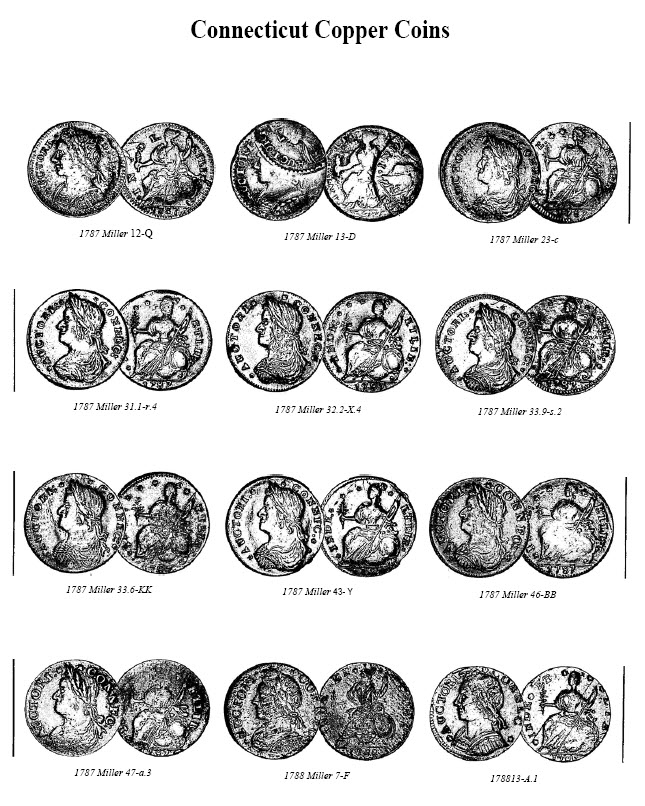
The authorization was given to coin no more than 10,000 pounds lawful money in value of the standard of British halfpennies, to weigh six pennyweight each, and to bear a design of a man's head on one side with the letters AUCTORI: CONNEC: ("by the authority of Connecticut"). The reverse side was to depict the emblem of Liberty with an olive branch in her hand and with the inscription INDE: ET. LIB: 1785. Yet another condition was specifically stated:
Nothing in this act shall be construed to make such coppers a legal tender in payment of any debt, except for the purpose of making even change, for any sum not exceeding three shillings.
About the same time another act was drawn up to prevent counterfeiting:
No person whatever shall coin or manufacture any copper coin of any description or size without permission first had and obtained from the General Assembly on pain of forfeiting for each offense the sum of one hundred pounds lawful money ...
On January 1789 a committee was appointed to inquire into the coinage. After meeting on April 7th of the same year, the committee gave a report to the Assembly the following May. It was related that on April 7, 1789, a meeting of the parties involved was held at a private home in New Haven. Attending were Samuel Bishop, James Hillhouse, Mark Leavenworth, and John Goodrich. It was learned that on November 12, 1785, Samuel Bishop, James Hillhouse, Joseph Hopkins, and John Goodrich, the original persons named in the coinage act, entered into an agreement with Pierpoint Edwards, Jonathan Ingersoll, Abel Buel, and Elias Shipman to form a company to coin coppers. The business continued until February 1786 when Ingersoll and Edwards sold one sixteenth part of the company each to Goodrich. In March 1786 Hopkins sold one sixteenth part to Goodrich, and in April 1786 Edwards, Shipman, and Ingersoll each sold one sixteenth part to James Jarvis. Jarvis continued pro-duction of Connecticut coppers until some time in the summer of 1786 when the supply of copper metal was depleted.