The History of United States Coinage As Illustrated by the Garrett Collection
Q.David Bowers
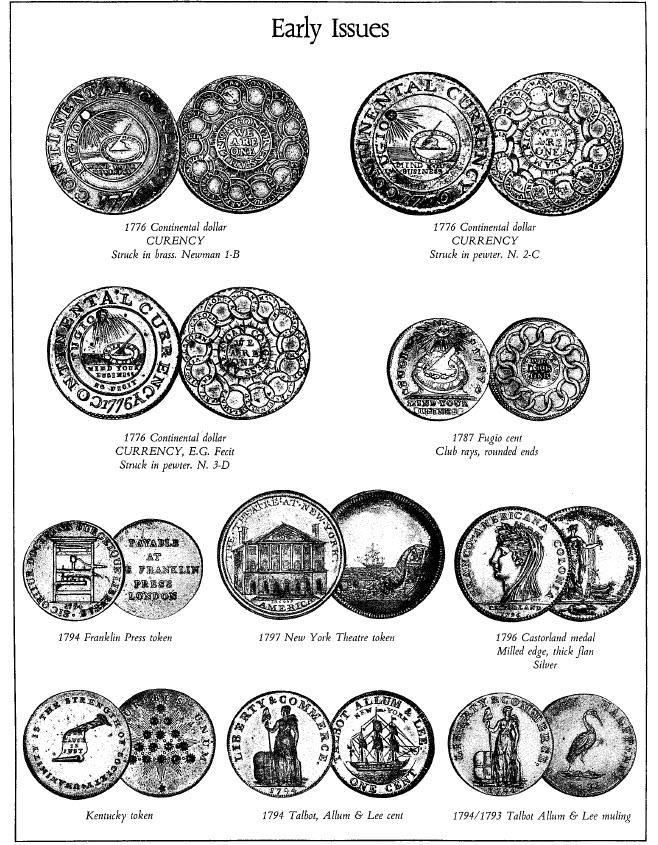
The 1796 Castorland jeton or "half dollar" pertains to a French settlement of that name made during the 1790s on the Black River, about 20 miles from the present-day city of Watertown in the northern part of New York state. Peter Chassanis, of Paris, purchased in August 1792 a large tract of land. Following the French Revolution a number of exiles settled in the area, but hardships were encountered, and the venture was later discontinued.
The 1796 Castorland pieces, originally struck in silver and copper (restrikes and copies were later made in silver, copper, and gold; today modern copies are available from the Paris Mint), were possibly intended to circulate at the value of a half dollar, for the size and weight is similar to the standard United States issue of the time. The obverse depicts a crowned princess with the legend FRANCO-AMERICANA COLONIA surrounding. CASTORLAND and the date, 1796, are below. The reverse depicts a standing goddess holding a cornucopia, with a rock maple tree nearby. Surrounding is the legend SALVE MAGNA PARENS FRUGUM. At the bottom of the reverse is a recumbent beaver, "beaver" in French being "castor" from whence the Castorland name came. Duvivier, who engraved many medals, is believed to have produced the pieces. Originals in silver and copper are exceedingly rare.
In the History of Lewis County (New York) occurs this poem by Caleb Lyon, of Lyonsdale, concerning the Castorland piece:
'I'hen was struck a classic medal: by this visionary band:
Sybele was on the silver, and beneath was Castorland; The reverse a tree of maple, yielding forth its precious store, Salve magna parens frugum was the legend that it bore. Many tokens relating to America were produced in Birmingham, England, from about 1787 to 1796, during the great halfpenny token craze. During that period collecting of tokens in England became a national pastime; What began as the orderly assembly of mer-chant's and souvenir tokens soon changed into a scramble for varieties. Thousands of different tokens were issued, including many varieties differing from each other only in minor variations of edge lettering. Obverse dies were combined with irrelevant reverses, producing illogical and 'nonsensical coins. Examples are provided by tokens bearing on one side the imprint of Talbot, Allum & Lee, New York City merchants in the India trade, with such irrelevant reverses as a die honoring the Blofield Cavalry, another with John Howard, Philanthropist, and still another showing the York (England) Cathedral.
The Virtuoso'sCompanion and Coin Collector's Guide, published in England in 1795, depicted many different varieties and achieved wide circulation. By using this large volume the proper English gentleman could attribute his tokens.
Of all of the British coiners, the Soho Mint, operated by Boulton and Watt, was the foremost.
Matthew Boulton (Jr.) was born in 1728, the son of a wealthy manufacturer of buckles, buttons, and uniform goods. When about 30 years of age he entered the trade on his own and produced buckles of steel. In: 1749 he married Mary Robinson (born 1727) who died in 1759. He then took as his second wife his sister-in law, Anne Robinson, in 1760. Two children resulted, Matthew Robinson Boulton (1770) and Anne Boulton (1768).
Boulton had many interests. In 1784 he wrote to his daughter Anne to describe a performance of Handel's Messiah which he had heard the month before at Westminster Abbey:
I scarcely know which was the grandest, the sound or the scene. Both were so transcendably fine that it is not in my power of words to describe. In the grand Hallelujah my soul almost ascended from my body ...