The History of United States Coinage As Illustrated by the Garrett Collection
Q.David Bowers
The moulds which I proposed to cast the copper into when melted, so as to have it in a proper situation for the rolling mill, without any further expense or trouble, was a matter of great consequence in the business; therefore I took the advice of all those persons that might be supposed to have good judgment in a matter of this kind; who unanimously agreed that it was not only a cheap but a very expeditious way of doing the business; therefore I pursued the plan, as soon as the first furnace that I could hear of was in blast, to get such a number of them as would be sufficient to prove the experiment which took some time and trouble to have them in proper order for the business proposed; when this was done it appeared that the above plan would not be a means of saving money and expediting business. as was expected, but would really injure the metal, employ more hands, and destroy more fuel, than casting it in much larger pieces, and drawing it with a trip hammer, which might be made, and fixed to the Mill at Dedham, which is now almost ready to operate; but before I began to fix the above hammers, I fully proved the experiment by having about a thousand weight drawn at Newton·."
Thus far I have given a general account of the matter to this time, and have surmounted every difficulty that commonly occurs in any new business, more especially in one of this nature, without any expense to, or assistance from government other than thirty-five-hundred pounds of rough copper, received from Hugh Orr, Esq.; and at your next meeting shall lay before you a more particular account of the state of the mint.
Most of the dies for Massachusetts half cents and cents were made by Joseph Callender, an engraver located at Half-Square, State Street in Boston. These dies were prepared at a cost to Massachusetts of one pound four shillings each. This was considered excessive, so Jacob Perkins, a silversmith of Newburyport, was engaged to produce additional dies at a payment of 1 % value of the coins to be struck from the dies. It is believed that the shape of the letter S on the coins was distinctive with each engraver. In all issues of 1787 and in some of1788, the S is open at the top and bottom. In both half cent die varieties of 1788 as well as several of the cents of the same year, the S is narrow and the serifs at the upper and lower part are close to the curves, resembling somewhat a figure eight. Itis believed that the latter ones are Perkins' work.
Problems continued at the mint, and on June 17, 1788, Joshua Wetherle reported that many other unfortunate circumstances, including particularly harsh weather the preceding winter, caused additional difficulties and delays. It was stated that $2,500 in coins had already been struck and was deposited to the account of the Commonwealth. It was anticipated that if the government could supply the proper amount of copper, the mint would be able to have a continuing output on the order of about $50 per day in half cents and cents. An additional 600 pounds was requested in operating expenses so that work could continue. (It should be noted here that while the output of the mint was in half cents and cents, part of a decimal system with fractional parts of a dollar, the prevailing money in use in Massachusetts at that time was based upon the British pound sterling.)
On November 5, 1788, an accounting was presented which showed that as of that time 2,136 pounds, fiveshillings, seven pence had been expended in the operation of the mint, for which just 939 pounds value of coppercoins were produced, leaving a loss of 1,197 pounds, fiveshillings, seven pence.
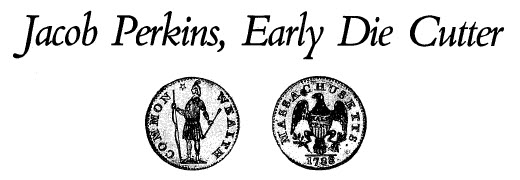
Jacob Perkins of Newburyport, Massachusetts, engraved 1788-dated dies for Massachusetts copper cents and half cents, supplementing the efforts of Joseph Callender. Over a decade later, in 1800, he produced several varieties of funeral medals portraying Washington, with the obverse inscription HE IS IN GLORY, THE WORLD IN TEARS.
He was born in Newburyport on July 9, 1766, the son of Mathew and Jane (Dole) Perkins. His father, a tailor by trade, brought up young Jacob strictly. It is related that in one instance Jacob, having committed some minor offense, was sent to his room. His father went there shortly thereafter to administer a spanking only to find the young Jacob had torn cloth into strips to make an escape rope.
At an early age he was apprenticed to a Mr. Davis, a goldsmith, who died during the third year of Jacob's training. There he learned to make gold beads, shoe buckles, and other items crafted of gold and silver.
Perkins became interested in die making and engraving. At the age of 21 he invented a machine to make nails by snipping off the iron and forming a head. Around the same time he made his first dies. Shortly afterward he engraved cent and half cent dies for Massachusetts.
On November 11, 1790, he married Hannah Greenleaf.
The New Hampshire Packet, issue of July 18, 1792, noted that Perkins had invented a machine to letter the edge of a coin as well as a device which would detect counterfeit money:
"Several newspapers of the past and present week have prematurely mentioned Mr. Perkins of this town being sent forward to Philadelphia, for the purpose of superintending the coinage there. Mr. Perkins' abilities in that line are fully adequate to such an appointment, as the specimens he has exhibited in that line amply testify ... He has invented a new machine which cuts the metal into such circular pieces as are wanted, and gives the impression at the same time-its motion is accelerated by a balance wheel, and more than one third of the time and labor thereby saved. He has also constructed another machine, of his own invention, for milling or lettering the edge, by which a boy can mill 60 each minute. Were it found necessary, he could apply steam to perform all the most laborious parts of the business. But what is of more importance, and will be found to be of more public utility than all the foregoing, is a check, which he has invented, for discovering counterfeits-this so contrived that 1/8 of a minute is sufficient to determine, without the possibility of a mistake, whether a piece of money is genuine or not, and any town or merchant can be supplied at a small expense with said checks, and then rest assured that an imposition would be absolutely impossible."
Perhaps sometime shortly after that date he engraved a die featuring the bust of Washington in military attire, facing left, with the word "Washington" incuse above. Matthew A. Stickney, a prominent 19th-century collector, once owned a piece and described it as: "$10 pattern dollar, 1793, by Jacob Perkins of Newburyport, given to me by his nephew-very rare."
On January 6, 1800, J. Russell's Gazette, published in Boston, printed this notice: