The History of United States Coinage As Illustrated by the Garrett Collection
Q.David Bowers
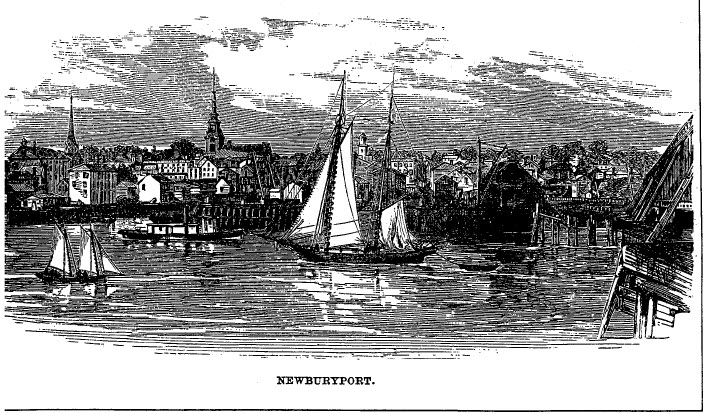
"Mr. Jacob Perkins of Newburyport has designed and executed a very beautiful medal of Gen. Washington. On one side is an excellent likeness of that illustrious personage; and on the reverse, a memoranda of the most remarkable periods of his life. They are struck in gold, silver, or white metal, and may be purchased of Mr. Perkins, or at the bookstore in Newburyport, and of Mr. Eben Moulton, a goldsmith in this town."
The legend of the pieces referred to, which bear the inscription HE IS IN GLORY, THE WORLD IN TEARS, is said to have been suggested by the Hon. Dudley A. Ting, who at one time was the revenue- collector for the Port of Newburyport.
In 1799 Perkins developed a new method of banknote printing which prevented counterfeiting. This consisted of having the denomination of the bill spelled out dozens of times in minute type characters and used as a background to form the various designs of the bills. Perkins' interest in banknotes intensified, and in 1804 he devised a process by which steel plates could be hardened. Plates for engraving could be produced in quantities, in separate sections, with space provided for the bank name to be inserted. A booklet published by C. Stebbins, a Boston printer in 1806, The Permanent Stereotype Steel Plate, with Observations on its Importance and an Explanation of its Construction and Uses, contained Perkins' description of the device as a case-hardened steel plate, with steel dies, one inch thick, keyed together in a strong iron frame, and firmly screwed to a metal plate one inch in thickness.
From that time forward he achieved fame in the field of banknote printing. At one time the Legislature of Massachusetts required all banks within that state to issue notes from Perkins-type plates in order to suppress counterfeiting.
In 1816 Perkins moved to Philadelphia, where he stayed for several years, after which he went to Liverpool, England. During the voyage across the Atlantic he formed the idea for a new invention, the "bathometer," which indicated depth in a moderate wind as well as on a calm sea. He later went to London where he devised a steam-operated gun which would discharge 1,200 balls a minute. A demonstration was arranged for the Duke of Wellington and others. The French government ordered an example.
Other Perkins devices included a "steam rocket engine" and a "propeller for steam vessels," the latter design to be a substitute for paddle wheels. In England, where he died on July 30, 1849, he was known as "the American inventor."