The History of United States Coinage As Illustrated by the Garrett Collection
Q.David Bowers
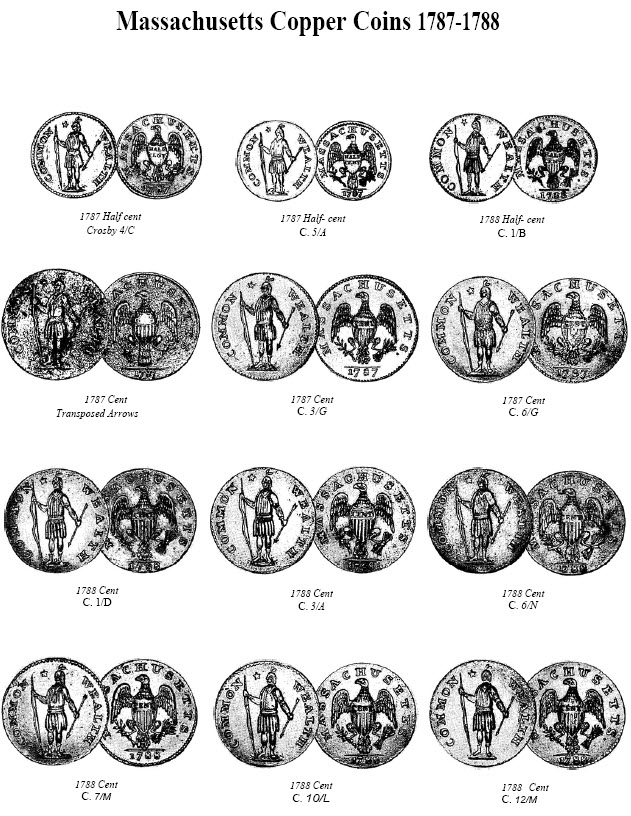
On November 22, 1788, realizing that each half cent and cent cost over twice its face value to produce, the Commonwealth thought to receive proposals "from any person who may offer a contract to carryon the coinage of copper within this Commonwealth ... " It was further resolved to coin all of the copper metal presently on hand at the mint and, when this was completed, to discharge all persons associated with the mint;
In January 1789 the mint accounts were closed, and those employed were dismissed. Joshua Wetherle subsequently petitioned the government to allow him to use the buildings and mint apparatus until the government had further use for them, for they were erected on Wetherle's property and no rent had been charged. Apparently Wetherle conducted a copper smithing business there.
Specimens of half cents and cents were struck bearing the dates 1787 and 1788. As the preceding text shows, most coinage materialized after late 1787, so most of the 1787-dated pieces were probably struck in 1788. Among all copper coins issued by the different states during the 1780s, the Massachusetts pieces were the best struck and of the most uniform weight.
The 1787-1788 Massachusetts copper coins are important as they represent the first appearance of the word CENT on a coin made within the United States. The denomination was intended to refer to a "cent" or one hundredth part of a Spanish milled dollar.
Coined in large quantities, Massachusetts half cents and cents of 1787 and 1788 are fairly plentiful today. Numerous die varieties exist. A major rarity is the 1787 cent with arrows in the eagle's right talon (to the observer's left on the left side of the coin), a transposition from the normal style.
The Massachusetts copper coins were well received in the channels of commerce and saw active circulation for several decades following their issue.
New York Copper Coinage
Although no official state authorization relating to a native coinage is known, a number of issues were made with legends pertaining to that state. On March 29, 1786, The Massachusetts and New Hampshire Advertiser contained a notice which stated that:
New York, Connecticut, and Vermont have authorized a person in each of those states to coin coppers; numbers of them are now in circulation; they are in general well made, and of good copper, those of New York in particular ...
Under what authorization the New York pieces referred to were coined is not known today.
On February 11, 1787, John Bailey and Ephraim Brasher petitioned New York for the right to produce copper coins. On March 3, 1787, Capt. Thomas Machin did the same. Neither proposal was acted upon favorably.
In the same year the legislature studied coinage in circulation and endeavored to regulate existing coinage, which came from many different sources. It was reported at the time that the principal copper coins circulating within the state of New York were composed of:
A few genuine British half-pence of George the Second, and some of an earlier date, the impressions of which are generally defaced. A number of Irish half-pence, with a bust on the one side, and a harp on the other. A very great number of pieces in imitation of British half-pence, but much lighter, of inferior copper, and badly executed. These are generally called by the name of "Birmingham Coppers," as it is pretty well known that they are made there, and imported in casks, under the name of Hard Ware, or wrought copper.
There has lately been introduced into circulation a very considerable number of coppers of the kind that are made in the State of New Jersey. Many of these are below the proper weight of the Jersey coppers and seem as if designed as a catch-penny for this market.