The History of United States Coinage As Illustrated by the Garrett Collection
Q.David Bowers
In addition, a number of mulings, or die combinations, some quite irrelevant, were produced. A 1785 Immune Columbia obverse die was combined with a Vermont obverse die, undoubtedly at Machin's Mills circa 1788, to produce an illogical combination. As noted, a Vermont obverse die was combined with a reverse die with the legend BRITANNIA intended for a counterfeit British halfpenny. A counterpart to this was the piece which combined the obverse die of a counterfeit British halfpenny with a Vermont reverse die. Another production combined a George III obverse with the Immune Columbia obverse. In still another instance, a Vermont reverse die was used in combination with an obverse die pertaining to Connecticut.
The Vermont copper coins struck in Rupert, the issues of 1785-1786 and the bust-left issue of 1787, were usually struck on imperfect planchets bearing many striae and fissures. Striking was irregular, with the result that Rupert-minted coins today often are weakly struck in certain areas while sharply defined in others. Well-centered, well-struck, sharply-defined pieces on perfect planchets are exceedingly rare.
The 1787 and 1788 coinage, produced at Machin's. Mills, consists primarily of lightweight pieces, usually with indistinct detail, not as a result of striking but as a result of die preparation.
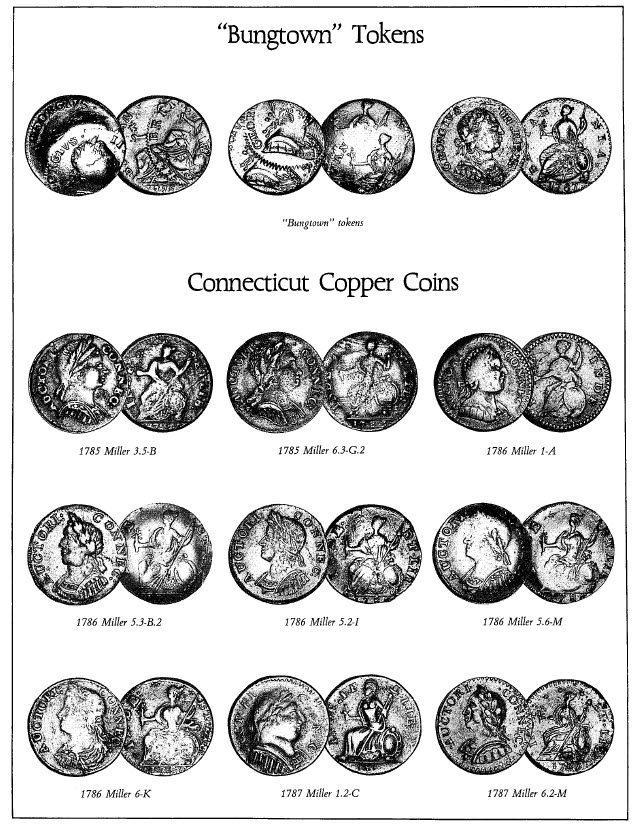
Bungtown Coppers
During the second half of the 18th century, counterfeit British halfpence flooded America. While some were produced in America (the Machin's Mills coinage of the late 1780s, for example), most emanated from England. Many were close copies of contemporary English halfpence, bore the portraits of George II and III, and incorporated the Britannia motif on the reverse. Others were deliberately different in certain characteristics from the regular issues, the word REX being spelled ROX, for example, perhaps in an effort to evade counterfeiting laws. Still others are of a satirical nature and relate to persons, places, and events of the time.
Thomas L. Elder, writing in his May 26-29, 1920, catalogue of the Henry C. Miller Collection, noted:
They [Bungtown coppers] circulated largely among the early German colonists in the eastern part of the state [Pennsylvania]; in fact, the cataloguer has hardly met with a single example in western Pennsylvania, where he resided for many years. And a good many of them never left England.
In Pennsylvania the problem of counterfeit coppers was so intense that on July 14, 1781, Joseph Reed, president of the Supreme Executive Council of the Commonwealth, issued a proclamation stating that:
Diverse ill-disposed persons have manufactured or imported into this state quantities of base metal, in the similitude of British half pence, but much inferior in value and weight to the genuine British halfpence, to the great depreciation of that coin, the injury of the community in general, and the poor in particular, and we have, therefore, thought proper to prohibit, and do hereby strictly enjoin all officers-not to receive such base coin in any payments whatsoever-and do earnestly recommend to all the faithful inhabitants of this state to refuse it in payment-and to make due inquiry after offenders in the premises, that they may be brought to speedy and condign punishment.
The origin of the term "Bungtown" has been debated by numismatists for many decades. One theory is that it may have been derived from a corruption of Barneysville, a Massachusetts town where certain imitation halfpence may have been made. The idea that "Bungtown" may have come from the slang term "to bung," meaning to cheat or deceive, has also been suggested.