Walter Breen's Encyclopedia of Early United States Cents
Walter Breen
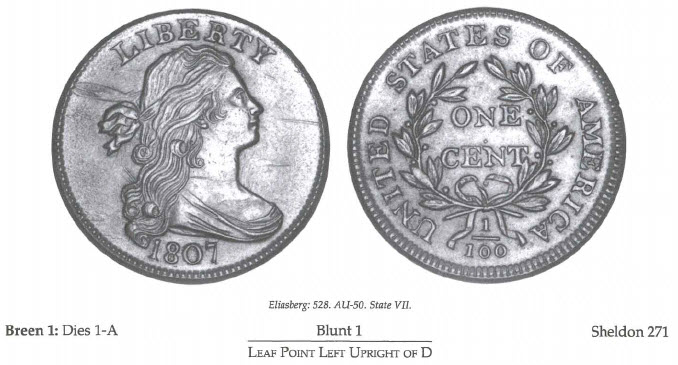
Obverse 1. Close date with blunt 1, small 7, and 18 farther apart than 807. Numerals and letters are from the same punches used on most 1803 dies. Similar to obverse dies 4 and 5, but LIBERTY is more widely spaced, ER well apart with their bases even. See Die states.
Reverse A. Small fraction and letters. U is very distant from the ribbon end. Point of leaf at the left side of upright of D. Point of the top right leaf is between ES, but this position recurs on reverse B.
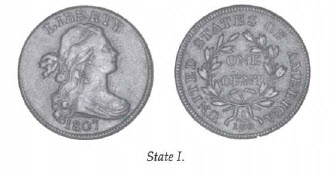
Die states: 1. Perfect dies: "Comet eclipsed." Usually in low grades and very rare in Fine or better.
II. The obverse has at least eight sets of heavy clash marks before and behind the head.
III. Faint linear flaw behind the head. Parallel straight flaw from the rim to near mouth. Very scarce.
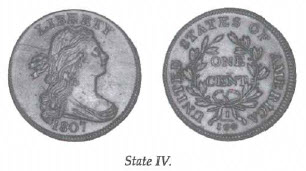
IV. "Comet" flaw behind the head is broad and plain. Additional parallel straight flaws in the fields before the neck, near end of drapery, and at the rim behind lower curls, others fainter elsewhere.
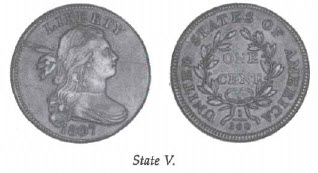
V. At least four sets of clash marks from leaves near the ribbon and throat. The "comet" becomes progressively broader and heavier. Nearly horizontal crack crosses part of bust into the hair. Reverse offset misaligned with top border narrow on coins whose obverse is normally centered. Later strikings are often weak in the central areas.
VI. A bulge develops between the left rim and hair, nearly reaching left end of the crack of state V.
VII. Severe additional clash marks from the leaves near ribbon and throat, and from TES at date.
VIII. The crack of state V extends along the bulge to the left rim.
IX. Bulge obliterates 7. Nearly entire obverse surface is scaled with flaws parallel to the "comet." Very rare.
Equivalents: Proskey 3. Doughty 205. McGirk 4A, 4B, 4B2. Clapp 1. Shelden 271. EAC 1. Encyclopedia 1770.
Rarity 1.
Remarks: The small 7 looks like the punch used in the last two obverses of 1798 and the 1800/179 dies. Because available specimens of the 1798s are normally weak at base of date, certainty on this point is not yet possible. Similarities also exist with the 1807 Classic Head half dollars.
One seen with a double profile.