Walter Breen's Encyclopedia of United States and Colonial Proof Coins 1722-1989
Walter Breen
1838
Cents. N-8. Date spaced 183 8; no line under L; forelock starts in a small ball before brow; 10th star away from hair. Rev. RI recut, lumps atop E I in AMERICA, die cut across 19th leaf, pointing to r. stand of M. Known only from the Newcomb report, possibly a Hines coin; if Newcomb had his own coin in mind (Philadelphia Estate ex Newcomb II: 696, cracked die, proof-like), the reference should be deleted.
- N-1. Double top to 1. Miller: 922, not since traced.
- N-11. Perfect E, bases of L E recut, heavy recut date closely spaced, base of 3 high. Rev. D high, final S low, both feet of M double, partial recutting on ERr. (1) ANS, ex G. H. Clapp, ex Wayte Raymond, Sept. 1925. (2) "Dupont" :792, D. N., TAD:130. (3) "Coogan" (=?), Wurzbach, Hines, Sheldon, Ernest Henderson, "Sheraton Coll.," T. James Clarke:300, N.J. Specialist. (4) Calif. Specialist, T.J. Clarke:299, Norweb, probably same as one of the others. (5) Winsor:962, H. P. Smith: 1156, Chapman, Roebling, NN 59:1306, W. G. Slife, pirvately. (6) Mickley:2041, Cleneay, Mougey:203, Jackman, Beckwith:90, Morgan:303 as "A-7," Newcomb II :699, Phila. Estate. (7) Morgenthau 6/16/42:357, Phila. Estate, bright red, possibly ex Bement:380. (8) Garrett estate, JHU, said to be red and blue with most stars flat, "narrow rim breaks over 8th and 9th stars." (9) MacAllister, Clarke, Calif. Specialist, claimed to be ex Beckwith, unverified. (10) J. G. MacAllister (1936), F. Sternberg, Bolender 3/56: 1669, unidentified intermediates, M. Kirzner, Del Bland, J. A. Bobbe, some stars flat. This or no. 9 possibly ex Earle:3531 and/ or Stickney: 1613 - unverified, as ANS's copy of Earle is missing. The "Andrews 14" in Bluestone's Auction VIII: 381 (2/17/1933) was probably this variety and possibly duplicates one of the above. Despite these uncertainties, the number of survivors is evidently nearer to 12 than to 8 and possibly higher.
Half Dime. Large stars. V-10. First star low, close to rock, double punched; top of 1 in date recut below serif; shield point left of 8; without the break between AMERICA and wreath described for V-10. (1) Bullowa, May 1952. (2) Ex W. L. Carson. (3) Eliasberg. (4) Adolph Friedman, 1946 ANA:52. (5) KS 2/60:1110, cleaned, possibly same as (2) or (4) above. One of these is presumably ex McCoy: 635, Leslie, Cf. "Dupont": 1374.
Dime. Large stars. Breen 7. (1) Boyd, WGC:51O, Adolph Friedman, 1946 ANA:261. (2) Impaired, Wolfson:530. No rumor of a third.
Quarter. Draped Bust. B-1, the only variety of this design; rev. 1837 B-2 above. Philip Straus estate, NN 53:730, Eugene Gardner, whereabouts unknown, probably ex McCoy:517, Lillendahl.
- Liberty Seated. Sept. 13, 1838. (Though the Director sent 20 on that day to Secretary of Treasury as a "new issue"he did not call them "specimens. ") Unique? "Dupont":1815, Edgar A. West:667, whereabouts now unknown. Wayte Raymond knew another.
Half Dollar. Apparently only four known of the regular Draped Bust type with HALF DOL. The following auction records have not yet been possible to sort out: McCoy: 464 to Levick; Cleneay: 1197; Parmelee: 1087; Newcomb II: 850 (gem), possibly reappearing as Reed Hawn: 120 ($9,500); Cass -"Empire": 1343, impaired (slide marks); Brand, Lichtenfels I: 2793 (KS 2/61) at $775 to R. E. Cox, later Cox: 1871. Also Mickley: 2162, "Mass. Consignment," Elder 6/24:2533, since untraced. These probably represent at least three different specimens. Wayte Raymond knew only four.
It is beyond the scope of this book to attempt close coverage of all the Kneass-Gobrecht patterns. Details -not all up to date - will be found in my monograph Secret History of the Gobrecht Coinages, NY, Wayte Raymond, 1956. All these patterns are rare, most were restruck, and restrikes are identifiable by weight; originals weigh about 206 grains, restrikes are on the 1853-73 standard of 192 grains. I should nevertheless take some notice of the true transitional coins, as these have a closer association with regular issues than do the frankly experimental designs. Transitionals normally represent a design later adopted, or mule the adopted type of one year with a type subsequently adopted.
First Transitional: Liberty seated, no drapery (adopted in 1839), rev. regular die, HALF DOL. Adams-Woodin 75, Judd 83. Unique, SI, cleaned. Adams originally listed as no. 76 a copper striking, but this is unknown and was expunged in his later notes.
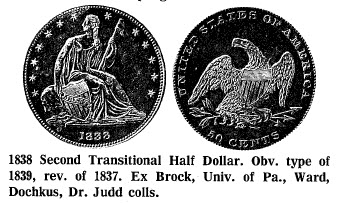
Second Transitional: Liberty seated, no drapery (same die). Rev. Adopted die of 1837,50 CENTS. Two originals known (206 grains) plus at least one lightweight restrike. (1) U.S. Mint, Joseph J. Mickley:2163, Col. Mendes I. Cohen:419, Lorin G. Parmelee, Parmelee: 1089, where pictured with the regular issues as unique and the discovery coin; Charles Steigerwalt, H. O. Granberg, W. H. Woodin, Waldo Newcomer, F. C. C. Boyd, various dealer intermediaries, Empire Coin Co., and one Walter Farris. Pictured in ANS 1914, plate 19, exhibited by Granberg as "unique," called unique in all copies of the Adams notebooks (ANS and elsewhere); pictured in Wayte Raymond's plate of 1838-9 half dollar patterns reproduced in the Standard Catalogues in the 1940's; pictured in my monograph. At some time in its history this coin was cleaned. About 1958 Farris attempted to trade it to Frank Spadone, a New Jersey mint error specialist (author of a popular guidebook in that field), valuing it at over $10,000, for a 1943 S bronze cent of unquestionable authenticity (the coin offered in the Ruby sale); during the negotiation I was called in for authentication certificates and was also, unfortunately, asked to attempt to sell it, though at the asked price there were no takers. Later, Spadone vainly attempted to move the half dollar at $2,000, then high but today cheap; it finally sold for a lower figure and now reportedly rests in the Stewart Witham collection. Similar stories could be multiplied about dealers' dreams. (2) Brock, Univ. of Penna., P. H. Ward, Dochkus, New Netherlands, Dr. Judd, "Ill. Hist.": 112, where said to be ex Brand. (3) Brand, Farouk:1727, Burton Krouner, LM 2/71:858