Walter Breen's Encyclopedia of United States and Colonial Proof Coins 1722-1989
Walter Breen
- Third head. Head of '38. Beaded hair cord, small letters. N-10: low date, recutting on curl tip of 3; rev. C in CENT double punched, S-ATE same base arc line, first T leans crazily to left, final S low. (Not rev. G of N-9, 11: Newcomb blundered here.) Perfect dies. (1) Philadelphia Estate ex Newcomb: 685. (2) Hines (the coin mentioned by Newcomb), WHS, Ernest Henderson-"Sheraton"-1947 ANA: 1656A - T. James Clarke: 284, not seen as it was out to a mail bidder when I was examining the Clarke cents e . (3) Calif. Specialist, ex Wm. Festus Morgan: 291, as 'A-9', J. G. MacAllister, T. James Clarke. (4) Dr. French: 571, possibly same as (3), unverified. Compare Cleneay: 1892, Earle :3521; Mougey: 199, "plain cord" is unidentified.
Half Dime. Draped Bust. V-3. Large 5 C. Base of 7 and 5 C. recut. (1) Neil: 1582 is described as showing recutting on all numerals: not seen, presumably this variety. (2) Bullowa, May 1952. (3) Reed Hawn: 580 at $625, ex 1971 ANA: 614, ex H. W., Merkin 4/66:68. (4) A. V. Weinberg, obtained at 1964 ANA convention. (5) Ex Reverend E. W. W. Lewis, at a San Diego convention ca. 1966. I have seen a fourth, some years ago, but it has since dropped from sight.
- Liberty seated, no stars. Gobrecht design. "Large date" - tall 1 with sharp peak atop upright, similar to preceding. V-I. Triple cut 8, double cutting on other numerals at bases. [20+] Proofs struck July 25, 1837, per #81, Letters Mint & Branches, 1837-8, R. G. 104, National Archives. (1) Smithsonian, from Mint. (2) Eliasberg. (3) Holmes: 2899. (4) Reed Hawn: 582 at $1900, possibly same as no. 3 or no. 6? (5) Lester Merkin auction, April 1966: 69 at $550, later 1971 ANA: 615. (6) Judd, Ill. Hist.: 100. (7) 1975 ANA: 154, ex "Gilhousen": 166, ex Dr. Charles L. Ruby, ex Kabealo sale 4/17/49, Guipe collection. I have Seen quite a number of others, some cleaned, a few impaired.
- V-2. Apparently later state of same obv. die, after some business strikes had been made; recutting now almost invisible. Rev. heavier letters, r. bases of first T in STATES, first A in AMERICA recut, notch (hub injury) on tip of innermost leaf under D in DIME. Eliasberg, with early state of cracks from rim to cap, rim to rocky base below foot, rim to shield.
No proofs of the so-called "small date" (flat top to 1 as in 1838) type have been verified. Cf. L. G. G. Consignment, S 12/69: 698, "square edges, 2 small R. edge cuts".
Dime. Draped bust design: rumors persist, unverified. Wayte Raymond saw one.
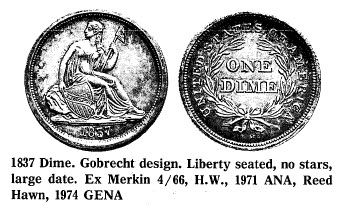
- Liberty seated, no stars. Gobrecht design. Large date, flat top to 3. Rev. Faint die scratch through ES-O; spur from border over first T of STATES. Breen II-I, Clapp 5. [30+] Struck June 30, 1837. (1) Mint, SI. (2) Stack 3/4/39 - Phila. Estate. (3), (4) Dr. Judd, "Ill. Hist.":102-3. (5) MacMurray:1169. (6) "Dupont": 1558. (7) LM 4/66:124 at $1200 (faint hairlines), H.W., 1971 ANA :616, Reed Hawn: 699 at $2,600, 1974 GENA:1297. (8) T. James Clarke, NN 47:1628. (9) Dr. Ruby, "Gilhousen" :319. Specimens -probably duplicating some of those above - were in Atwater, WGC, Neil, other famous auctions; possibly 20 seen in all, some badly cleaned.
Quarter. B-2. Curl begins r. of serif of 7; wide low 25 C., A very close to arrow. First reported from the Browning (?) -Col. Green coin; cf. Cleneay:1352. The Newcomer-Green-T. James Clarke coin in NN47:1578 was doubted. I saw one other authentic proof, over 20 years ago, but its present ownership is not now known to me.
- Breen 5, not in Browning. Obv. B-4, perfect die; curl begins over r. tip of 7. Rev. C of 25 C. recut at base; stem extends beyond serif of that C and is very close to it. U low, A T too far apart; E in AMERICA too low. (1) Philip G. Straus coli., 1951, scratched up, brought $100 in 1959 NYMet. (2) Eliasberg, impaired proof; freak, struck once far off center, then replaced in press for two proper impressions. (3) "Dupont": 1813, carelessly made but unimpaired. Two or three business strikes also are reported.
McCoy:516, to Lilliendahl, is probably one of the above.
Half Dollar. Only four seen; rev. not the same die as 1836. (1) Col. Green, Adolph Friedman, 1949 ANA:1492, not now located. (2) "One-sided," rev. frosty unc., midwest coin firm. The other two were seen in private collections in the 1950's.
*Silver Dollar. From the 1836 dies with name on base and starry reverse; dies aligned. Delivered March 31, 1837.[600] Proofs are less often seen than of the Dec. 31 issue; many survivors are circulated. QS 9/73:484, others. See above, under 1836. Those with dies aligned (eagle level, dots flanking ONE DOLLAR not in level line ) are restrikes; see Restrikes and Fantasy Pieces, below.
Quarter Eagle. B-2. (1) SI, from Mint. (2) Parmelee: 1071, to Mills; last seen in the Mills sale (1904), lot 552. (3) Harry Bass, same as (2)? Wayte Raymond knew three in all.
Half Eagle. Large date, SI, from Mint collection.
No rumor of a second one.
Some proof sets made up this year would presumably have been in some way connected with the Michigan Statehood, Jan. 26, 1837. (Others may have been made for M. Alexandre Vattemare.) They would have included the silver dollars - one or both varieties - from the Dec. 31, 1836 issue. As the Gobrecht halves and dollars dated 1836 are technically patterns owning to their having been made anterior to passage of the Mint Act of 1837 authorizing coinage at the reduced weight (412 1/2 grains for the dollar instead of 416), perhaps they should not have been listed, but omission would lessen the value of this book since the coins are thoroughly assimilated to the regular series, and since the mint people themselves took little or no notice of the technical status of the coins but struck and issued them exactly as though they were regular issues. The dollars delivered March 31, 1837 would therefore be regular issues, and if they are included why not the earlier ones from the same dies?